How the UTXO Transaction Model Works
Understand transaction inputs, outputs, change, fees and privacy in the UTXO model, and how it differs from account-based networks.
DTCC Trading Editorial

A crypto balance can be represented in several ways. Some blockchains track separately spendable outputs from earlier transactions. Understanding those outputs explains why sending one amount can create both a payment and change.
The model used by Bitcoin is called UTXO: unspent transaction output. Networks such as Ethereum and Solana organize state around accounts. These are design choices with different implications; the model alone does not determine a network’s security or performance.
Understanding Unspent Outputs
A UTXO is an output from a previous transaction that has not yet been spent. It specifies a value and spending conditions. A wallet’s spendable balance is derived from outputs whose conditions it can satisfy, subject to matters such as confirmations and time locks.
Inputs, Outputs and Fees
A transaction uses existing outputs as inputs and creates new outputs. In an ordinary Bitcoin payment, the total input value equals the total output value plus the transaction fee. An input consumes its referenced output in full; any value returned to the sender appears in a new output.
A Payment With Change
Suppose a wallet controls one spendable output worth 1 BTC and creates a payment of 0.25 BTC. If the fee is 0.0001 BTC, the transaction can create a 0.25 BTC recipient output and a 0.7499 BTC change output. The original 1 BTC output is consumed.
The Cash Analogy
Cash offers a useful starting analogy because a payment can use a larger unit of value and return change. The analogy describes the accounting pattern rather than every technical property.
Paying a five-unit bill with a twenty-unit note leaves fifteen units of change. Likewise, a transaction can spend one output and create separate payment and change outputs. The network fee must also be included in the digital example.
Unlike a paper note, an output carries programmable spending conditions. A transaction can combine several inputs and create several outputs. Change is common, but it is not compulsory when the selected input value exactly covers the intended outputs and fee.
UTXO and Account Models
An account model generally records account state, such as balances and transaction counters. A UTXO model records separately spendable outputs. Both require consensus rules that reject invalid state changes and prevent conflicting spends.
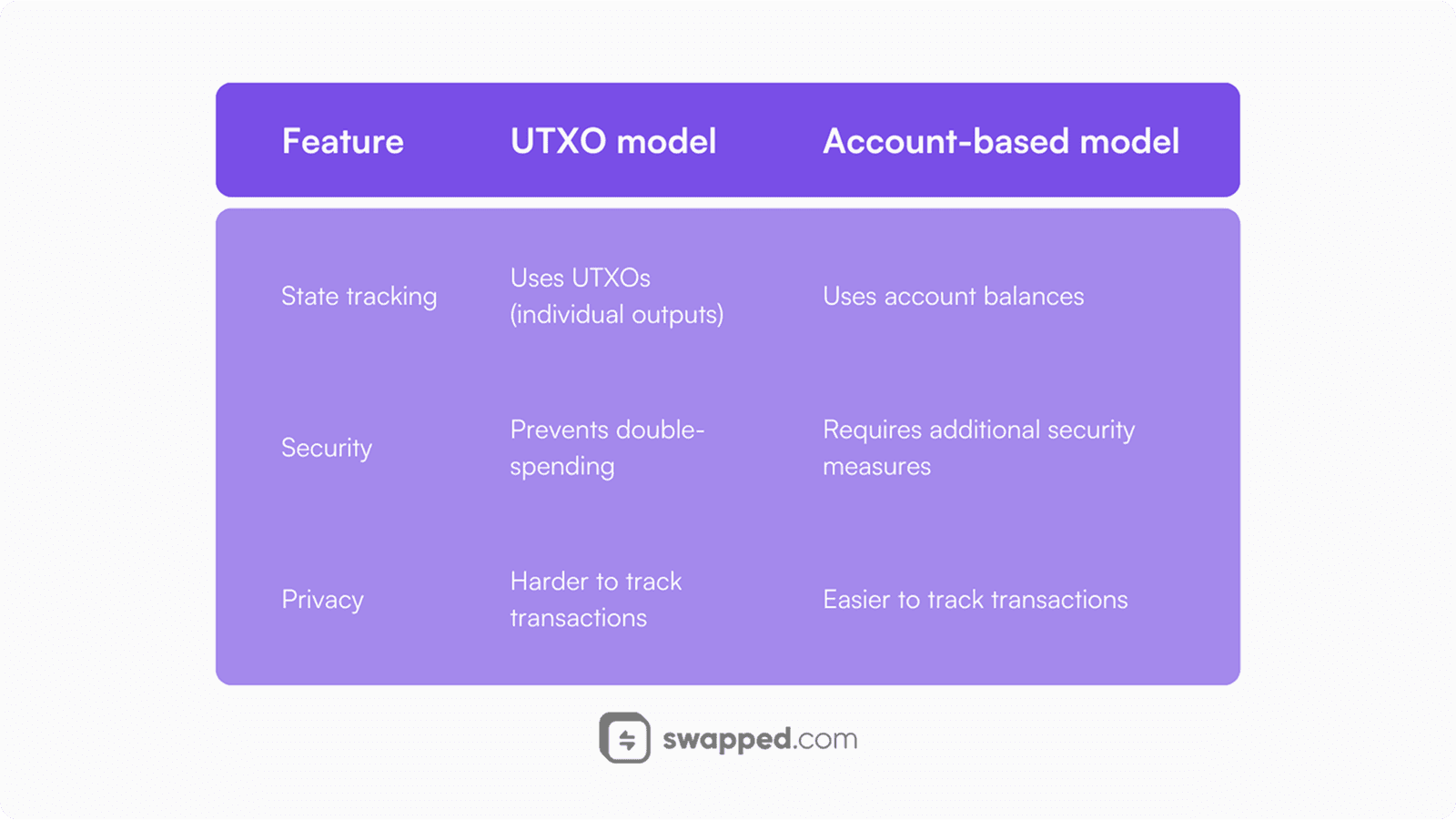
Two accounting models organize transaction state differently.
What Each Model Makes Explicit
UTXOs identify the particular outputs a transaction consumes. That explicit dependency helps validation determine whether an output exists, remains unspent and satisfies the required spending conditions. It does not make activity anonymous or remove the need for network consensus.
Account-based execution gives applications a direct way to read and update shared account state. Ethereum contracts, for example, can maintain balances and other data in contract storage. That convenience comes with rules governing execution, ordering and authorized updates.
Tradeoffs Depend on the Network
Smart-contract capability cannot be inferred from the accounting model alone. Networks choose different scripting languages, execution environments and limits. Bitcoin’s script rules and another UTXO network’s application model can differ substantially.
Account-based networks also prevent double spending. Ethereum checks transaction authorization, balances and nonces as part of its validity rules. Neither accounting model can substitute for sound consensus, correct software and appropriate application design.
Comparing the Complete Design
Evaluate an actual network through its validation rules, execution model, fees, privacy properties and operational limits. A simple claim that UTXOs mean security while accounts mean speed leaves out the decisions that produce those outcomes.
Why UTXOs Matter to Bitcoin
Bitcoin validation relies on knowing which outputs are available to spend and whether a transaction satisfies their conditions. This makes the UTXO set a central part of validating new transactions.
Explicit Spending Conditions
An output can be spent only through a valid transaction meeting its conditions. Once consumed on the accepted chain, it cannot be consumed again there. Competing transactions that try to spend the same output cannot both remain valid in that chain history.
Transaction Dependencies
Independent outputs can make transaction dependencies easier to identify. Actual throughput still depends on block capacity, propagation, validation costs and other protocol constraints. Independent inputs do not mean a network has unlimited parallel processing capacity.
Privacy Requires Care
A fresh receiving address can reduce straightforward address reuse, but public transactions still expose relationships between inputs and outputs. Combining outputs can provide clues that they share a controller. A wallet’s address and coin-selection choices therefore matter to privacy.
How Ethereum Accounts Differ
Applications often described as Web3 need to coordinate persistent state, permissions and contract execution. Ethereum’s account model supplies one way to organize that work; it is not evidence that other approaches are inherently unsuitable.
Account State
Ethereum distinguishes externally owned accounts from contract accounts. Account state includes a balance and nonce; contract accounts also relate to code and storage. A wallet provides an interface for controlling an account rather than storing the underlying coins inside the application.
Contract Interactions
A transaction can invoke contract code that reads or changes state according to the network’s execution rules. Gas measures execution resources and affects transaction cost. A familiar account balance can therefore sit alongside considerably more complex application state.
Ordering and Validation
An account transaction must fit the current state and ordering rules. A nonce helps distinguish successive transactions from an externally owned account. Validation complexity depends on the operation being performed, so account-based execution is not automatically faster than every UTXO design.
Understanding Small Outputs
People use the word dust for very small crypto amounts, but its precise meaning depends on context. A small Bitcoin output, an unwanted token and a tiny exchange account balance are different things with different handling rules.
When an Output Is Uneconomic
Spending an output adds transaction data. If the fee required to include that input approaches or exceeds its value, spending it can be uneconomic. Bitcoin relay policies also have dust thresholds; those policy thresholds should not be confused with a fixed universal minimum balance.
Review Before Consolidating
Consolidating outputs can simplify later spending, but it costs fees and can link previously separate activity. Unwanted NFTs or token messages are a different issue: interacting with their links or contracts can create risk. Small balances on a centralized exchange follow that service’s own conversion and withdrawal rules.
Dust and Transaction Privacy
A dusting attempt can send tiny outputs to addresses and then watch how those outputs move, seeking clues about common control. This is distinct from phishing messages embedded in token transfers. Receiving unsolicited value alone does not authorize someone to spend your other assets.
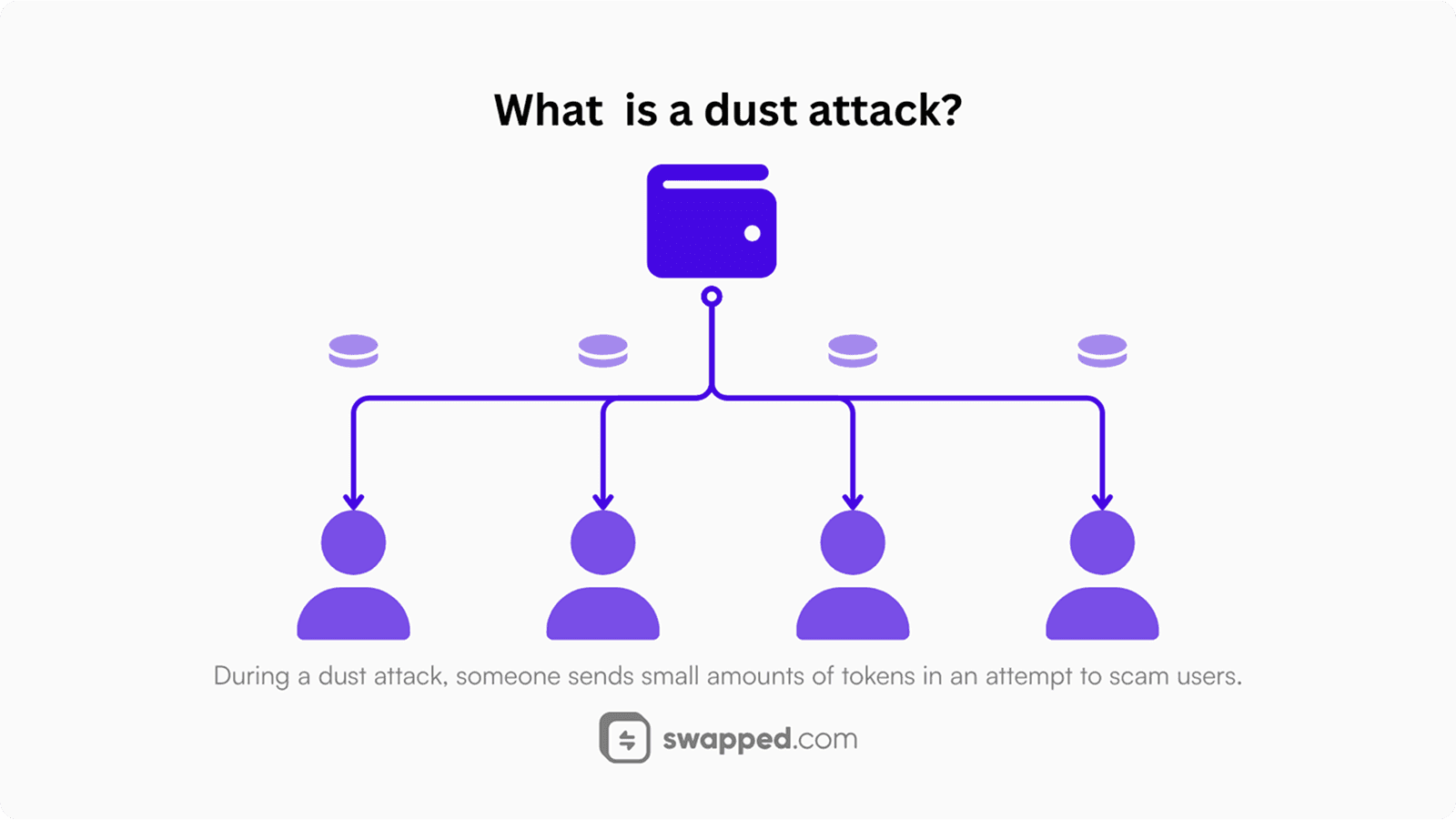
Tiny unsolicited transfers can create privacy or phishing concerns.
Why the Model Remains Useful
UTXO accounting makes the relationship between an input and the output it consumes explicit. That idea continues to inform transaction design, wallet behavior and research into programmable payment systems.
For a user, the practical lessons are concrete: a displayed balance can consist of many outputs, change is a new output, and combining inputs affects both transaction size and privacy. Understanding those details makes wallet fees and transaction records easier to interpret.
Related Reading
The linked explainers provide additional introductions. Use protocol documentation to verify the exact rules of the network or wallet you are studying.