Crypto Addresses and Complete Transfer Destinations
Understand address formats, network compatibility, memos, tags and account permissions so a receiving destination can be checked before a transfer.
DTCC Trading Editorial

A cryptocurrency address identifies a destination or account under a network’s rules. An address used for Bitcoin is different from one used for Ethereum, and a familiar-looking string does not establish that a receiving service accepts the intended asset.
Understanding addresses begins with the blockchain and asset involved. The complete receiving instructions may include a memo or tag as well as the address. Every required part needs to survive from the receiving screen to the final authorization.
What an Address Identifies
An address can refer to spending conditions, an account or a program depending on the network. A destination on Solana follows that network’s account rules. An address is therefore more than a universal mailbox number that works the same way everywhere.
The network uses the encoded identifier as part of processing an operation. It does not know whether the person sending the transaction intended that particular recipient. A technically valid destination can still be the wrong destination.
Bitcoin Addresses
Bitcoin addresses encode information used to construct an output’s spending conditions. The resulting coins are represented by transaction outputs rather than stored inside the address text. A wallet identifies which outputs it can spend.
Bitcoin has several address formats associated with different output types, including legacy, SegWit and Taproot. Wallet support and network selection matter. Mainnet and test-network destinations should never be treated as interchangeable.
Illustrative Bitcoin format: bc1q… (shortened example, not a payment destination)
Address construction uses cryptographic and encoding rules. An address is generally shareable for receiving, but sharing it can reveal transaction relationships on a public network. Public does not mean privacy-neutral.
A Bitcoin wallet can generate fresh receiving addresses from its key structure. This can reduce address reuse, but it does not make transactions anonymous. Combining outputs and disclosing addresses can link activity.
Ethereum Addresses
An Ethereum address is commonly displayed as 0x followed by forty hexadecimal characters. It can identify an externally owned account or a contract. The same visual format also appears on other EVM-compatible networks, so the string alone does not identify the intended chain.
Illustrative Ethereum format: 0x… (shortened example, not a payment destination)
An Ethereum address can participate in DeFi or hold NFTs, but each operation follows the relevant contract rules. Sending a token to an address is different from invoking a contract function or granting a spending approval.
Solana Addresses
Solana accounts use 32-byte addresses commonly displayed in base58. Some correspond to public keys, while program-derived addresses do not have a matching private key. Token balances can also use separate token accounts under the relevant token program.
Illustrative Solana format: Base58 address… (shortened example, not a payment destination)
Whether the asset is SOL, a stablecoin or one of many memecoins, verify its mint identifier and the receiver’s instructions. Address appearance does not prove token compatibility or determine how quickly an application will credit a transfer.
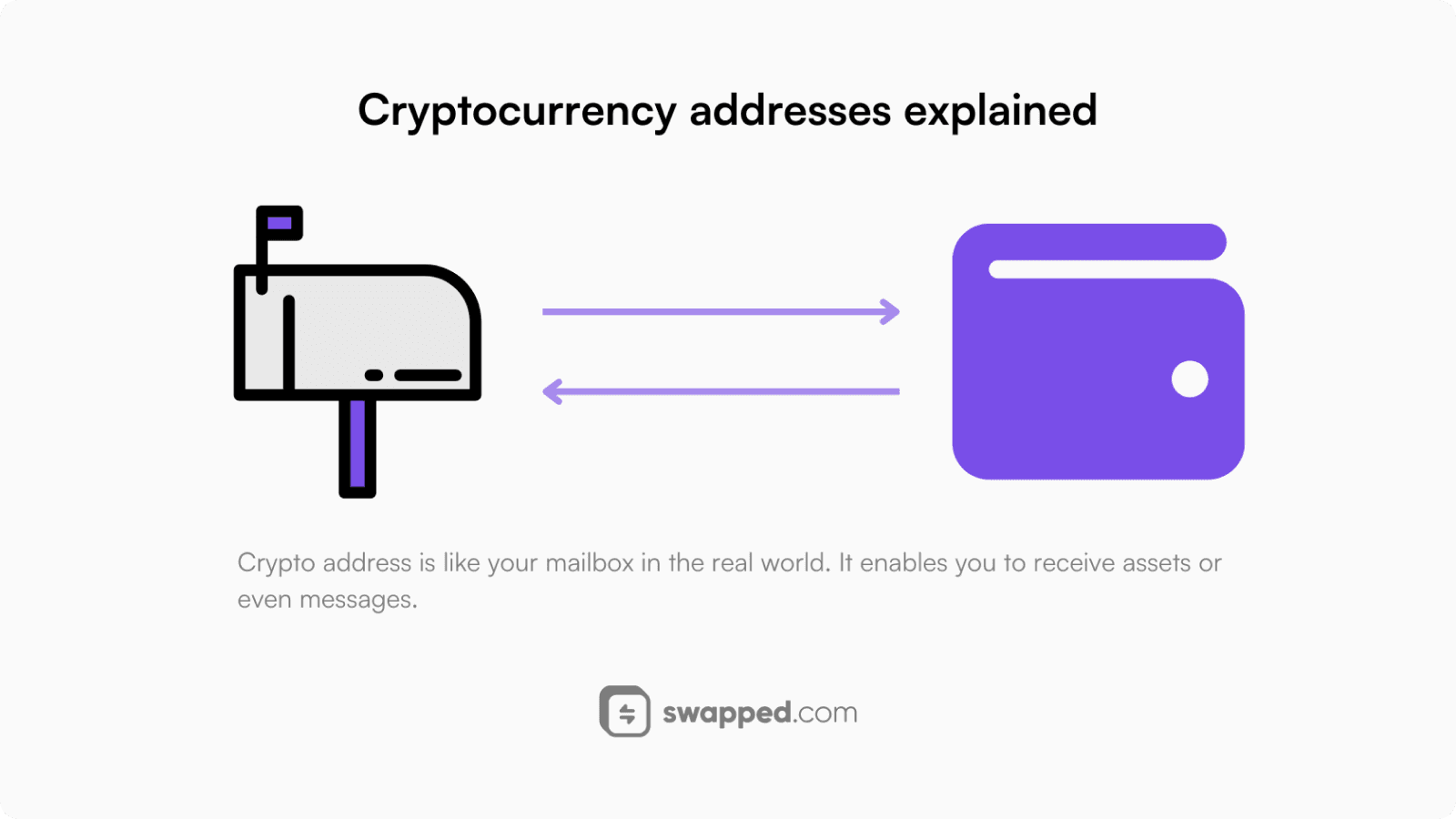
A complete destination combines the address with the required network and routing details.
Keys and Address Generation
A wallet can derive key pairs and addresses according to its supported networks. The private key authorizes applicable operations, while the public key supports verification. Contract accounts, multisignature arrangements and program-derived addresses can use different control models.
Receiving an asset creates or updates a network record under those rules. Spending it later requires valid authorization. Knowing an address does not normally provide that authorization, and no legitimate receiving instruction needs your recovery phrase.
QR Codes and Payment Requests
A QR code can reduce typing by encoding an address or payment request. It can also contain an amount, asset or other fields. Scan it with a trusted application and inspect the decoded details; the code itself does not establish that the destination is correct.
If a merchant displays a request, confirm the network, asset, amount and expiry after scanning. A substituted code or misleading website can still present a valid but unintended address. Convenience changes data entry, not the need for verification.
A Transfer Review
Begin with the receiving service’s current instructions. Confirm that deposits are enabled and identify the exact asset, network, minimum amount and any memo or tag. Old successful transfers do not prove those instructions remain unchanged.
When a QR code fills the form, review every populated field. Some services use a shared address and rely on a tag or memo to identify the customer. Omitting that field can leave a confirmed transfer uncredited.
When copying text, compare the entire destination after pasting and on the signing screen. Avoid using an address copied from unsolicited transaction history. Similar-looking entries can be deliberately placed there through address poisoning.
After authorization, follow the original transaction identifier and receiving account status. Network confirmation and platform crediting are different stages. Do not repeat an uncertain transfer solely because a balance display has not changed.
Why the Strings Look Unfamiliar
Addresses encode identifiers in formats suited to the network. Some include error-detection features or checksums. Those features can catch certain mistakes, but they cannot determine whether the recipient is the one you intended.
Encoding and Security
The security of an account depends on cryptographic assumptions and authorization rules, not on an address looking complicated. A checksum is not proof of ownership, and a valid format is not proof that an exchange accepts the asset being sent.
Readable Names
Names ending in .eth can resolve through Ethereum Name Service to configured records. A readable name still needs verification, including spelling, resolution and the relevant network. Names and their records can change, so review the actual destination shown for the transaction.

Readable names help navigation but still resolve to specific records and rules.
Multiple Signers
A multisignature arrangement requires a defined combination of approvals rather than one ordinary key alone. Its security depends on signer separation, recovery and the underlying implementation. It can improve control for some uses while adding coordination requirements.
Public Addresses and Privacy
Public ledgers can expose balances and transaction relationships. An address does not necessarily reveal a person’s name, but additional information can connect it to an identity. A large address can also represent a service holding assets for many customers.
Sharing addresses publicly or reusing them across contexts can make that connection easier. Do not assume a wallet app, fresh address or readable name guarantees anonymity. Consider which information the transaction and receiving service will disclose.
The Most Useful Habit
Treat a destination as a complete set of instructions, not just a copied string. The asset, network, address and any tag or memo need to agree. Review fees and minimums as part of the same operation.
This habit applies to self-custody wallets, exchanges and tokenization applications. Correct formatting is the start of a check; compatibility and intended control complete it.
Keep the public transaction reference after sending so any delay can be investigated without exposing signing secrets.
Related Reading
The linked explainers introduce common formats. Use the receiving service and network documentation for the exact destination requirements.