Blockchain: Shared Records and Validation Rules
Learn how blocks, hashes, signatures and consensus fit together, and where a shared ledger’s guarantees end when applications depend on external data or services.
DTCC Trading Editorial

A shared record is useful only when participants understand how it changes and which version to accept. Blockchain systems address that coordination problem through linked blocks and validation rules. Their design determines who participates and what the record proves.
Some networks are public and open to broad participation; others restrict access. Some support only narrow transaction types, while others execute general application code. Blockchain is therefore a family of designs rather than one uniform product.
Start with the record, the rules and the participants. That approach explains both the technology’s useful properties and the limits of claims made about it.
Coordinating a Shared History
A conventional service can designate one organization to maintain the authoritative account record. Other parties rely on its database, controls and contractual obligations. Replication and backup can exist within that arrangement too.
A blockchain can let multiple participants independently check proposed changes under shared rules. It also needs a way to agree on ordering when valid operations conflict. That is a coordination task, not merely a matter of copying data.
The result can reduce reliance on a single recordkeeper for certain functions. Applications may still rely on issuers, custodians, data providers or administrators. Map those dependencies before describing the whole system as trust-free.

Blocks organize records; validation and consensus determine the accepted history.
The Main Components
A block contains data and metadata specified by the network. A cryptographic reference connects it to earlier history. Additional rules govern which blocks participants accept and how they resolve competing histories.
What a Block Contains
In Bitcoin, a block contains transactions and a header used in validation and proof of work. Other networks use different fields and transaction models. A block should be understood through its actual specification rather than a universal container analogy.
Applications can record data directly or record a reference to data stored elsewhere. This choice affects cost, privacy and availability. Placing a document hash on-chain does not automatically store the document or prove that its contents are truthful.
How Hashes Link History
A block can include a hash of its predecessor. Changing the referenced data changes the hash, making the mismatch detectable. Consensus rules and economic or operational assumptions determine the difficulty of replacing accepted history.
The common word immutable describes resistance to alteration under those assumptions. It should not be interpreted as a claim that reorganizations, upgrades or application-level corrections are impossible in every design.
Different Forms of Distribution
Traditional databases can be distributed across many servers, and blockchain infrastructure can be concentrated among a few operators. The relevant question is who can validate, propose changes and control critical services, not simply how many machines exist.
Full nodes independently apply the rules and retain the data needed for their role. Other participants can use lighter verification methods or external services. Not every device in an ecosystem holds a complete copy of every historical record.
A node rejecting invalid data helps enforce rules, but the overall system still depends on its consensus and network assumptions. Replication does not make every software defect or coordinated attack harmless.
Following a Transaction
Consider a transfer between two compatible accounts. The user’s intent passes through preparation, authorization, submission, execution and any receiving-service crediting. Each stage has its own evidence.
Preparation and Authorization
A wallet prepares the operation using the destination address, asset and amount. The signing screen should accurately describe what will be authorized. Some transfers also require a memo or tag, while contract operations can request additional permissions.
Checking the Rules
Nodes or validators check requirements such as valid authorization, available inputs or balances and operation-specific rules. They do not verify the user’s private intention or establish that a recipient is trustworthy.
Validation asks whether an operation follows the rules. Consensus determines the accepted ordering and state among competing possibilities. Many protocols use stake or work rather than a simple count of all visible nodes.
Inclusion and Execution
A block producer includes eligible operations according to the protocol and available capacity. The network checks the resulting block or state transition. Submission does not guarantee inclusion, and inclusion does not necessarily mean every requested application action succeeded.
Confirmation and finality rules vary. Some systems provide increasing confidence as blocks accumulate; others have defined finality conditions. Read the network’s status and application result rather than treating every first confirmation as equivalent.
The Receiving Result
A self-managed account can reflect the network result directly, while a receiving service may apply additional crediting requirements. That can create a delay after a successful network transfer. Identify which stage remains incomplete.
A useful interface shows the transaction identifier, status and next step. If the result is uncertain, check the original record before repeating the operation. A success animation is weaker evidence than a confirmed network result and credited destination.
Useful Properties
Shared verification can support applications that need a common record across parties. Its value depends on the specific problem and on whether the design’s costs and assumptions fit that problem.
Detectable Changes
Hashes and signatures help detect changed records and unauthorized operations. Public block data is generally not encrypted merely because it belongs to a blockchain. Security comes from the combined rules and implementation, not from a claim that every block is secret.
Visibility and Privacy
Public ledgers can make transactions inspectable without printing a person’s name beside every address. Additional data can still connect addresses to identities. Pseudonymity and privacy are different properties, and publishing sensitive data can create lasting exposure.
Costs and Timing
A blockchain route can simplify some forms of settlement, but complete cost includes conversion, custody, network and payout stages. Timing varies by network conditions and service requirements. Comparisons should measure equivalent end results.
A route to sell a digital asset may include both a network transfer and a separate payout service. The network’s fee is only one part of that route, and the responsible provider can differ at each stage.
Control and Permissions
A user controlling signing keys can directly authorize supported operations. Issued tokens can still include issuer controls, and application contracts can have administrative powers. Custodial accounts introduce another control layer. Identify the actual authority over each asset.
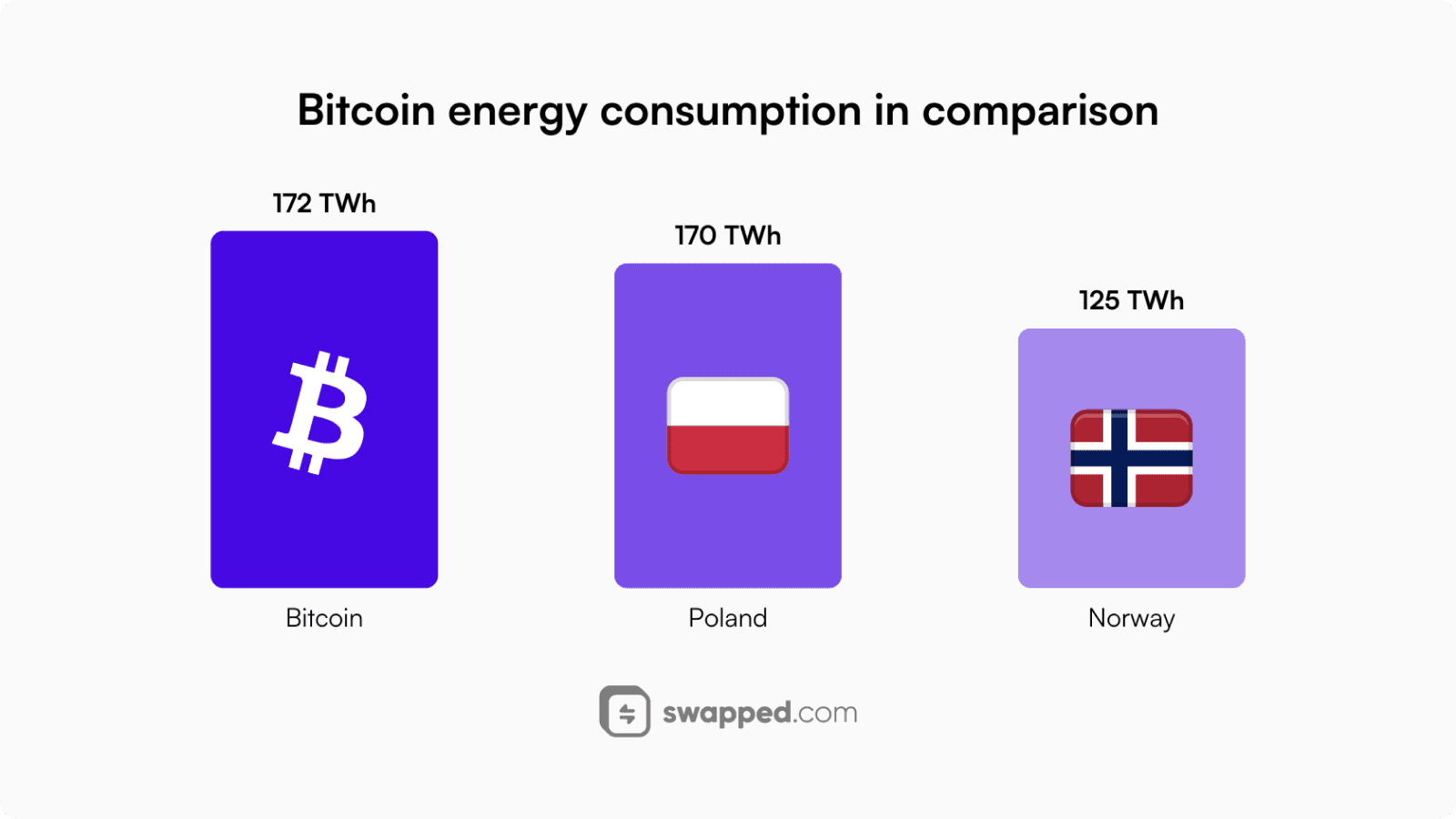
Historical Bitcoin energy comparisons depend on their assumptions; the linked study provides context for the retained illustration’s December 2023 figures.
Design Tradeoffs
Every system has constraints. A useful evaluation describes them specifically instead of assuming blockchain automatically means greater security, lower costs or unlimited capacity.
Resource Use
Proof-of-work networks expend computation and energy as part of consensus. Other mechanisms commit different resources and have different failure assumptions. Energy comparisons need a date, methodology and clear system boundary.
Capacity and Scaling
Execution, communication and storage impose limits. Increasing capacity can raise participant resource requirements, while additional layers can move work elsewhere. Compare what is verified and where data remains available as well as the headline throughput.
Understanding the Interface
Users need clear explanations of accounts, recovery, fees and transaction permissions. A polished interface can hide significant complexity. Good design makes essential consequences understandable before authorization and provides evidence afterward.
External Rules and Obligations
A system involving cryptocurrencies can also involve legal agreements, issuers and service providers. The technology does not determine every obligation or exemption. Evaluate the actual activity and relationships alongside the network mechanics.

Linked blocks are one component of a complete ledger system.
Blockchain and Bitcoin
Bitcoin is a particular network and native asset with its own rules. Blockchain describes a broader way of organizing and coordinating records. Learning Bitcoin’s design is useful, but its details should not automatically be applied to every other network.
A programmable network such as Ethereum uses a different execution and account model. Other systems make different consensus and access choices. The shared label does not make their applications, assets or trust assumptions interchangeable.
Choosing a Useful Application
Ask why multiple parties need a shared record and what each party must verify independently. Then identify the external facts and services the design still depends on. These questions help determine whether blockchain adds a practical benefit.
In tokenization, the on-chain record can track issuance, authority and transfers. The connection to an external asset or obligation needs separate evidence. A reliable product explains both parts clearly.
For a user, the practical foundation is understanding the asset, the controlling account, the operation and its confirmed result. Those concepts apply across many networks even though the technical details differ.
DTCC Trading focuses on Stellar tokenization and multichain interoperability. This overview provides the vocabulary for evaluating those systems while keeping protocol behavior, product features and external asset claims distinct.
Related Reading
The linked introductions describe blockchain from several perspectives. Network specifications provide the precise rules needed to evaluate a particular implementation.