NFTs: Token Records, Content and Ownership
Learn what an NFT identifies, where its content lives, which rights it can convey and how to assess minting, marketplace and transfer arrangements.
DTCC Trading Editorial

An NFT connects a distinct token identifier with a record maintained by a blockchain system. That record can support art, access passes, game items or other applications. Understanding the token is only the first part of understanding what a holder receives.
Public attention often focuses on collectible prices, but the technical concept is broader. As with other cryptocurrencies, a displayed value does not establish useful rights, authenticity or a liquid market.
What Non-Fungible Means
A non-fungible token is individually identified within its blockchain system. The token can have an owner or controller recorded under the applicable rules. Its connection to an artwork, physical object or service comes from additional metadata and agreements.
Fungible and Distinct Units
Fungible units are intended to be interchangeable within a category. A unit of Bitcoin is ordinarily accounted for by amount rather than as a named collectible. Interchangeability as an accounting concept does not mean every transaction or source of funds has an identical history.
A non-fungible item has a distinct identity. Two seats at the same event, for example, can belong to the same category while carrying different locations. Distinct identity does not automatically imply rarity, value or legal ownership of an external object.
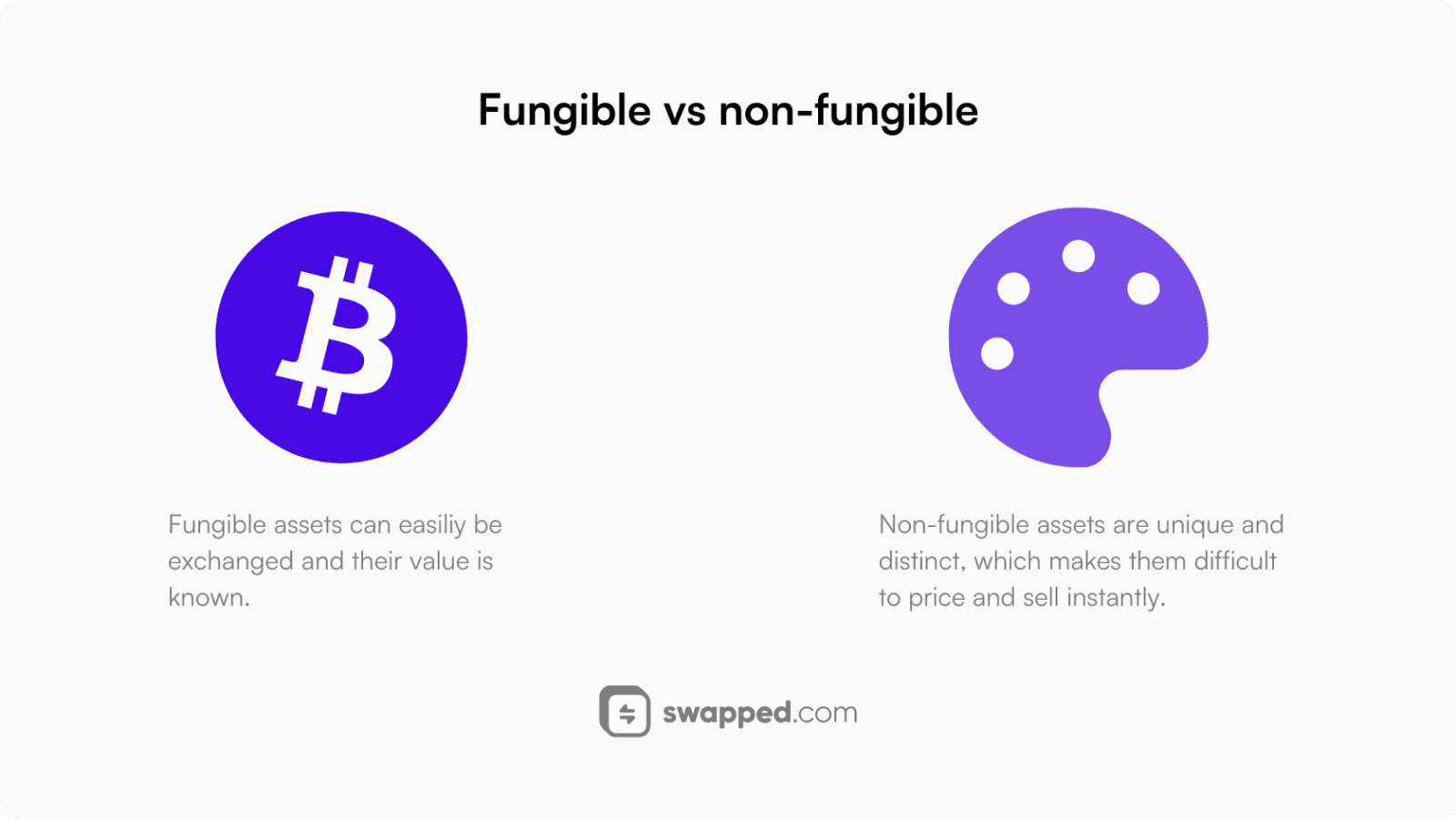
Fungibility concerns interchangeability; uniqueness alone does not establish value.
The Token, Metadata and Media
Networks such as Ethereum and Solana support token systems with different rules. An NFT can point to metadata describing its content. That content may be on-chain, on a conventional server or available through a system such as IPFS. Storage availability and royalty behavior depend on the actual implementation.
Identifying the Exact NFT
A name and image are not sufficient identifiers. On a contract-based network, the network, contract and token identifier establish which record is involved. Similar-looking collections can have different issuers and permissions, including powers to change metadata or restrict transfers.
How Standards Helped Adoption
Standards such as ERC-721 defined common interfaces for individually identified tokens. Standard interfaces let wallets and applications recognize operations such as ownership queries and transfers. They do not certify the issuer, associated content or economic purpose.
Collectible markets brought attention to these records, including highly publicized art sales. A notable sale is one transaction under particular conditions. It does not provide a general valuation method or guarantee demand for another token.
Possible Applications
The useful question is what a distinct record enables in a specific application. Rights, transferability and continued service availability need to be defined for each use case.
Digital Art
An artist can associate a token with a work and describe its edition or provenance. Buyers should verify the artist’s authorization and the license. Owning the token does not by itself transfer copyright or prevent copies of the image from existing.
Music and Experiences
A token can represent access to a release, performance or community experience. The organizer must define what access includes, when it is available and what happens if the service ends. A permanent token record cannot force an unavailable event to occur.
Game Items
A game can use token records to track items or access. Moving an item to another game requires that game to recognize its data and meaning. Interoperability is an agreement and implementation challenge; it does not happen automatically because both games use NFTs.
Virtual Spaces
A token associated with a virtual location records rights within a particular platform’s rules. It is not automatically a property title in the physical world. The platform’s continued operation, content policies and modification powers remain important.
Tickets and Passes
A ticketing system can use a distinct token to track access and transfers. It must still handle redemption, copied display screens, lost access and any resale restrictions. The token record is one component of the admission process.
Credentials and Privacy
A credential system can combine digital records with zero-knowledge proofs to demonstrate selected facts. Publishing personal documents as ordinary NFT metadata can expose sensitive information. Credential designs need issuer verification, revocation and disclosure rules rather than assuming that a token itself provides privacy.
Creating and Transferring Tokens
Minting, listing, selling and transferring are separate operations. A marketplace can combine them in its interface, but each operation can involve different fees and permissions.
Minting
Minting creates a token according to the issuer’s contract or network rules. A wallet may authorize the operation and pay network costs. Before minting, establish the content rights, metadata location, supply rules and administrative powers. Creating a token does not establish that anyone will buy it.
Reviewing a Marketplace
Check the networks and contracts a marketplace supports, its listing mechanism and how fees are calculated. Distinguish the marketplace’s interface from the underlying token contract. A collection appearing in search results is not necessarily verified or endorsed.

A marketplace displays records and facilitates trades under specific rules.
Listings, Offers and Sales
A listing can involve a signed order or an on-chain transaction. Read the asset, amount, payment currency, expiry and approval request. Some signatures authorize later execution without another prompt, so signing an order deserves the same attention as an immediate transfer.
Questions for Participants
For Buyers
Confirm the exact token and the issuer’s connection to the work. Read the license, access promises and storage arrangements. Check actual liquidity and fees before treating a quoted floor price as the amount you could receive for a specific item.
For Creators
Describe the edition, rights and ongoing commitments clearly. Explain where content is stored and whether metadata can change. If royalties depend on marketplace support, communicate that dependency instead of promising that every future transfer will generate a payment.
Durability Beyond a Marketplace
A token can remain on-chain while its media becomes unavailable or its associated service closes. IPFS content addressing helps identify data, but someone must continue providing that data. Long-term availability needs an explicit storage and maintenance plan.
The strongest NFT explanations connect the record to a clear purpose and verifiable rights. Evaluate those details separately from market excitement. A technically valid token and a useful, durable product are different achievements.
Related Reading
The linked introductions explain the basic model. Token standards, storage documentation and the issuer’s terms provide the details needed for a particular collection.