DeFi: Financial Applications and Their Dependencies
Learn how decentralized finance uses programmable networks for trading, lending and other activities, and how to evaluate its custody, liquidity and contract risks.
DTCC Trading Editorial

Financial activity requires records, rules and a way to settle obligations. Decentralized finance, or DeFi, implements parts of that activity through blockchain protocols and contracts. It changes how responsibilities are distributed rather than eliminating every intermediary or source of trust.
A useful introduction follows the assets and permissions. Who controls a balance, how does a price enter the system, and what conditions allow assets to leave? These questions reveal more than a broad promise of open finance.

Different financial systems organize access, records and settlement differently.
Defining DeFi
DeFi is a category of applications that provide financial functions through programmable network rules. Common examples include asset exchange, collateralized borrowing and liquidity provision. The degree of decentralization varies between applications and their individual components.
Public digital-asset systems such as Bitcoin helped establish direct transfers with shared verification. Later programmable networks expanded the kinds of rules applications could implement. DeFi builds on those capabilities without making every application equally transparent or reliable.
Public records can make transactions inspectable, but they do not automatically explain all liabilities or off-chain dependencies. A protocol can rely on an oracle, administrator, bridge or issuer whose decisions affect the assets being used.
What Smart Contracts Do
A smart contract executes defined logic under a network’s rules. It can enforce exchange formulas, collateral conditions or withdrawal calculations. Its behavior is only as appropriate as the implemented logic, inputs and permissions.
An Intermediated Arrangement
In a conventional account-based service, an operator commonly manages customer records, authorizations and settlement instructions. Users rely on its processes and contractual obligations. That arrangement can provide support and recovery while concentrating operational responsibility.
A Programmed Arrangement
An on-chain exchange involving Ethereum can settle through contract or protocol rules after authorization. Execution still depends on fees, available liquidity and valid inputs. A programmed route is not a promise of instant completion or unrestricted access in every interface.
Common DeFi Activities
Each activity introduces a different position and different obligations. Understand the resulting exposure before comparing quoted yields or transaction speed.
Swapping Assets
A swap exchanges one asset for another under a quoted route. The wallet confirmation should make the assets, amount and permissions clear. Review minimum output, route expiry and fees; a successful submission is not the same as successful execution.
Providing Liquidity
Liquidity providers commit assets to a pool or market so other users can transact. Their position can change composition as prices move. Trading fees and incentives must be weighed against price exposure, impermanent loss and the protocol’s contract risks.
Staking and Related Products
Some applications connect users to staking or issue tokens representing staked positions. Other reward programs use the same word without participating in network consensus. Identify the actual mechanism, withdrawal process, operator fees and potential penalties before comparing rates.
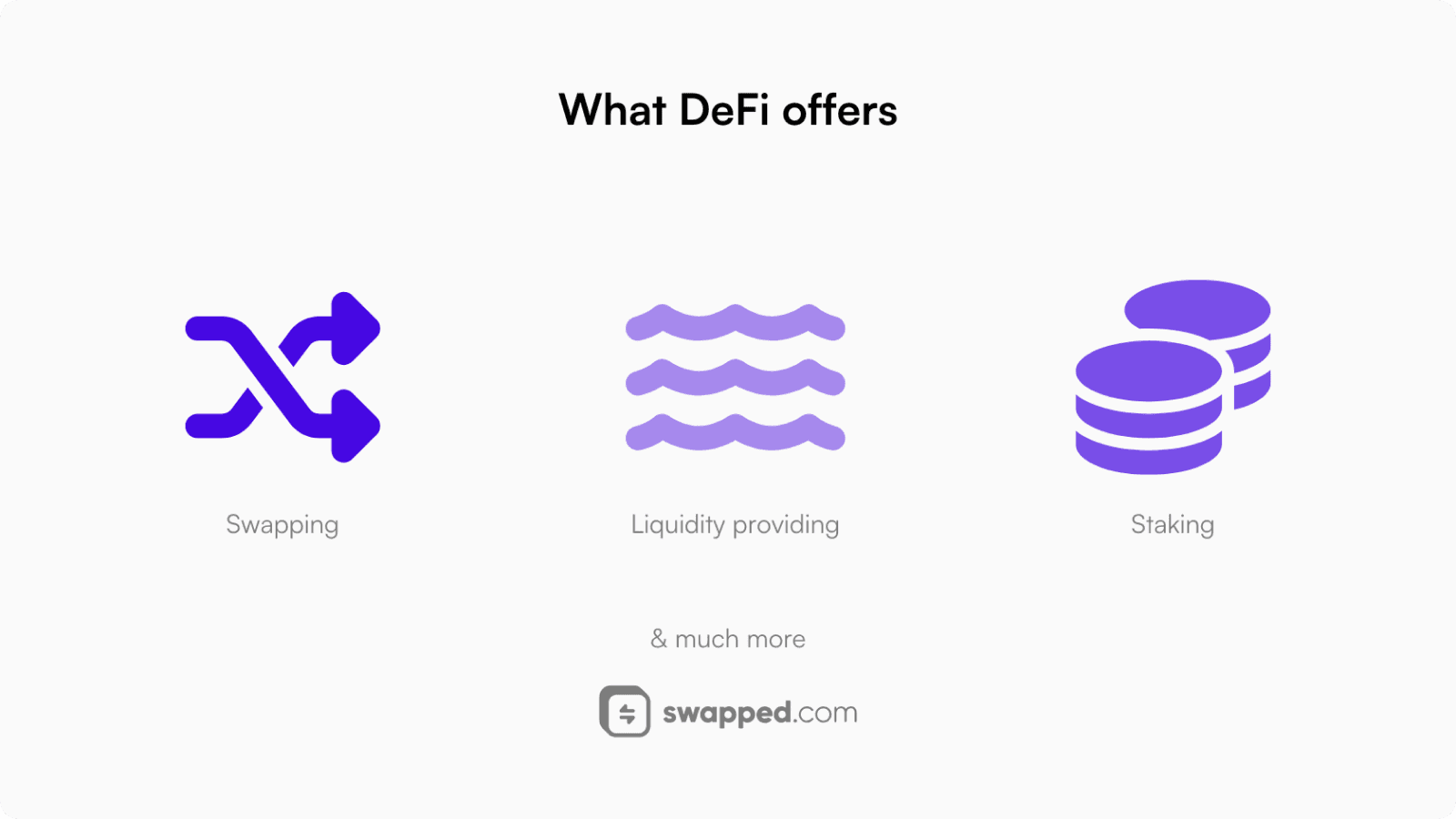
A quoted reward must be assessed alongside the position and its withdrawal rules.
Interpreting DeFi Metrics
Total value locked, or TVL, estimates the value of assets held in selected contracts under a provider’s methodology. It can change because asset prices move even when no new units are deposited. It is not a direct measure of safety or profitability.
Metrics can also double-count linked positions or include assets with limited liquidity. Review the definition, price sources and date of a statistic. A percentage without its methodology can make very different protocols appear directly comparable.
Comparisons across networks such as Solana require consistent definitions. Transaction counts, users, volume and locked value measure different kinds of activity. Growth in one does not necessarily establish growth in the others.
Understanding the Main Dependencies
A DeFi position can combine several risks. A token, bridge, oracle and lending contract may all be necessary for one displayed balance. Map that chain of dependencies instead of treating the application as a single isolated product.
Contract and Permission Risk
Security reviews should examine contract behavior, privileged roles and upgrade controls. An audit reduces uncertainty within its scope; it does not prove that all integrations, later changes or economic assumptions are safe. Token approvals can also remain active after a website session ends.
Access and Applicable Rules
A public protocol, a hosted frontend and a custodial service can have different access policies and responsibilities. The word decentralized does not determine all applicable requirements. Check the actual service arrangement and location-specific rules when they matter to an intended activity.
Usability and Recovery
A clear interface should explain the network, resulting position, fees and failure states. Recovery can be difficult when a user signs an unintended operation or sends an asset to an unsupported destination. Good usability includes those edge cases.
Learning an Application’s Flow
Begin by understanding which account or wallet controls the digital assets involved. Read the application’s documentation and inspect an example transaction before connecting a funded account. Public records and test environments can support learning without committing capital.
If an activity requires funding, a purchase or transfer route is a separate operation with its own fees and compatibility requirements. Verify that route independently rather than assuming an application’s suggested provider is suitable for every user.
Trading and lending protocols illustrate different flows. A lending position, for example, can become liquidatable when collateral conditions change. A displayed account value should be read together with the protocol’s health and withdrawal rules.
When the System Behaves Unexpectedly
Confirm the transaction status and contract result before repeating an action. A failed frontend update can look similar to a failed transaction, while the underlying outcomes differ. Keep public identifiers and seek support without sharing signing secrets.
How the Infrastructure Can Improve
Better interfaces, clearer permissions and stronger verification can improve application quality. Layer 2 networks can change execution costs and capacity, but they add their own settlement and operating assumptions. Evaluate improvements as specific capabilities rather than promises of universal adoption.
A More Concrete DeFi Assessment
Identify the function, assets, permissions, pricing inputs and exit route. Then distinguish live behavior from roadmap claims. This approach supports a meaningful comparison between applications with very different architectures.
DTCC Trading’s work in tokenization and multichain interoperability makes these concepts relevant to digital-asset design. This overview explains DeFi mechanisms; it does not establish that a named protocol, yield product or trading route is available through DTCC Trading.
Related Reading
The linked introductions provide broader context. Protocol documentation and deployed contract information are the appropriate sources for the mechanics of a particular application.