Cryptography: Hashes, Keys and Digital Signatures
Learn the different jobs of encryption, hashing and digital signatures, and how blockchain systems use them without making every transaction private or safe.
DTCC Trading Editorial

Cryptography supplies tools for protecting information and verifying claims. In blockchain systems, those tools help authorize transactions and detect changes to records. They do different jobs, so encryption, hashing and signing should not be treated as interchangeable words.
From Secret Messages to Digital Systems
People have used secret-writing methods for centuries. Modern cryptography develops precise algorithms and security definitions for computers and networks. Its strength depends on the assumptions, implementation and key handling involved, not on keeping the algorithm’s name mysterious.
Confidentiality and Authenticity
Encryption protects the confidentiality of information when correctly applied. Authentication mechanisms help establish who authorized a message and whether it changed. A system often needs both, but a signed public message can be authentic without being secret.
Public and Private Keys
Asymmetric cryptography uses related public and private keys. The available operations depend on the algorithm. Some schemes support encryption and decryption, while others support signing and verification. A signing key should not automatically be described as an encryption key.
In a suitable public-key encryption scheme, someone can encrypt information for a recipient using the recipient’s public key. The corresponding private key enables decryption. This is one useful analogy for selective access, but it does not describe every blockchain transaction.
For a digital signature, the private key creates a signature and the public key helps verify it. Protecting the private key is therefore essential. If another party obtains it, they may be able to produce authorizations the system accepts.
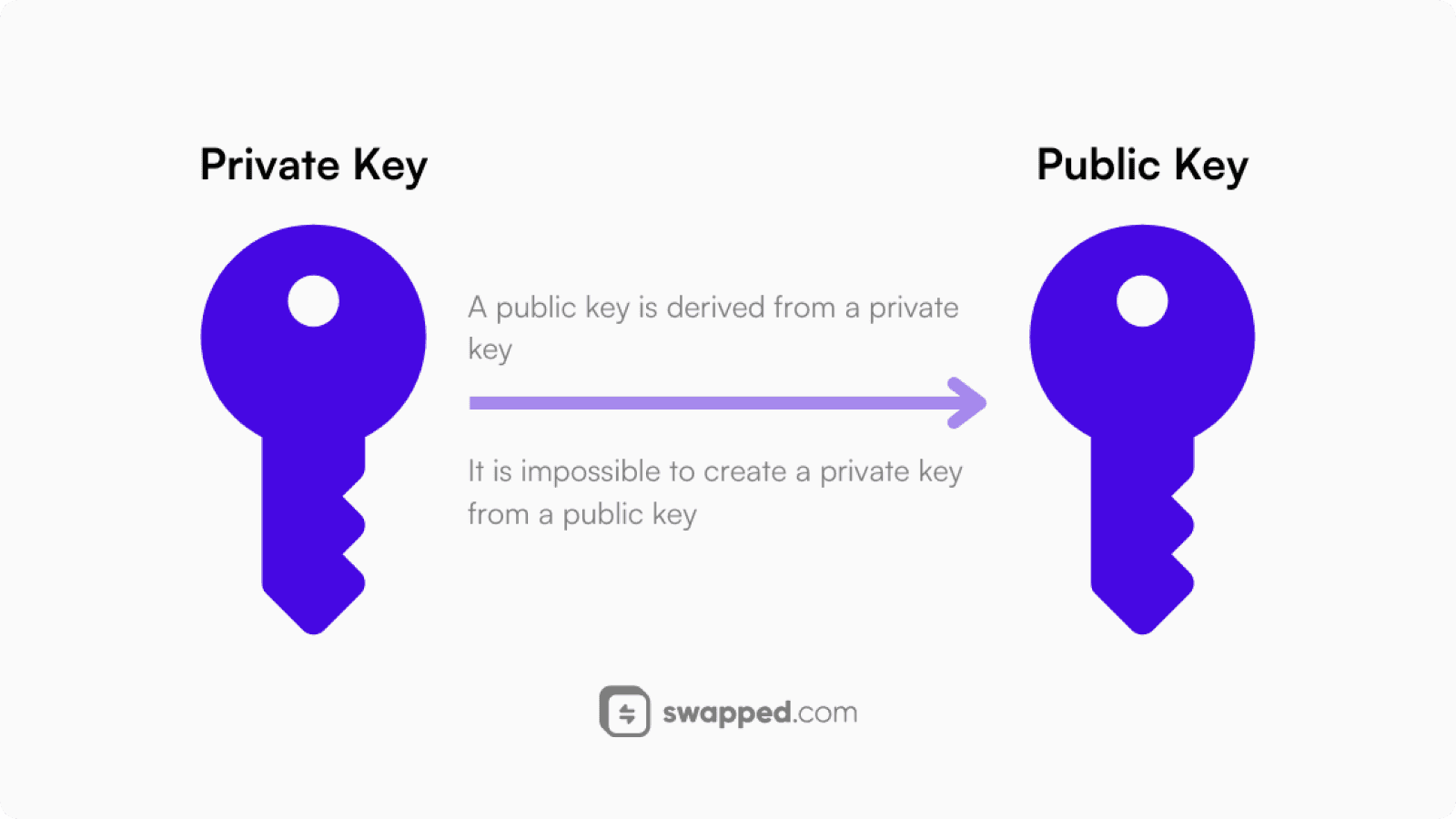
Private signing material must remain under the intended controller’s protection.
What a Hash Function Does
A cryptographic hash function such as SHA-256 maps input bytes to a fixed-size digest. It is designed to make reversing a digest or finding collisions computationally difficult. Hashing is not encryption: there is no decryption key that reconstructs the original input.
A Reproducible Hash Example
Applying SHA-256 to the UTF-8 text A public record, with no quotation marks or trailing newline, produces this hexadecimal digest:
9995606b73a373e5e4d5fee783e931b72fee9f57a8c46e56acd5d0c2015bccbf
Changing only the capital letter to make the text A public Record produces a different SHA-256 digest:
2521570aa96f889f84b5e8f10a48e15fbcc1e28f74e2484c2ae8845f786db16c
Cryptography in a Ledger
A cryptocurrency system combines cryptographic tools with validation and consensus rules. A hash can identify data, and a signature can authorize an operation. Neither tool alone decides which of two conflicting transactions belongs in the accepted history.
Digital Signatures
A transaction signature commits to specified transaction data according to the signing scheme. Verification can establish that the matching key authorized those bytes. It cannot determine whether the human understood the transaction, whether a website was honest or whether the resulting trade was sensible.
Addresses and Identifiers
Crypto addresses follow network-specific construction rules. Some are derived from public keys or scripts; others identify contracts or program-controlled accounts. Their formats should not be generalized into one universal algorithm. An address is normally public, while the authorization material must remain protected.
Linking Records
Block headers can include a hash of an earlier block, making changes to the referenced history detectable. Consensus rules determine which valid history participants accept. Hash linking helps expose tampering, but it does not alone prevent every reorganization or malicious proposal.
The System Around the Mathematics
Security also depends on software, devices, recovery procedures and the meaning of each authorization. Strong mathematics cannot stop a user from signing an operation whose harmful effect they did not understand. Protect keys and inspect the transaction the wallet actually presents.
Use a signing setup appropriate to the assets and operations involved, and verify important details on a trusted display where supported.
Keep recovery material in a protected backup arrangement that you understand and can recover without exposing it to websites or support agents.
Never disclose private keys or recovery phrases to someone claiming they are needed to receive funds, verify an account or resolve a transaction.

Correct implementation and careful authorization are part of cryptographic security.
Recognizing the Different Guarantees
Encryption can keep information confidential, hashes can identify data and signatures can verify authorization. A blockchain then combines those tools with rules for state and consensus. Understanding the division makes technical claims easier to assess.
When a product says it uses cryptography, ask which guarantee the mechanism provides and what remains outside that guarantee. A secure signature does not imply a private transaction, and a valid hash does not prove the truth of an external claim.
Related Reading
The linked introductions provide broader context. Standards and network specifications define the exact algorithms and assumptions used in a particular system.