The Blockchain Trilemma as a Design Question
Explore the tradeoffs among network capacity, security and decentralization, and learn how to assess scaling claims without relying on a slogan.
DTCC Trading Editorial

Designing a cryptocurrency network involves choices about who verifies activity, how much work they perform and what happens when participants fail or act dishonestly. The blockchain trilemma is a useful shorthand for discussing those choices, but it is not a complete model of every system.
The familiar triangle names security, scalability and decentralization. To compare real networks, each term needs a definition and evidence. Otherwise, a claim to solve the triangle can simply hide a changed assumption.
What the Trilemma Describes
The trilemma describes tension among processing capacity, resistance to attacks and the ability of many independent participants to verify the system. Increasing the work performed by each node can increase capacity while making participation harder.
The concept appears in Ethereum-related research and broader blockchain discussion. It is a design framework rather than a universal law that every network can achieve exactly two properties. More sophisticated designs can change the tradeoffs while introducing their own assumptions.
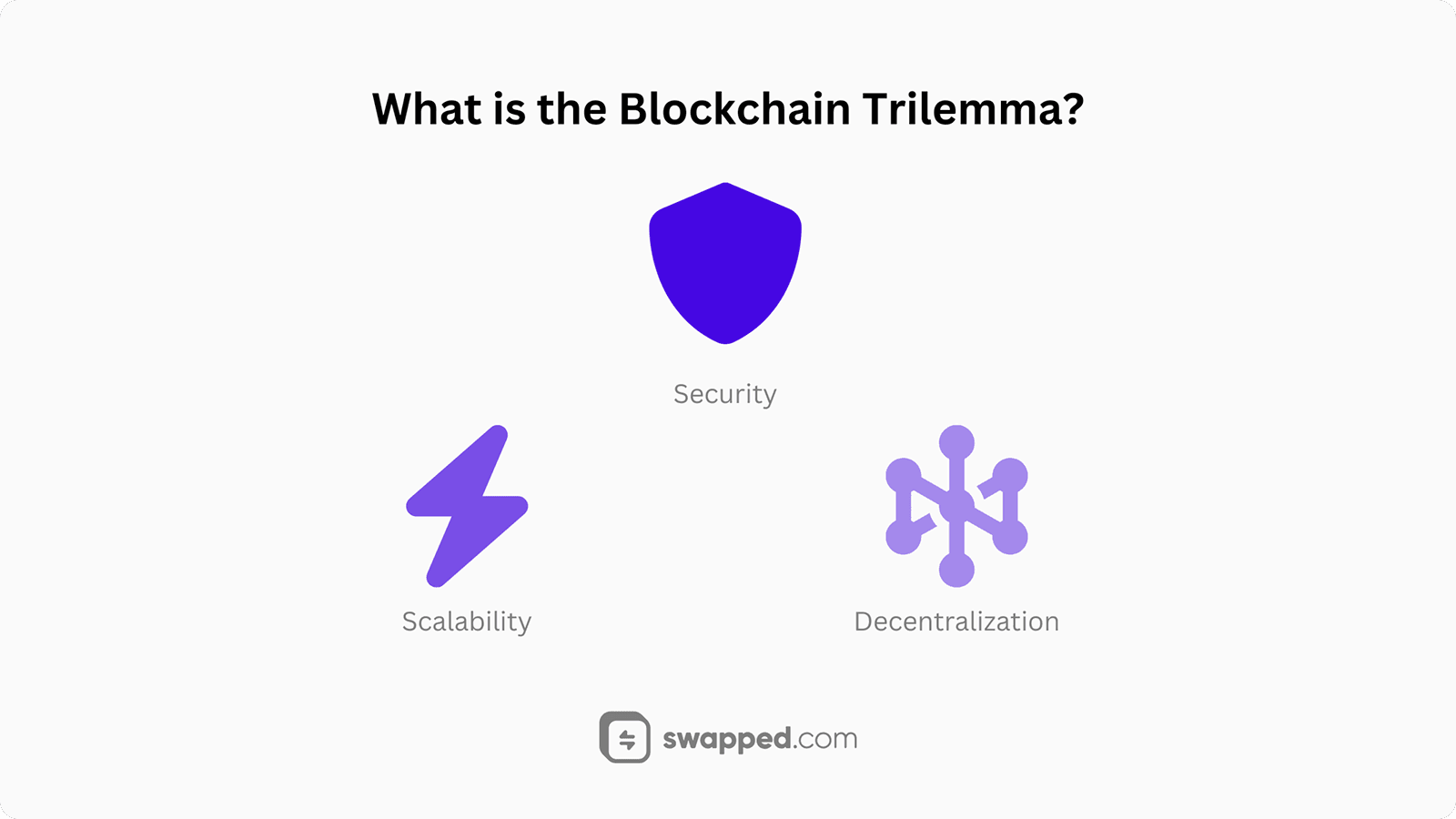
The triangle highlights questions to investigate, not a universal rule that only two goals are possible.
Enforcing Valid Network State
Security concerns which failures or adversaries a system can withstand under stated assumptions. It includes more than preventing one kind of attack. Transaction validity, consensus safety, liveness and application security are related but distinct questions.
A protocol can have strong consensus properties while a wallet or contract remains vulnerable. Define the system boundary before calling an entire ecosystem secure. The claim should identify what is protected and under which conditions.
Handling Additional Demand
Scalability concerns how a system handles increasing demand while keeping relevant resource and operating costs manageable. Throughput, latency, state growth and verification requirements all matter. One transactions-per-second figure cannot capture them all.
A benchmark should specify transaction types, hardware, network conditions and the definition of completion. Processing simple transfers under ideal conditions is not the same workload as sustained execution of complex applications.
Distributing Participation and Control
Decentralization concerns the distribution of control and the practical ability to participate independently. Relevant dimensions include validator concentration, software diversity, infrastructure dependencies and governance powers. A node count alone is an incomplete measure.
Independent verification also matters. If ordinary participants must rely entirely on a small set of providers to learn the state of the network, the practical trust arrangement differs from a system they can verify themselves.
Why the Tradeoffs Matter to Users
Before deciding to acquire a digital asset, understand the network and services needed to use it. The trilemma can guide that research, but it does not identify the best investment or prove that DTCC Trading supports a particular network route.
Understanding Completion Time
A fast acknowledgement, block inclusion and final settlement can occur at different times. Network designs use different finality models, while services can add their own confirmation requirements. Compare the stage that matters to the actual operation.
A transfer also includes wallet preparation, provider processing and destination crediting. A protocol latency figure does not establish the complete user experience. Trace the whole route before promising a completion time.
Understanding Cost
Fees can reflect demand for scarce execution or data resources as well as network policy. Low fees in a quiet period do not prove unlimited capacity, and high fees do not by themselves prove superior security.
The full cost of using a route can include bridging, withdrawals, account requirements and service charges. Compare the same operation and destination before treating a cheaper individual transaction as a cheaper end-to-end workflow.
Understanding the Security Boundary
Identify which component protects the operation: a base-layer consensus process, a rollup proof system, a bridge or a custodian. Their guarantees differ. A strong underlying network does not automatically secure every application built around it.
Also identify privileged controls, upgrade powers and recovery mechanisms. These can affect the actual trust assumptions even when a system uses decentralized components elsewhere. Security review needs the deployed arrangement.
Reading Different Network Approaches
Network comparisons are more useful when they describe concrete design choices. The examples below illustrate questions to ask; they do not rank networks or assign a permanent score to each corner of the triangle.
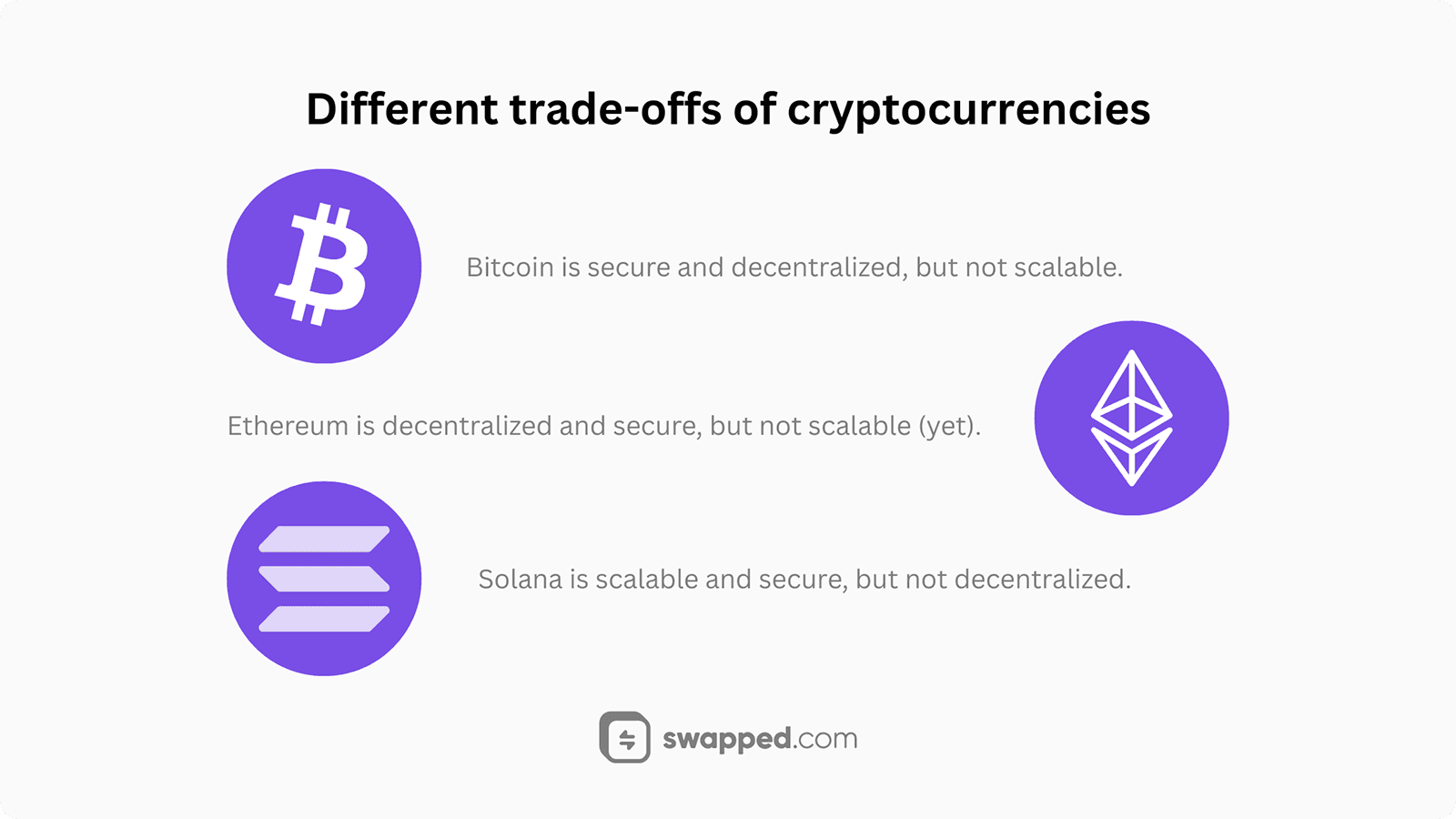
Compare actual resource requirements, control distribution and security assumptions.
Bitcoin and Independent Validation
Bitcoin combines proof-of-work consensus with rules that nodes independently validate. Its design places importance on checking the chain’s rules, while block-space limits constrain base-layer capacity. This description does not imply that every Bitcoin-related service is secure.
Transaction throughput depends on transaction size and the available block space. A fixed headline rate can obscure batching and different transaction formats. Use the relevant workload when comparing capacity with another system.
Additional payment mechanisms can move some activity outside ordinary base-layer transfers. Their capabilities and constraints must be examined separately. A scaling layer is not simply extra throughput with no added operating assumptions.
Ethereum and Layered Scaling
Ethereum supports general-purpose contract execution and uses proof-of-stake consensus. Its scaling approach includes improvements to the base layer and support for rollups. Those parts address different resource constraints.
Execution and data availability are separate costs. Rollups can execute many operations outside the base layer while publishing information or proofs needed for verification. The security result depends on the particular rollup design.
Roadmaps change as research and implementation progress. Distinguish deployed upgrades from proposals and planned work. An old reference to a future upgrade should not be used as evidence that a feature is currently available.
Solana and Processing Requirements
Solana emphasizes a high-performance execution environment used by applications including NFT systems and trading services. Assess that approach through current validator requirements, workload measurements and network behavior rather than a single advertised maximum.
Hardware, bandwidth and operating costs affect who can participate reliably. Validator distribution and client diversity also matter. It is too simplistic to reduce decentralization to a comparison of raw validator counts between different protocols.
A useful assessment asks whether the deployed network meets the application’s needs under realistic conditions and which dependencies remain. The same network can be suitable for one operation while creating unacceptable assumptions for another.
Approaches to Scaling
Research can improve efficiency or distribute work differently. Each proposal should explain how data remains available, how invalid results are rejected and what resources independent verification requires.
Layer 2 Systems
Layer 2 systems move some activity into an additional protocol that relies on a base layer in defined ways. Rollups and payment channels use different mechanisms, so the broad label does not establish identical guarantees.
For a rollup, examine its proof system, data availability, sequencing and upgrade controls. For a channel system, examine funding, routing and closure requirements. The added layer has its own operational conditions.
Users should also understand withdrawal or exit paths. A fast internal confirmation can coexist with a longer route back to the base layer. Describe both stages when explaining the practical timing of a layered system.
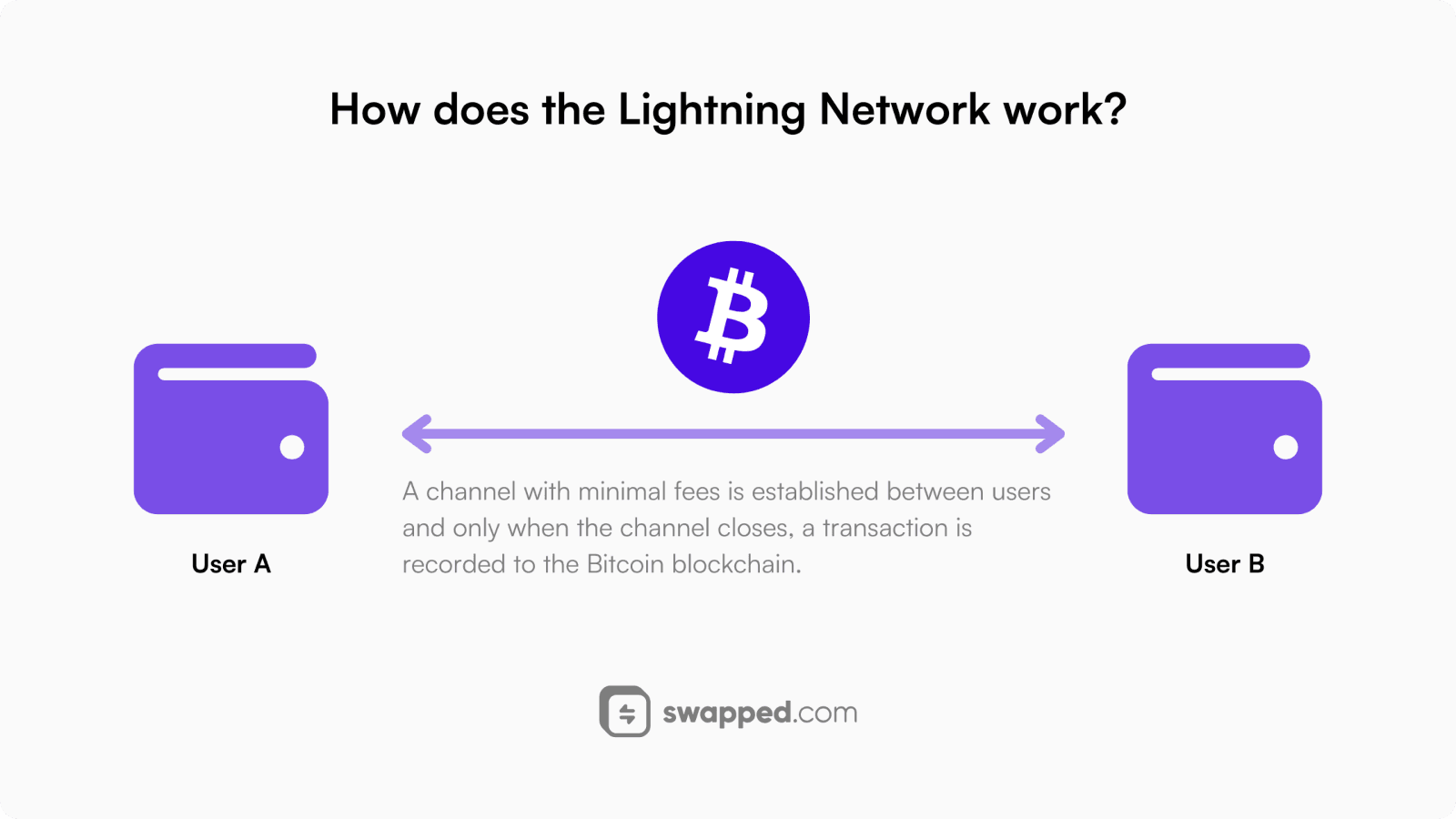
Payment channels add a separate protocol with funding, routing and closure requirements.
Distributing Data and Work
Sharding broadly divides work or data among subsets of participants. Its benefit depends on preserving enough assurance that the full system remains valid and available. Distributing the workload creates coordination and verification questions.
Data-availability techniques can help participants gain assurance without each downloading every byte. The design must explain its sampling or proof assumptions and how missing data is handled. Efficiency claims need that security context.
Ethereum’s current scaling direction should be read from its current roadmap, which has evolved away from older execution-shard plans. Historical descriptions of Ethereum 2.0 are not a reliable specification of today’s deployed architecture.
Consensus and Resource Use
Proof of work and proof of stake use different resources and incentives to support consensus. Comparing them requires examining adversary assumptions, participation requirements and recovery behavior, not merely energy use or nominal speed.
Changing the consensus mechanism does not automatically remove execution or networking bottlenecks. A network can still be limited by the amount of state, data and computation its participants need to process.
Improvements should therefore be measured against clearly defined goals. A reduction in one resource cost can be valuable without proving that all security and decentralization questions have been resolved.
What Would Solving It Mean?
There is no single agreed measurement that certifies a network as having solved the trilemma. A meaningful claim specifies the workload, threat model, participation requirements and evidence supporting the result.
Ask what assumption changed. More powerful hardware, a smaller trusted set or a different data-availability model can produce impressive performance while altering the system being compared. Those changes should remain visible.
The trilemma is most useful as a prompt for precise questions. It encourages examination of capacity, verification and control together, while leaving room for research that improves the tradeoffs under clearly stated conditions.
Related Reading
Compare introductory discussions with protocol documentation and original research. Check which claims describe a deployed system and which describe a proposal or benchmark.