Layer 2 Networks and Blockchain Scaling
Compare rollups, payment channels and related scaling designs through execution, data availability, settlement, fees and withdrawal assumptions.
DTCC Trading Editorial

Networks supporting cryptocurrencies have finite capacity. On Ethereum, additional execution layers can share base-chain resources while processing activity separately. A network such as Solana makes different architectural choices. Comparing these systems requires more than a headline transaction-speed figure.
Understanding Network Layers
Layer 1 usually means a base blockchain with its own consensus and validation rules. Layer 2 describes a system that handles activity separately while relying on a base chain for defined security or settlement functions. The details of that reliance matter.
The Base Chain
A network such as Bitcoin establishes an accepted transaction history through its own protocol. Applications and additional layers can build on that history. The availability of another layer is a design option, not evidence that the base chain is broken or that another network will never need scaling.
Capacity and transaction costs help motivate additional execution layers.
Finite Resources
Nodes must receive, check and store enough information to follow the network. Protocol limits balance those demands against capacity and participation. Raising a limit can shift costs elsewhere in the system.
When demand exceeds available capacity, users can compete through fees or wait for inclusion. Transaction-per-second comparisons often hide differences in transaction complexity, voting activity, hardware assumptions or finality. Compare equivalent workloads and clearly defined milestones.
The Role of Layer 2
An additional layer changes how work is distributed. It can improve the economics of common operations while introducing contracts, operators and exit mechanisms that need their own review.
A Working Definition
A layer 2 executes or coordinates activity away from the base chain and uses the base chain to help enforce its outcomes. The term is used inconsistently, so ask what the base chain actually verifies and what users can do if an operator stops cooperating.
Where the Work Happens
Some systems execute transactions on a separate network. Others let participants update a payment channel between on-chain transactions. Both can reduce the work recorded directly on the base chain, but their user experience and security assumptions differ.
Off-chain does not mean unrecorded or unverified. A design must still explain who retains the data, how participants detect invalid behavior and how claims reach the base chain. Those mechanisms determine whether users can recover independently.
Several Scaling Approaches
Rollups, channels, sidechains and validiums solve related problems through different mechanisms. Grouping them under a scaling label should not erase the differences in consensus, proof verification and data availability.
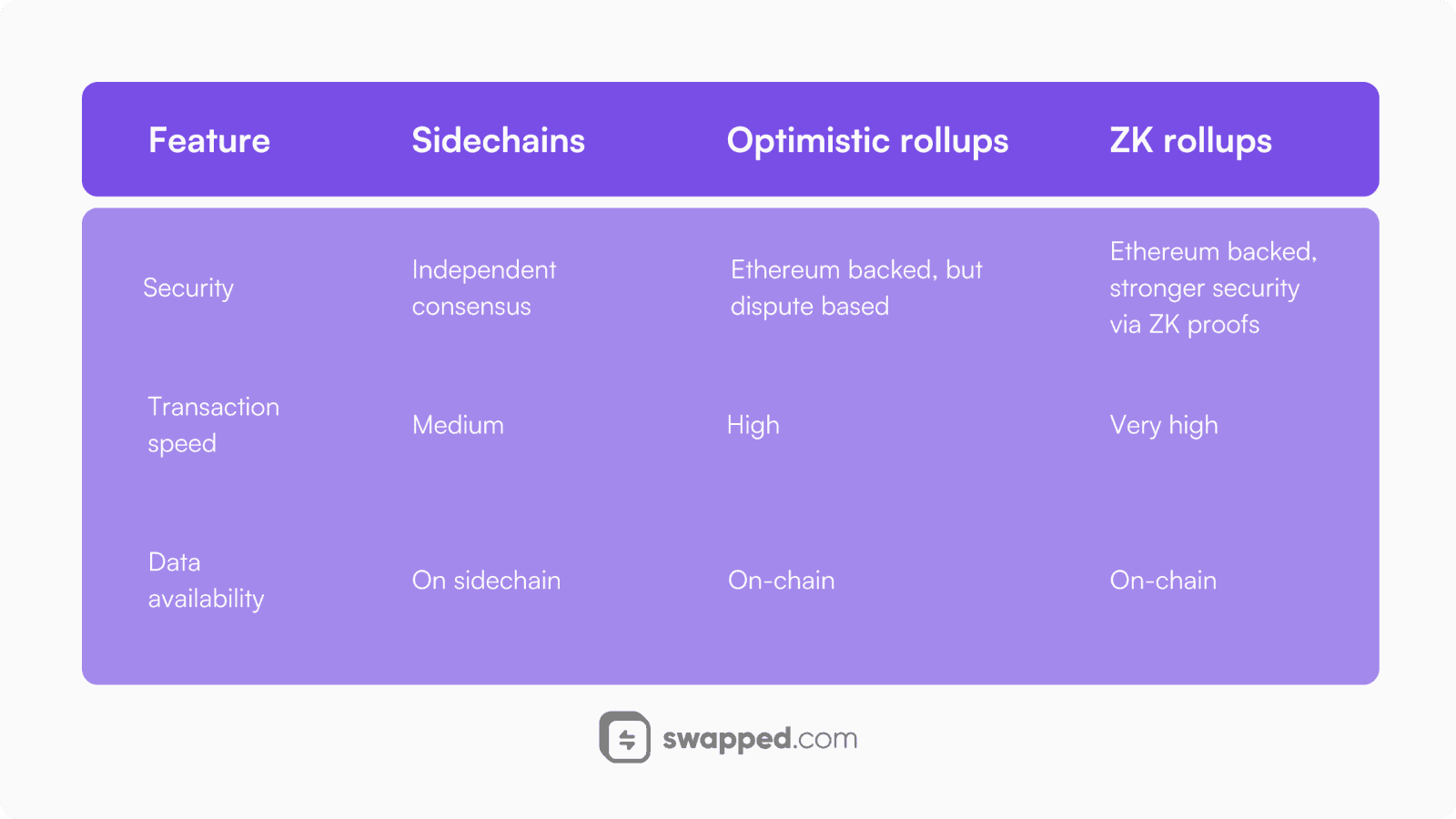
Compare who executes, who verifies and where the required data is available.
Separate Sidechain Consensus
A sidechain operates its own consensus and connects to another network through a bridge or related mechanism. It generally has a separate security model rather than inheriting the base chain’s full validation guarantees. The bridge adds another dependency.
Rollup Execution and Settlement
Rollups execute activity separately and publish information to the base chain. Optimistic designs use dispute mechanisms; validity designs verify proofs of state transitions. A rollup must also make the required state data available under its design.
Validiums
A validium uses validity proofs while keeping required transaction or state data outside the base chain’s data-availability layer. Proofs can establish correctness without guaranteeing access to that data. A data-withholding failure can therefore affect users even when no invalid state is proven.
Bitcoin Payment Channels
The Lightning Network connects payment channels that can update balances without recording every payment on Bitcoin’s base chain. Channel opening, closing and disputes interact with on-chain rules. Routing also depends on available paths and liquidity, so every payment is not guaranteed to succeed instantly.
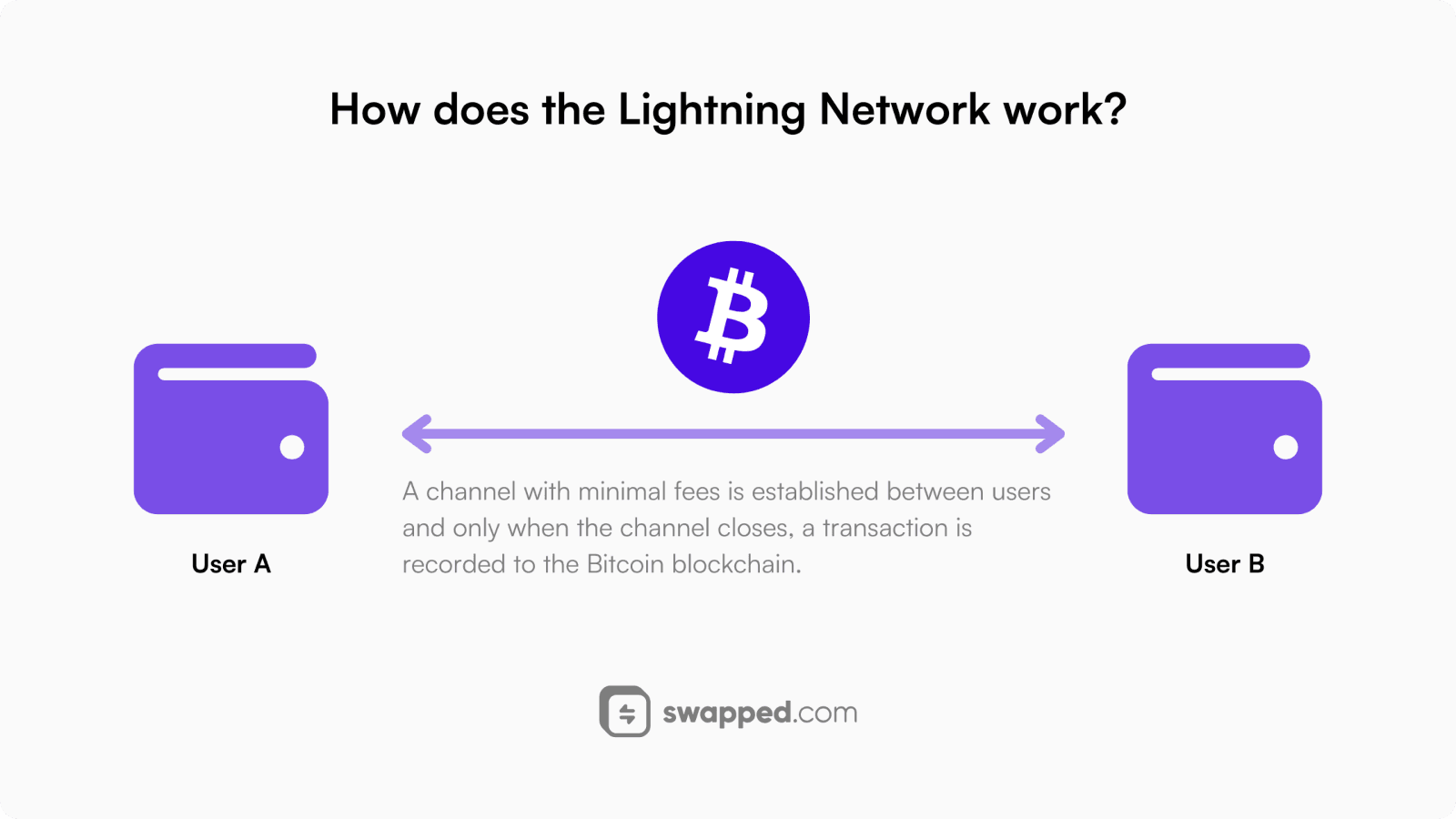
Payment channels move repeated payment updates away from the base chain.
Potential Benefits
The useful benefit is a better result for a particular workload. Measure that result through total costs, confirmation stages and recovery behavior rather than assuming every additional layer performs identically.
More Activity per Base-Chain Operation
Batching can spread settlement and data costs across multiple operations. Channels can support repeated payments between on-chain updates. The resulting capacity still depends on execution limits, available data bandwidth and the architecture of the system.
Different Fee Economics
A small operation can become more affordable when shared infrastructure amortizes a fixed cost. Users may still pay execution charges, data charges and bridge or withdrawal costs. Review the complete route instead of comparing only its cheapest intermediate step.
Faster Initial Feedback
An operator or channel can provide fast feedback that a payment was accepted. Base-chain settlement and withdrawal availability can occur later. A status screen should make those stages visible rather than use one confirmation label for all of them.
Questions That Remain
Scaling changes where trust and operational responsibilities sit. Understanding those responsibilities is essential when a system holds assets or becomes part of an application’s critical workflow.
Contracts and Exit Paths
Bridge contracts, proof verifiers, dispute mechanisms and upgrade controls can affect funds. Review which components are live, which participants can change them and how users exit during an outage. A claim of inherited security needs that implementation context.
Implementation Complexity
Additional components create additional failure modes. An application can work during ordinary conditions yet behave differently when a sequencer fails, a proof is delayed or the base chain is congested. Recovery procedures deserve the same attention as normal transaction flow.
Moving Between Networks
The same token symbol can refer to different contracts or representations on different networks. A bridge transfer, direct withdrawal and swap are distinct routes. Confirm the destination asset, network and final amount before authorizing any combined operation.
Operator and Upgrade Control
Decentralization varies by system and by component. Transaction ordering, proof production, upgrades and data availability can have different operators. Count the actual powers held by each party instead of assuming a validator count describes the whole design.
A Clear User Experience
Users need to see the active network, exact asset, fee requirements and the meaning of each transaction status. A convenient interface should also explain delays and recovery routes. Hiding those details can turn a simple-looking transfer into an unexpected investigation.
Application Examples
Scaling designs can support many kinds of activity, but suitability depends on the application. A game action, a payment and a large asset transfer need not prioritize the same properties.
Financial Applications
Exchanges and lending applications can benefit from lower execution costs, but they retain market, contract, liquidity and oracle risks. Operating on a layer 2 does not make a lending position safe or guarantee that a quoted trade can be completed.
Collectibles and Digital Records
An NFT application can use a scaling network to reduce the cost of issuance or transfers. The record’s rights, metadata storage and transfer restrictions remain separate questions. Low transaction fees do not establish ownership of an external asset or the durability of its content.
How Scaling Evolves
Base-chain upgrades and additional layers can develop together. Roadmaps change over time, so distinguish completed upgrades from proposals and avoid treating a single future milestone as the end of scaling work.
Ethereum’s Continuing Roadmap
Ethereum moved to proof of stake in 2022. Later upgrades introduced and expanded mechanisms for rollup data, including blob transactions. These developments support a broader scaling strategy rather than a one-time upgrade that automatically makes every additional layer unnecessary.
A base-chain improvement can lower costs or change design tradeoffs. Each layer still needs to demonstrate useful execution, reliable settlement and a coherent operating model.
Changing Technical Choices
Teams continue to develop proof systems, sequencing mechanisms and interoperability tools. Evaluate implemented features through documentation and observed behavior. A roadmap promise should not be treated as a security property already protecting current users.
Fragmented Liquidity and Access
More networks can divide liquidity and require users to navigate more routes. Applications sharing a technology do not automatically share balances or markets. A useful comparison includes the cost of entering, operating within and leaving the chosen network.
A Practical Comparison
For any scaling system, identify where transactions execute, how validity is checked, where data is available and how assets return to the base chain. Then compare fees and timing using the complete journey.
DTCC Trading’s focus on tokenization and multichain interoperability makes these distinctions relevant to evaluating digital-asset systems. This overview explains architectural concepts; it does not identify a particular layer 2 as an available DTCC Trading integration.
Related Reading
The linked introductions explain common categories. Use the chosen network’s live documentation for its current contracts, operating assumptions and withdrawal process.