Zero-Knowledge Proofs: Privacy and Verification
Explore what zero-knowledge proofs establish, how validity rollups use proofs, and which privacy, security and operational questions remain.
DTCC Trading Editorial
Zero-knowledge proofs separate two ideas that often seem inseparable: checking a claim and seeing the information behind it. In a blockchain application, that distinction can support privacy or make computation easier to verify. The exact claim and the system around the proof determine what it actually achieves.
What a Verifier Learns
A zero-knowledge protocol lets a verifier check a defined statement without learning the private information used to establish it, beyond what the statement itself reveals. The statement can still disclose something meaningful, so the design must specify what remains public.
The Claim and the Witness
The prover supplies evidence for a statement using private information called a witness. A verifier checks that evidence according to a mathematical protocol. For example, the claim might concern possession of a credential or the correctness of a computation; those are different applications of the same broad idea.
Three Core Properties
A proof system is evaluated through precise security properties. Everyday descriptions are useful introductions, but an implementation must state the assumptions, probability bounds and adversary model under which those properties hold.
Accepting True Statements
When the statement is true and the protocol is followed correctly, the verifier should accept the proof according to the system’s completeness guarantee. A malformed input or incorrect implementation can still prevent a real application from completing the process.
Rejecting False Claims
A false statement should be infeasible to establish except with the probability allowed by the security definition. Many practical systems rely on computational assumptions. Soundness concerns the statement encoded in the proof, which might differ from what a user informally assumes it means.
Limiting Disclosure
Verification should reveal no additional information about the private witness beyond what the public statement and inputs already reveal. Public addresses, timing, application logs or identifying network activity can still disclose information outside the proof itself.
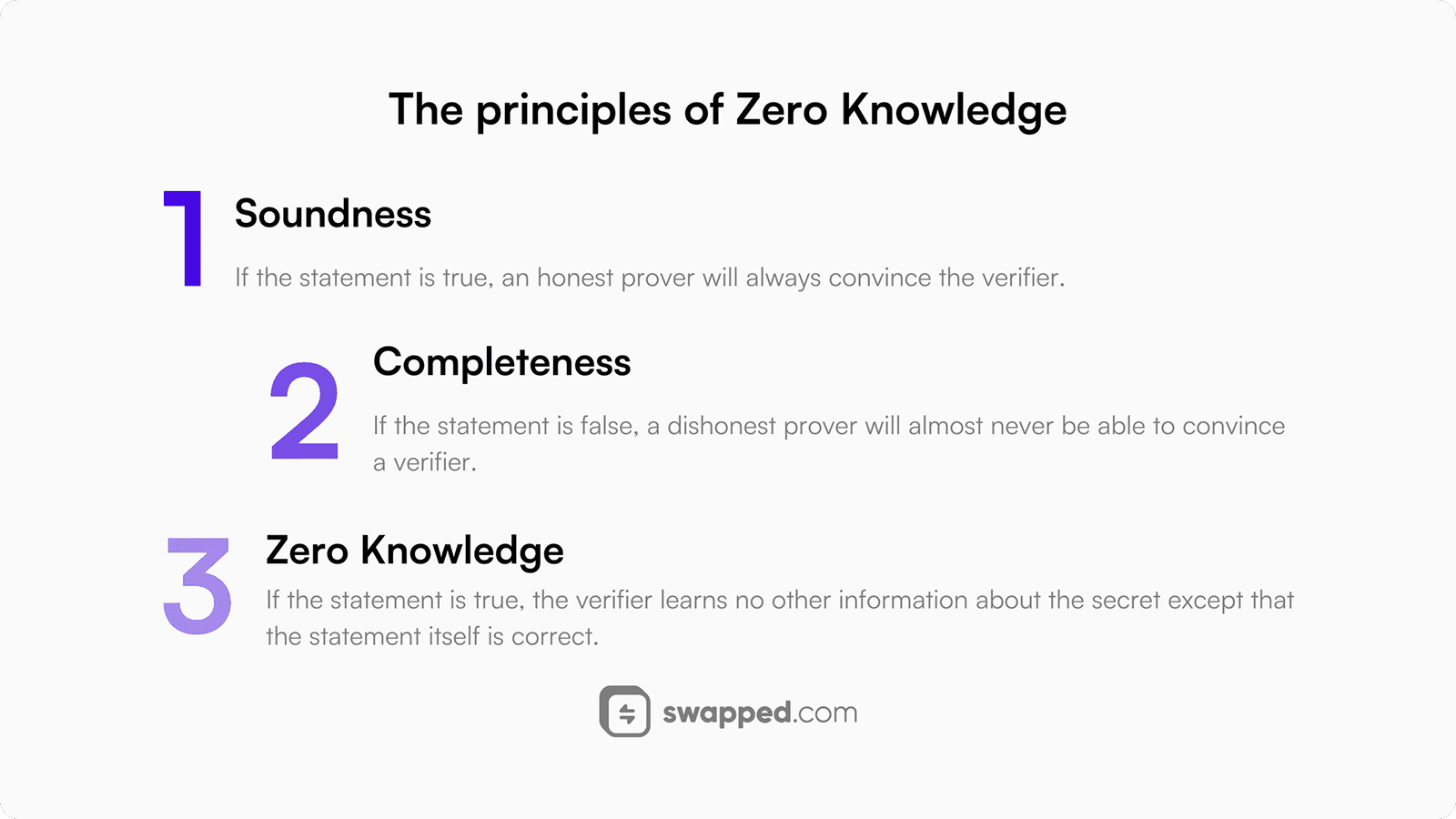
Completeness, soundness and zero knowledge describe different guarantees.
An Everyday Analogy
Imagine proving that a sealed puzzle has a valid solution without showing that solution. A carefully designed interaction can convince a checker while preserving the secret. The phrase carefully designed is essential: hiding a piece of paper alone proves nothing.
Simply opening a locked safe demonstrates access at that moment, but it is not a full zero-knowledge protocol. A real construction needs a defined statement, a way to reject false claims and an argument that verification does not reveal the protected secret.
From Research to Applications
Zero knowledge grew from research into what a verifier needs to learn in order to be convinced. Its history helps distinguish a longstanding cryptographic field from the newer products that use its terminology.
The Foundational Idea
Research by Shafi Goldwasser, Silvio Micali and Charles Rackoff in the 1980s formalized the relationship between interactive proofs and knowledge disclosure. Later work developed additional constructions and ways to reduce interaction between the parties.
Practical Systems
Advances in algorithms, engineering and hardware made more applications practical. Credential checks, confidential payments and verifiable computation impose different requirements, so success in one setting does not make a proof system suitable for every other setting.
Families of Proof Systems
SNARKs and STARKs are prominent families, but they are not the only approaches to zero-knowledge proofs. Their labels summarize design properties rather than providing a complete security review.
A succinct non-interactive argument of knowledge, or SNARK, aims to make a statement efficiently verifiable with a compact proof. Some constructions need a trusted setup and others do not. Setup requirements must be checked for the particular construction rather than inferred from the acronym alone.
A scalable transparent argument of knowledge, or STARK, uses a transparent setup approach. Proof size, proving work and verification costs differ across implementations. Quantum-resistance claims also need to be tied to the actual cryptographic assumptions and the complete system.
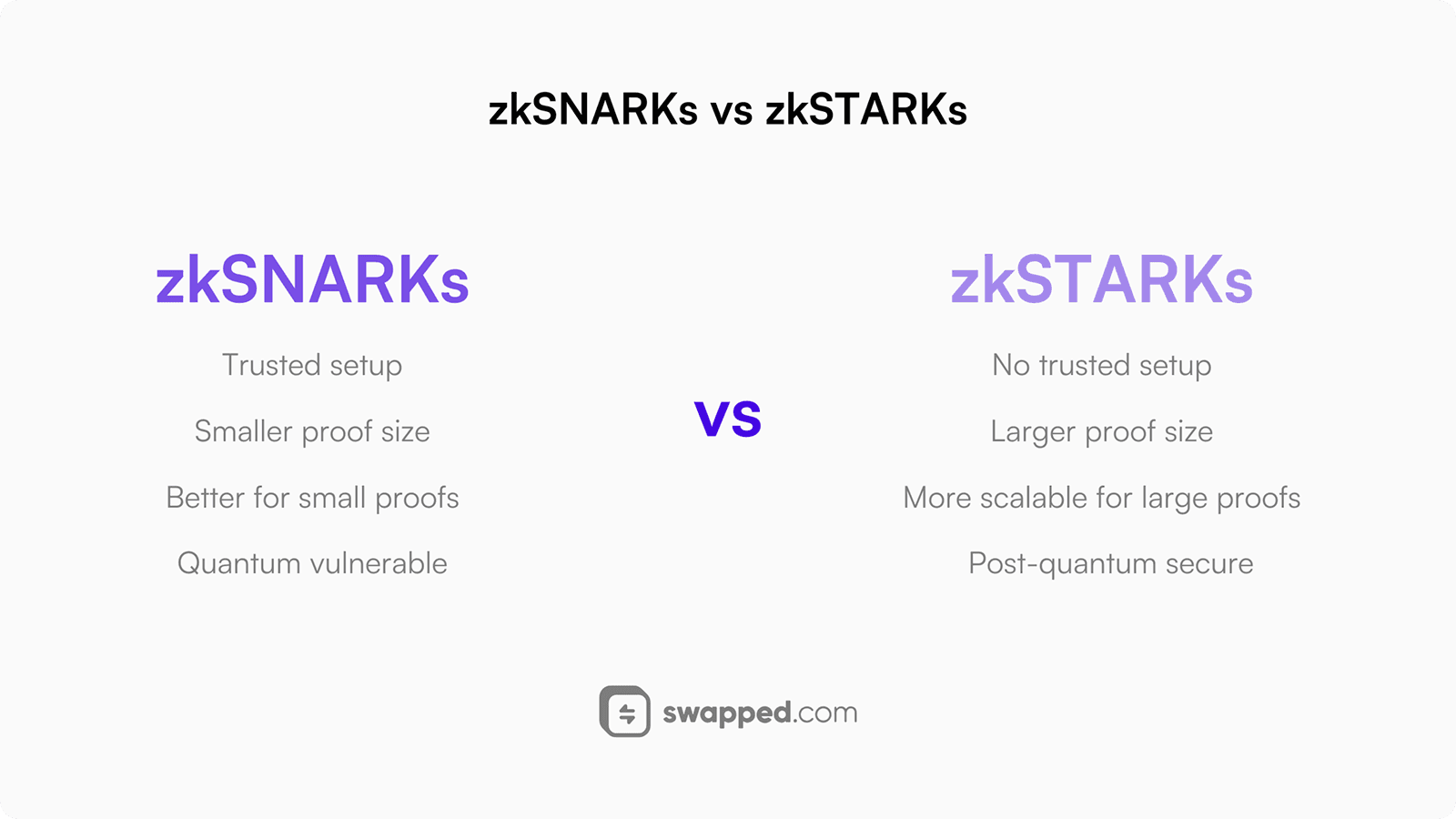
Proof families differ in setup, size and computation requirements.
Where Scaling Enters the Picture
Networks have limited capacity to execute and record activity. Layer 2 designs can move some work away from the base chain while using it for settlement or verification. Proof systems are one way to make that division of work checkable.
Demand and Shared Resources
On Ethereum, applications compete for limited execution and data capacity. The cost of using a cryptocurrency network therefore depends on demand and the resources a transaction consumes. Scaling designs change where those resources are used; they do not eliminate the need to account for them.
Layer 2 in Context
A layer 2 processes activity separately while using a base network for defined security or settlement functions. The exact design matters: users need to know how state is verified, where the required data is available and how they can exit the system.
What Rollups Combine
Rollups group activity and publish information to a base chain. Validity rollups accompany state updates with proofs; optimistic rollups use a challenge mechanism. These approaches differ in how invalid updates are handled, not merely in the number of transactions inside a batch.
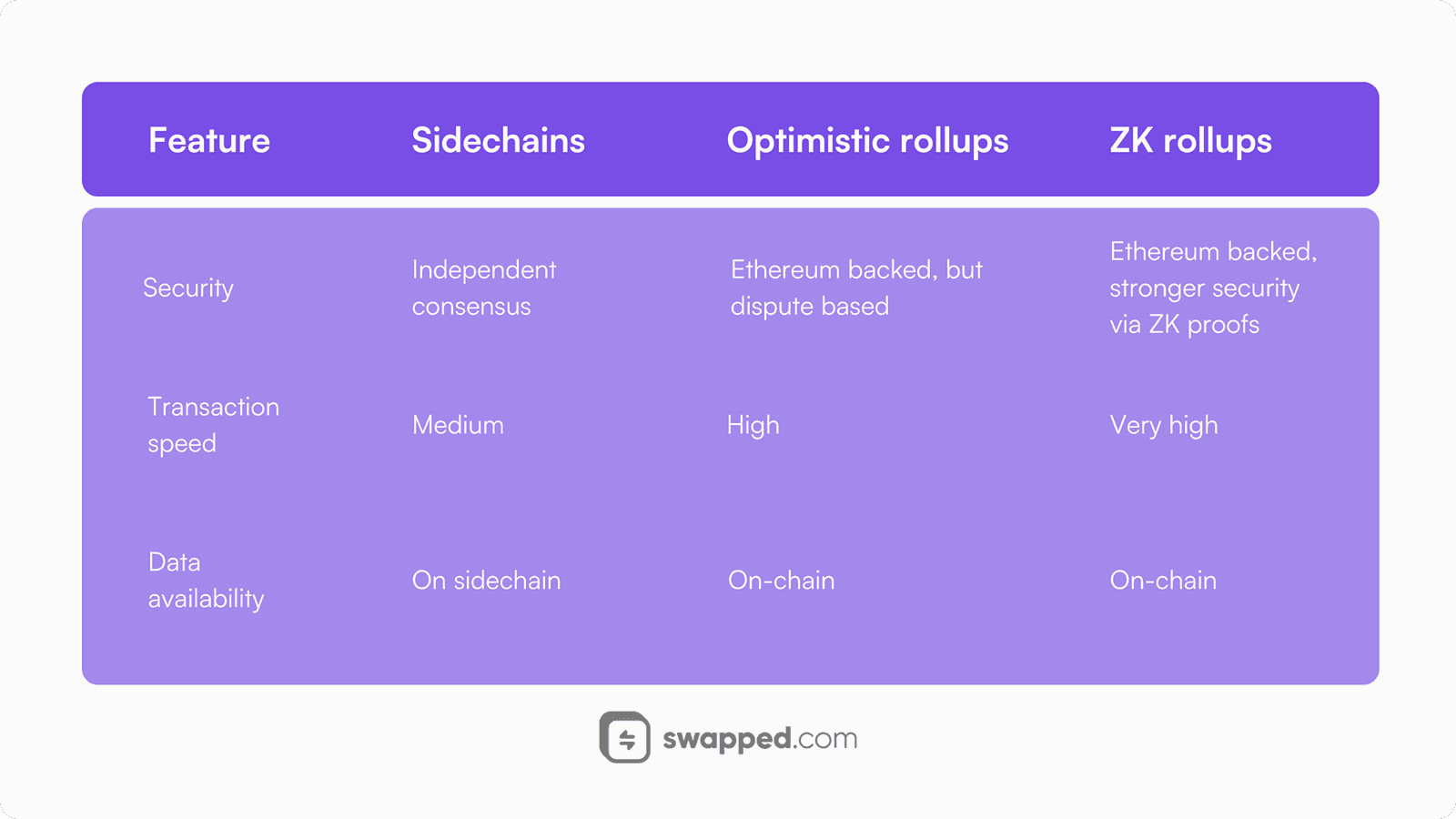
Execution, proof mechanisms and data availability are separate design choices.
Understanding Validity Rollups
Systems commonly called ZK rollups use validity proofs to establish that state changes follow the encoded rules. The word ZK in a product category should not be treated as a guarantee that its transactions are private.
What the Proof Checks
A validity rollup produces cryptographic evidence that a proposed state update follows its specified computation. A verifier contract checks the proof and public inputs. Its guarantee depends on correct rules, correct implementation and the proof system’s assumptions; it is not unconditional mathematical certainty about every part of an application.
Comparing Optimistic Rollups
Optimistic rollups allow submitted state claims to be challenged during a defined period. Their security depends on the implemented dispute process and related assumptions. Calling one approach inherently safe and the other inherently unsafe skips the actual mechanisms that need review.
Following a Proven State Update
A useful way to understand a validity rollup is to follow a transaction from execution through proof verification and settlement. A quick interface confirmation is only one point in that sequence.
Execution and Proving
An operator can order transactions and execute them into a new state. A prover then performs the work needed to establish that the transition follows the encoded rules. The architecture can divide these roles among different components or participants.
Verification and Availability
A base-chain contract checks the proof and relevant public inputs before accepting the update. Users also need the data and mechanisms required to reconstruct state or withdraw. A correct proof does not by itself make unavailable data accessible.
Benefits and Remaining Questions
The value of zero knowledge depends on the problem it solves. Evaluate a deployed application through its disclosures, permissions and operating model as well as the cryptographic technique named in its documentation.
Privacy by Design
A privacy-focused design can prove a condition while withholding selected details. A scaling-focused rollup can still expose transaction information publicly. Determine exactly which inputs are hidden, who can see them and what metadata remains outside the proof.
Correctness
A proof can enforce an encoded computation, but that computation can contain a design mistake. Contract upgrades, privileged keys, bridges and frontends introduce additional ways for the wider system to fail even when the underlying proof system works as intended.
Resource Savings
Succinct verification can let one party check work more cheaply than repeating every step. The prover still performs computation, and the system still pays for data and settlement. Actual throughput and fees depend on its workload and implementation.
Implementation Complexity
Developers must translate intended behavior into constraints or circuits and integrate them with application logic. Missing constraints can leave an apparently successful proof checking less than intended. Reviews need to cover the statement being proved as well as the proof machinery.
Operational Costs
Generating proofs can require substantial memory, processing time or specialized infrastructure. A service must account for those costs and for what happens if a prover becomes unavailable. Fast verification does not imply inexpensive proof generation.
Application Requirements
A privacy feature does not by itself resolve an application’s identity, recordkeeping or access requirements. Define the intended disclosure policy and confirm that the technical design actually supports it. Product claims should describe verified behavior rather than assume a cryptographic label answers every requirement.
Common Questions
These distinctions help interpret the language used in proof-system documentation and product announcements.
Does a Proof Guarantee Complete Security?
No. A proof establishes a specified claim under stated assumptions. A secure application also needs correct inputs, sound contract logic, appropriate permissions and reliable operations. A flaw outside the proof can undermine the overall result.
Does Every SNARK Need a Trusted Setup?
No. Setup requirements vary by construction. Some systems require carefully generated public parameters, while others avoid that ceremony. Check whether a setup is application-specific or reusable, how it was performed and which assumptions the construction uses.
What Does a Prover Do?
A prover uses the statement’s inputs and witness to generate evidence accepted by the verifier. Proving a computation can be much more expensive than checking the resulting proof. The prover’s access to private inputs also belongs in a privacy review.
What Does a Verifier Do?
A verifier checks a proof against the expected public inputs and verification rules. It does not investigate whether an external document, price or identity claim was truthful unless the proof’s statement and trusted inputs actually establish that fact.
A Practical Way to Assess ZK Claims
Ask what statement is proved, what remains public, what assumptions are required and who controls the surrounding application. Those questions turn a broad technology claim into something that can be evaluated.
Zero-knowledge research offers powerful tools for selective disclosure and verifiable computation. The most informative products explain their specific guarantees, limitations and operational dependencies instead of presenting the technique as a universal answer.
Related Reading
Use the linked introductions for context, then consult the documentation of the actual proof system and application being evaluated.