Testnets and What They Can Prove
Learn how blockchain testing networks differ from production, how to choose a test environment and what evidence to collect from a useful test.
DTCC Trading Editorial

Learning about cryptocurrency involves more than recognizing names such as Bitcoin and Ethereum. A blockchain testnet provides a separate environment for trying network operations. Its value comes from the behavior you can observe, while its limits come from the ways it differs from production.
Testnets support application development, protocol experiments and education. They reduce the need to use valuable production assets for every exercise, but they do not make arbitrary software, websites or wallet permissions harmless.
What a Testnet Is
A testnet is a network intended for testing rather than ordinary production activity. It has its own state and asset balances. The exact protocol, participants and lifecycle depend on the network’s design and purpose.
Developers use separate environments to evaluate changes before relying on them in production. A test can reveal a problem without placing the production system under the same conditions. That separation is useful only when the environment is clearly identified.
A testnet can resemble mainnet without being identical. Software versions, validators, traffic, data and application deployments can differ. A result should therefore state which environment and configuration produced it.
Testing is evidence about observed behavior under specified conditions. It cannot demonstrate that every possible failure has been eliminated. The right question is what the test exercised and what remains outside its scope.
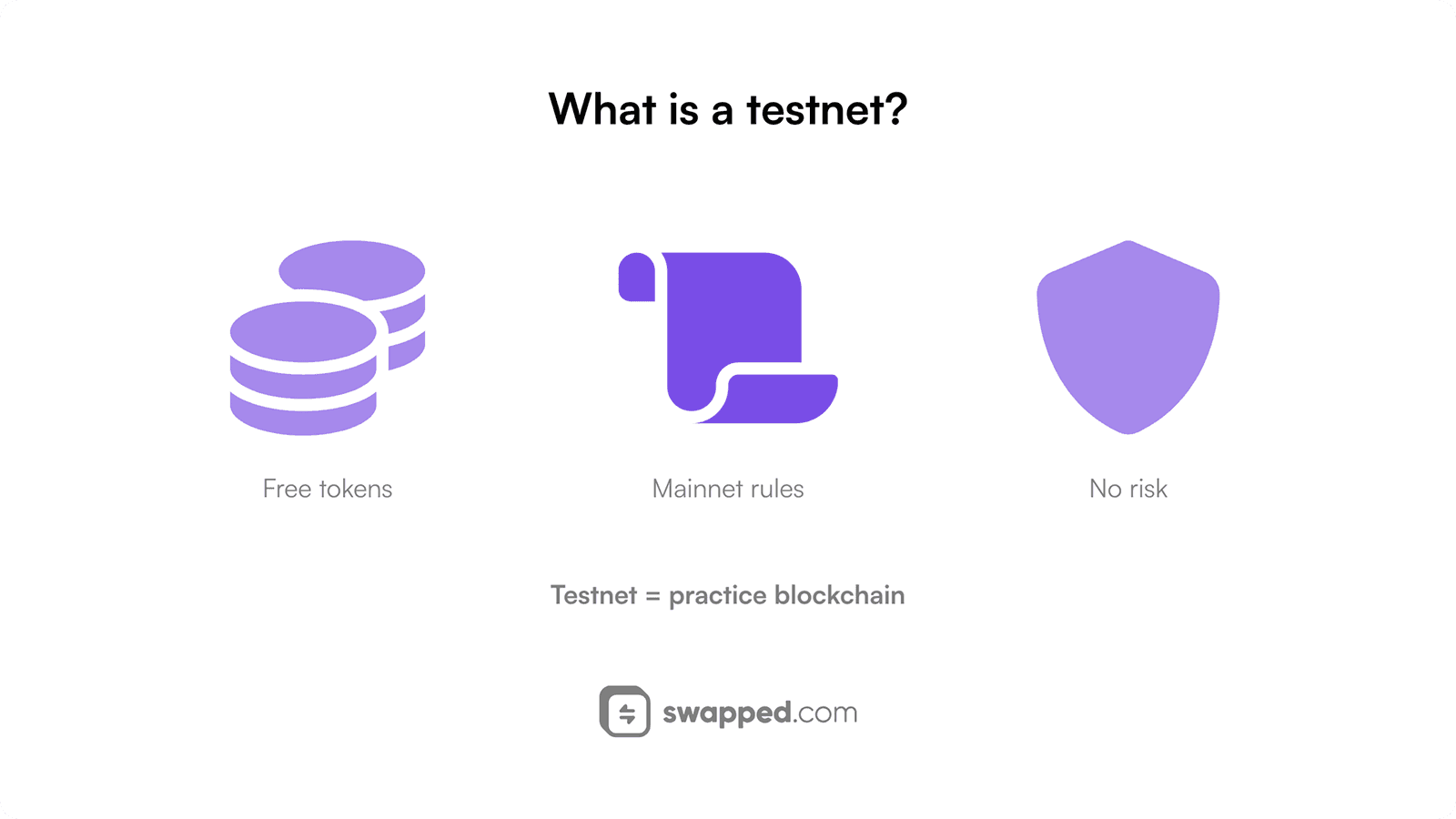
Test environments support experimentation, while keys and permissions still require careful handling.
Why Separate Testing Networks Matter
A production network can support valuable assets and live obligations. Separate testing gives developers and users room to inspect behavior before taking on those consequences. It also makes it easier to reproduce a problem without depending on a live balance.
A test can expose transaction failures, incompatible client behavior or a potential fork condition. It does not follow that every past incident would have been caught by a testnet. The scenario, configuration and observations determine what a test can detect.
For education, a test wallet can help demonstrate addresses, fees and confirmation states. Use separate recovery material from production accounts and verify the network before every operation. A practice exercise should not require importing valuable wallet credentials.
A public test deployment can also let others reproduce an application workflow. Provide its network, contract or asset identifiers and expected result. A screenshot without those details is much weaker evidence than a repeatable test record.
How Testing Networks Operate
A testnet uses a defined set of protocol rules and connected participants. It can run similar software to a production network while maintaining independent history. The common technology does not merge the two sets of balances.
A transaction submitted to one environment belongs to that environment. The same-looking account identifier on another network does not carry over its funds or history. Explorers and RPC connections must point to the intended network.
Consensus participation can differ from mainnet. A testnet may use a controlled validator set or parameters chosen for experimentation. Those differences can affect resilience, timing and how representative a test is of production.
Some environments reset regularly; others are deprecated or replaced as testing needs change. Record the network lifecycle and retain evidence you need outside the testnet itself. Do not assume its history will remain available indefinitely.
Choosing a Test Environment
Choose according to the task: application development, validator operations, protocol upgrades or a local reproducible exercise. The most familiar network name is not necessarily the correct environment for every purpose.
Ethereum Testing Networks
Ethereum’s current documentation distinguishes Sepolia for application development from Hoodi for validator and protocol testing. Consult that documentation before setup because testing networks are retired and replaced over time.
A test deployment needs the correct contracts and dependencies for its chosen network. A mainnet contract address should not be assumed to identify an equivalent application on Sepolia. Verify the actual deployment records.
Bitcoin Testing Modes
Bitcoin supports separate testing environments, including public test networks, signet and local regtest. These serve different needs and are not interchangeable. Wallet, node, faucet and explorer support must align with the chosen environment.
Local regtest is useful for controlled experiments, while a public network exposes a different operating context. A test that manually produces local blocks should not be used to promise public-network confirmation timing.
Other Network Ecosystems
Networks such as Solana have their own development and testing environments. Read each project’s current documentation for names, endpoints and intended use. Historical tutorials can point to retired networks, so verify the environment before copying configuration.
Testnet and Mainnet Compared
The distinction includes assets, security assumptions, infrastructure and lifecycle. Comparing these dimensions helps explain which findings can be carried forward and which need separate production verification.
Test assets are intended for experimentation rather than normal economic use. Their names can resemble production assets without making them interchangeable. A test balance is not evidence of a valuable mainnet holding or a right to future tokens.
Security conditions can differ because participants and incentives differ. Even so, test software still processes signatures and secrets. A malicious site can exploit reused credentials regardless of whether its interface describes the activity as testing.
Production traffic, liquidity and third-party services are often difficult to reproduce. An application that works with test assets may behave differently when quotes expire, providers reject requests or many users act simultaneously.
A testnet’s persistence policy also matters. Resets and migrations can remove state or require redeployment. Keep configuration, transaction references and observations in the project’s own records rather than treating the network as a permanent archive.
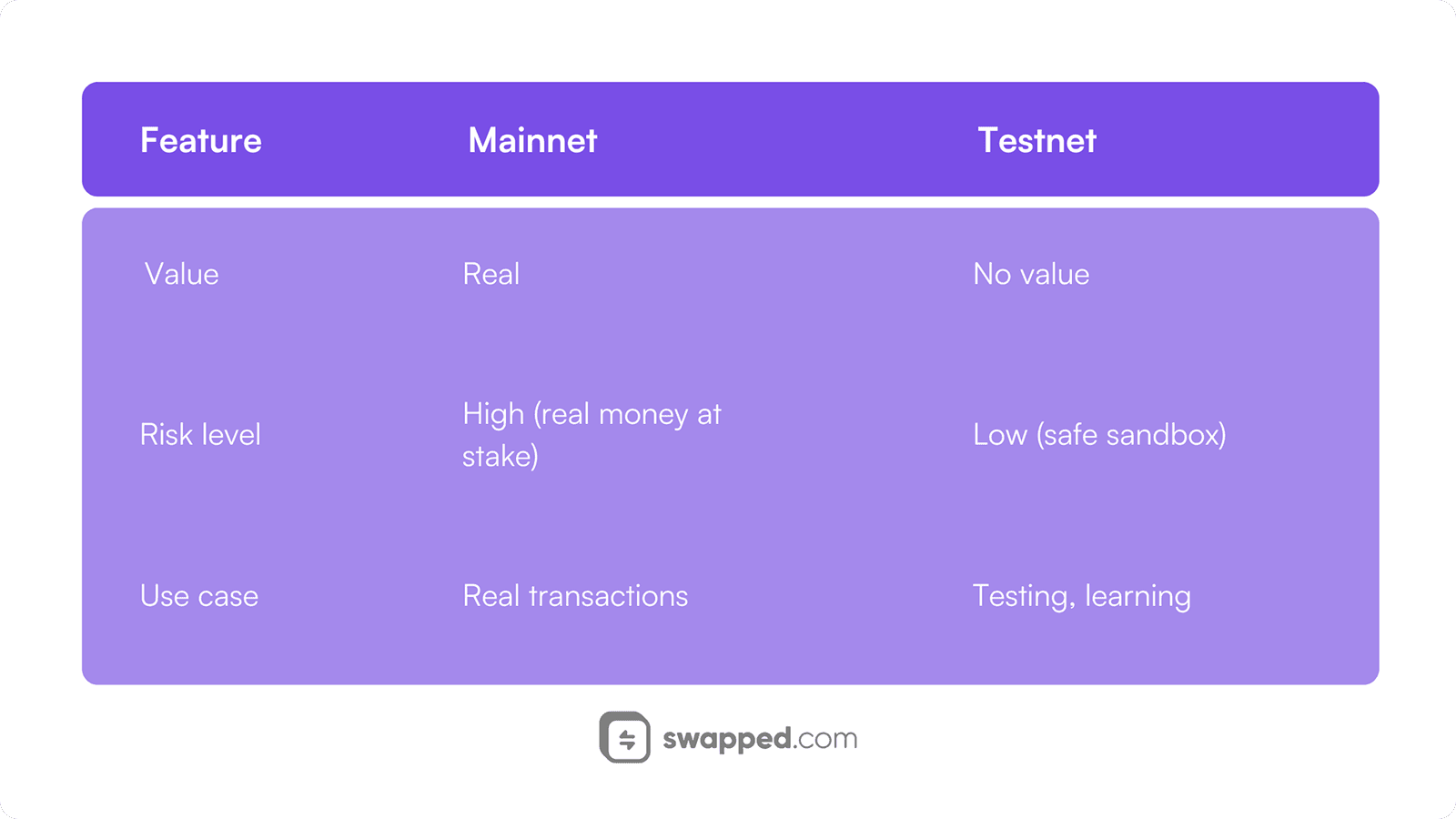
A test result belongs to its environment and configuration; production remains a separate verification step.
What Testnets Are Useful For
Useful tests answer a defined question. They can check a learning exercise, contract behavior, application integration or network upgrade, but the required observations differ for each task.
Learning Transaction States
Practice preparing a transaction, reviewing its details and checking the result through a matching explorer. Include an expected rejection so the difference between submission, failure and success becomes visible.
Testing Contract Behavior
A deployed test contract can expose integration issues that unit tests miss. Test permissions, input boundaries and expected failures as well as the normal path. Testnet execution supplements other review methods; it does not certify the contract as secure.
Testing Applications
An application test should follow the user-visible outcome across wallet, network and backend records. A button animation or successful API response is not enough if the expected balance or record was never produced.
Testing Network Changes
Protocol and client teams can use test networks to rehearse upgrades and observe compatibility. Results depend on the participating software versions and scenarios. A successful rehearsal provides evidence for that setup rather than a universal guarantee.
Obtaining Test Assets
Faucets distribute test assets under their own limits and access requirements. Start from references in the network’s official documentation and check that the faucet supports the exact network you selected.
A faucet normally uses a public receiving address. It should not need a recovery phrase or private key. Inspect any requested signature or permission rather than assuming that a testnet label makes it safe.
After requesting funds, check the transaction on the matching explorer and compare it with the wallet state. If no transaction exists, investigate the request status before repeating it. Faucet limits and outages can affect delivery.
Moving from testing to production is a separate decision. It requires verification of the production deployment, asset identifiers, fees and service availability. Testnet participation does not imply a DTCC Trading purchase route or an entitlement to a reward.
Test assets can become scarce, and access policies can change. Do not treat an unsolicited demand for payment as an official faucet requirement. Verify the current documented options for obtaining the assets needed by your test.
Building a Useful Test Record
Write down the question being tested, the network, software versions and expected outcome. Record both successful and failed operations. This makes the result useful to someone who did not watch the test happen.
Where the workflow uses several systems, identify the evidence from each: request creation, transaction submission, network result and application state. That prevents a partial success from being mistaken for a completed workflow.
A strong testnet practice combines isolation with precise observation. Keep production keys separate, use current network documentation and describe the limits of the result. Those habits transfer to many kinds of digital-asset development.
Related Reading
Use the linked introductions for context and current official network documentation for operational setup. Check dates and deprecation notices before following a tutorial.