Understanding Blockchain Forks
Learn how soft forks, hard forks and temporary chain branches differ, why upgrades happen and what a split means for asset holders.
DTCC Trading Editorial

Cryptocurrencies depend on shared rules, and those rules can change. A fork can describe a change in compatibility or a divergence in chain history. Understanding which meaning applies is the first step toward interpreting an upgrade announcement.
Some forks are coordinated software upgrades. Others leave communities operating different networks. A fork does not automatically create a second valuable asset, improve security or require immediate action by every user.
What a Fork Describes
A chain can briefly have competing blocks before its consensus rules determine the accepted history. That temporary branching is different from a deliberate rule change. The same word appears in both contexts, so the surrounding details matter.
Blockchains rely on participants applying compatible validation rules. A software upgrade can change the set of transactions or blocks those participants accept. Whether older software agrees with the changed rules determines how an upgrade is classified.
Two Types of Rule Changes
Soft fork and hard fork describe rule compatibility. They do not measure whether an upgrade is small, popular or beneficial. A technically complex change can be a soft fork, while a narrow rule adjustment can require a hard fork.
Soft Forks
A soft fork restricts the set of valid activity so that blocks following the new rules also satisfy the older rules. Older nodes can accept the resulting chain while lacking the ability to enforce the added restrictions themselves.
For example, imagine rules that permit a particular range of values. A new rule allowing only a subset can remain compatible with older validation. The reverse change, admitting activity the old rule rejects, has a different compatibility consequence.
Successful activation still requires the network’s relevant coordination and enforcement mechanisms. Calling an upgrade a soft fork does not mean every node enforces the new rule or that every activation method is free of disruption.
Hard Forks
A hard fork permits a rule change that is incompatible with earlier validation. Software following the previous rules can reject blocks that the upgraded network considers valid. Participants that intend to follow the upgraded network need compatible software.
A lasting chain split occurs only if participants continue supporting incompatible histories. Many coordinated hard forks proceed without a durable competing network. A permanent split and a new traded coin are possible outcomes, not defining requirements.
Hard forks can introduce new capabilities or alter existing rules. They also require careful coordination among node operators, infrastructure providers and applications so each party understands the intended network and activation point.
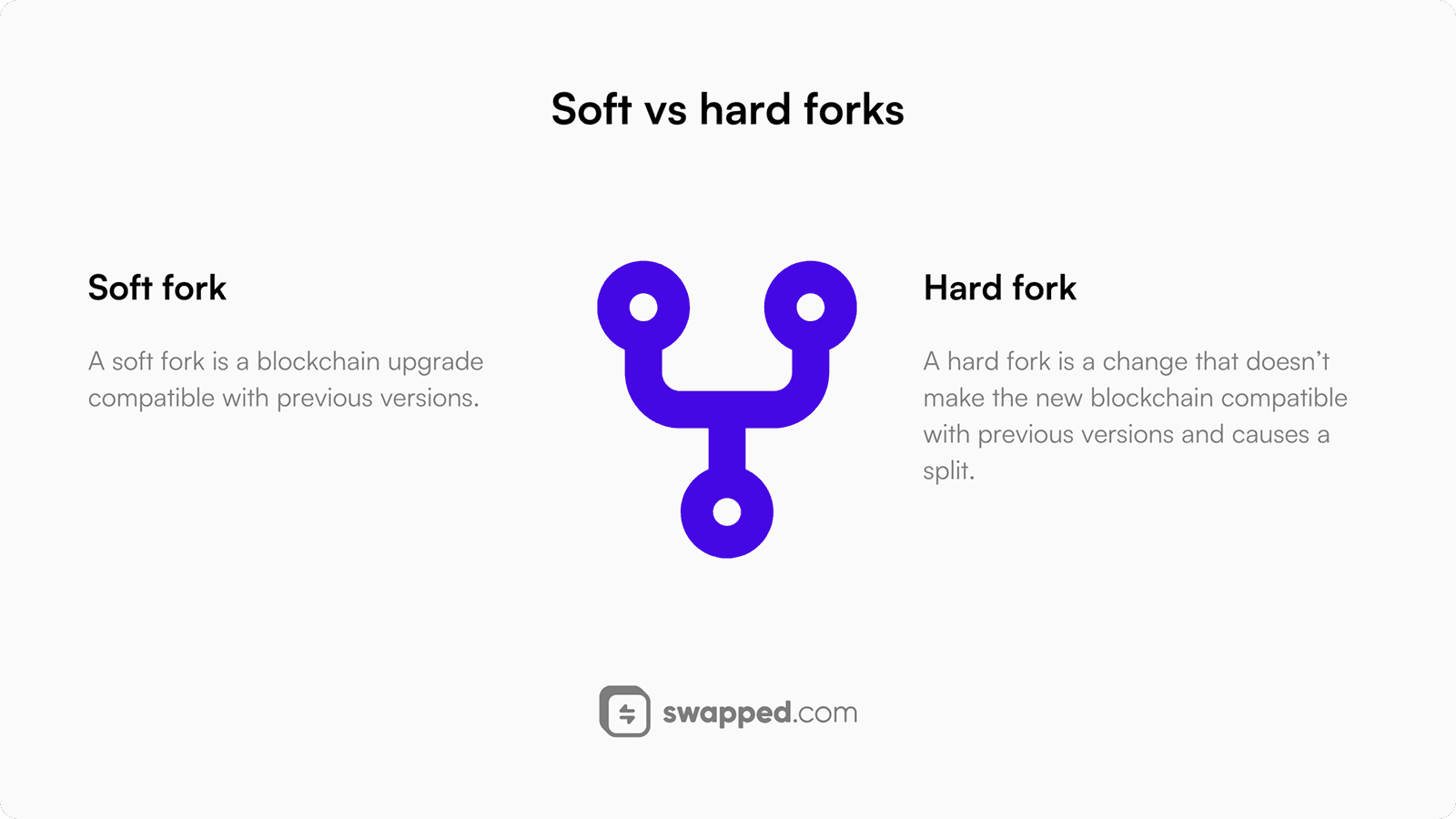
Compatibility explains the distinction between soft and hard forks.
Why Networks Change Rules
An upgrade can respond to a discovered problem, implement planned improvements or reflect a disagreement about the network’s purpose. The proposal and activation process reveal more than the word fork alone.
Security and Execution Changes
Upgrades can fix defects or change transaction processing. Ethereum’s London upgrade included a redesign of its fee market. Such changes should be evaluated through their specific rules; a new fee mechanism does not promise that congestion or high fees will disappear.
Capacity and Resource Choices
A community can disagree about how much data the network should process and what resources participants should need. Bitcoin Cash followed a separate path from Bitcoin in 2017, with block capacity among the central points of disagreement.
Different Governance Decisions
Disagreement can also concern how a network should respond to an exceptional event. A technical change may carry a social decision about intervention, continuity or acceptable tradeoffs. The software expresses that choice, but software alone does not settle the disagreement.
What a Fork Means for Holders
The practical effect depends on the chain’s rules, the custody arrangement and the support provided by applications. Read the actual announcement before assuming that a wallet balance or exchange position will behave in a particular way.
Balances on Diverging Histories
When two networks share an earlier history, balances can appear on both under their respective rules. That does not guarantee usable access, a liquid market, equal value or custodian distribution. A claim that every hard fork gives holders free money is misleading.
Prices and Liquidity
Uncertainty around a fork can affect markets, deposits and withdrawals. A displayed price for a new asset may come from a limited venue or shallow order book. It should not be treated as proof that a particular balance can be sold at that price.
Service Support
Exchanges and wallets decide which networks and assets they support. A provider can pause transactions around an upgrade or require an updated application. Confirm the network identifier and support policy before using a deposit address or signing a transaction.
Replay and Recovery Risks
On some splits, a transaction valid on one network can also be valid on the other unless appropriate replay protection or separation exists. Claiming a forked asset can also expose users to malicious software. Never enter a recovery phrase into an unverified claim website.
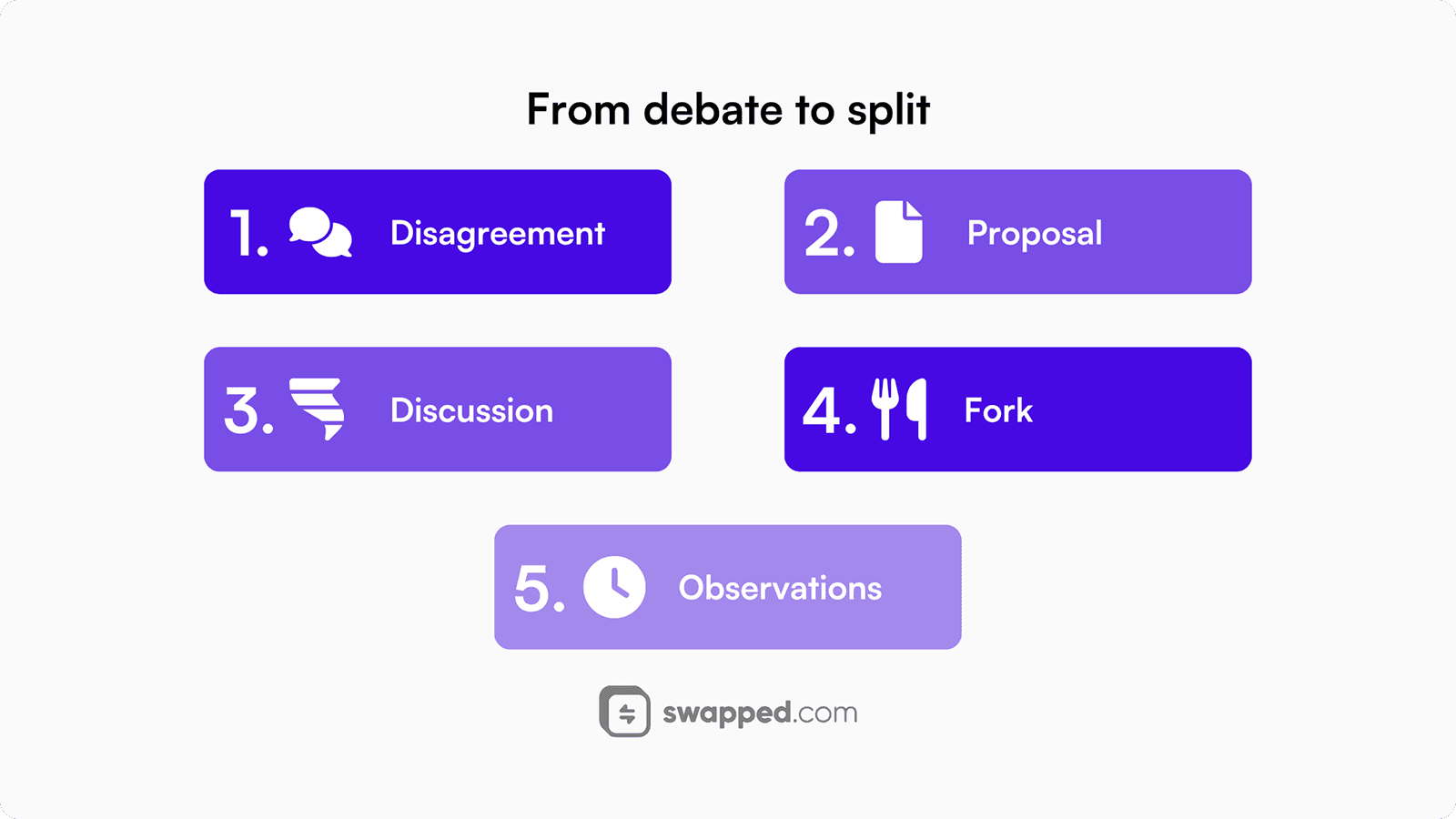
An activation date is one part of a broader coordination process.
Two Historical Examples
Bitcoin Cash and the Ethereum–Ethereum Classic split illustrate different reasons for divergence. Each involved technical rules and decisions by participants about which history to follow.
The Bitcoin Cash Split
Bitcoin Cash separated from Bitcoin in August 2017 amid disagreement over scaling choices. The networks subsequently developed their own rules and ecosystems. Shared earlier history does not make their later transactions, addresses or service support interchangeable.
The DAO Fork and Ethereum Classic
In July 2016, Ethereum implemented a hard fork following the DAO exploit. The change moved funds associated with the affected contracts into a withdrawal mechanism. Participants continuing the unmodified history formed the network known as Ethereum Classic. This was a specific state change, not the deletion of every earlier transaction.
Evaluating a Proposed Fork
A useful assessment starts with the proposal’s purpose, exact rule changes, activation method and expected effect on applications. Labels such as good or bad obscure those details.
Potential Improvements
Rule changes can repair a vulnerability, add functionality or adjust resource use. Evaluate those benefits against a clearly described starting point and test evidence. The fact that an upgrade exists does not establish that every application will benefit equally.
Coordination Costs
Operators may need software updates, testing and temporary service restrictions. Applications can depend on behavior the upgrade changes. A contentious split adds questions about naming, infrastructure, replay protection and asset support that a coordinated upgrade may not face.
Reading Fork Announcements Clearly
Identify whether an announcement concerns temporary branching, a compatible restriction or an incompatible rule change. Then check the activation point, required software and the policy of any custodian involved. Those details explain the practical consequences more reliably than speculation about new coins.
Related Reading
Use the linked introductions for terminology, then consult the network’s proposal and release documentation for the upgrade being evaluated.