Crypto Airdrops: Eligibility, Claims and Tradeoffs
Understand token distributions, snapshots and claim conditions, and learn to distinguish an announced allocation from a verified and usable asset.
DTCC Trading Editorial

An airdrop is a distribution of tokens under a project’s chosen rules. It can recognize past activity, broaden participation or support governance. The word free describes neither the full cost of participation nor the future value of the token.
Offers of free cryptocurrency deserve the same source and transaction checks as any other wallet interaction. A token can arrive without a purchase, while claiming it can still involve fees, eligibility conditions or permissions that require careful review.
What an Airdrop Distributes
A blockchain project can allocate tokens to selected accounts and deliver them directly or through a claim process. The distribution rules determine who qualifies, how much is available and whether additional steps are required.
An allocation is not a guaranteed cash value. Market prices, available liquidity, transfer restrictions and claim costs affect what a recipient can actually do with a token. A headline valuation often omits those conditions.
Some distributions send tokens to wallets automatically; others require a claim transaction. An unexpected balance does not prove that the issuer is legitimate. Avoid following unsolicited token metadata to a site that requests access to other assets.
Why Projects Use Airdrops
A distribution can serve several objectives, and its design should be evaluated against the stated purpose. Giving tokens to many addresses does not by itself prove that control is broadly distributed among independent people.
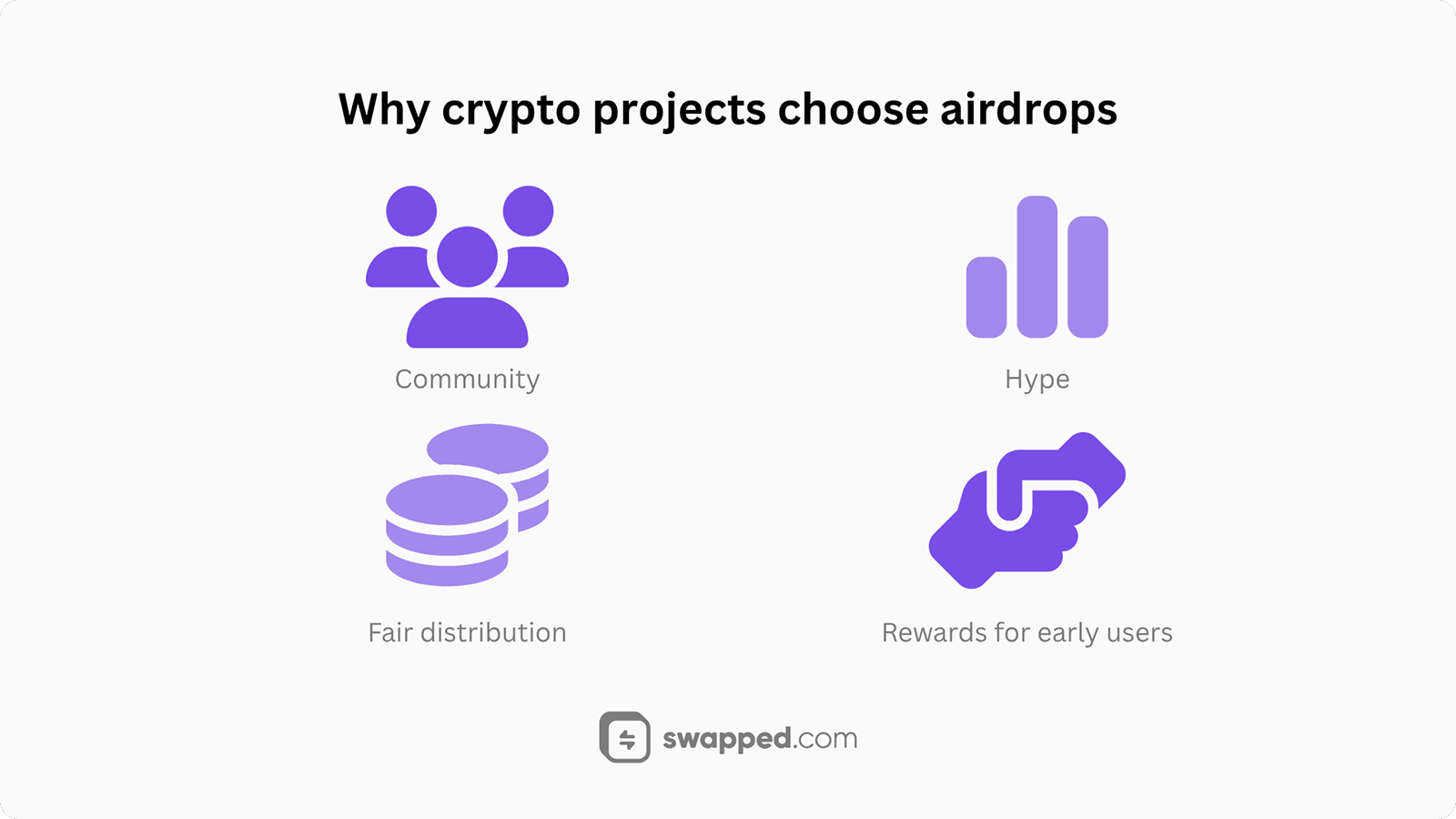
Airdrops can support participation, but their rules determine who actually receives tokens.
Encouraging Participation
A project may distribute tokens to invite participation in a network or governance process. The practical question is what recipients can do afterward. Token ownership and meaningful influence are not always the same thing.
Attracting Attention
A distribution can draw attention to a project, including attention from people seeking a short-term reward. Promotional reach should therefore be distinguished from retained users, useful activity or a durable community.
Distribution and Concentration
A cryptocurrency distribution can reach a large address set while remaining concentrated among related accounts or large holders. Review allocation limits, exclusions and the treatment of multiple accounts before calling a distribution fair or decentralized.
Recognizing Earlier Activity
Some airdrops use past activity to identify recipients. That does not create a standing promise that every early user of another project will receive a reward. Participation undertaken solely on that expectation can produce costs without an allocation.
What a Snapshot Measures
A snapshot records eligibility-relevant state at a specified time or ledger position. It might measure balances, account activity or another defined condition. The exact network, block and rule matter more than the general word snapshot.
A project can use that historical state to calculate an allocation later. Moving assets after the snapshot may not change the result, but the published rules determine that outcome. Do not infer eligibility from a current wallet balance alone.
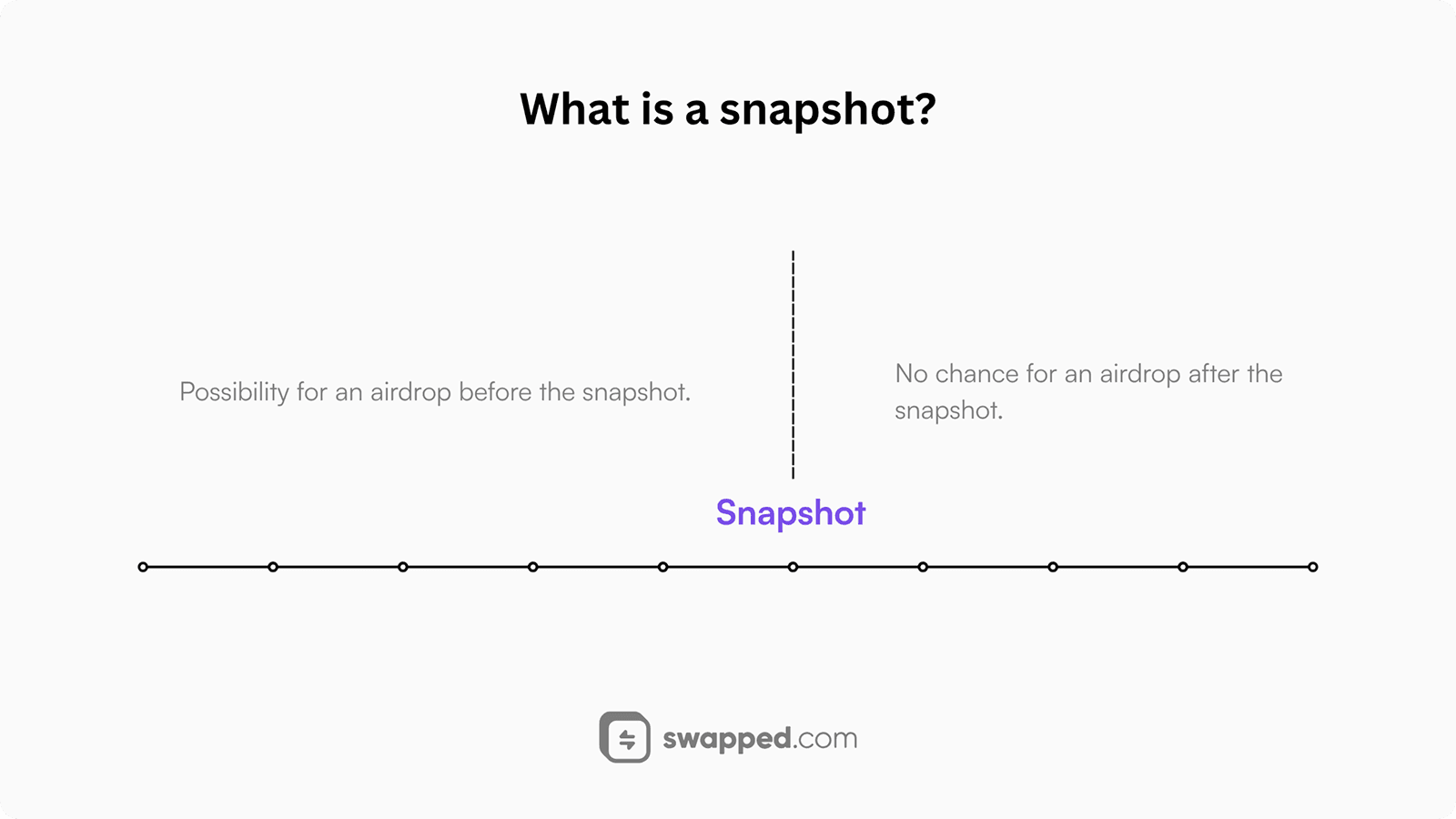
A snapshot fixes a reference point; the project’s rules define how it affects eligibility.
Timing and Eligibility
A snapshot can precede or follow an announcement. Some programs use several qualifying dates or activity windows. Read the official specification rather than assuming all airdrops use a secret cutoff before launch.
Multiple Reference Points
A design can combine repeated observations, duration or activity thresholds. Those choices can reward different patterns than a single balance check. The calculation should be explainable from the project’s published criteria.
Maintaining a balance or creating transactions solely for an unannounced reward is speculative. It can incur fees and exposure without qualifying for anything. A historical reward program is not evidence that the same behavior will be rewarded again.
Common Distribution Designs
Different designs use different eligibility evidence. Understanding the category helps you find the relevant rules, but it does not replace reading the actual announcement and claim documentation.
Holder-Based Distributions
A distribution can reference holdings of an asset such as Bitcoin or another token at a chosen time. Custodial balances may be handled differently from directly controlled addresses. The service’s policy can determine whether a customer receives anything.
Activity-Based Distributions
A project can allocate tokens according to previous application usage. The rules may exclude particular regions or activity patterns and can require additional claim steps. A visible transaction history alone does not establish eligibility.
Contributor Distributions
Developers, community contributors or other defined groups can receive allocations under specific criteria. Such programs may use off-chain records as well as network activity. The reviewer and evidence standard should be identified.
Assets Following a Chain Split
A chain split can leave related balances on more than one network. That is technically different from a normal promotional airdrop. Accessing a resulting asset can introduce replay, software and key-exposure concerns that require network-specific guidance.
Common Claiming Mistakes
A reward message can pressure people to act before they understand the requested operation. Slow down enough to verify the source, identify the exact asset and inspect what the wallet is being asked to authorize.
Keep Recovery Material Private
A claim process should not require your recovery phrase or private key. Those secrets give access rather than proving eligibility safely. Support agents and claim websites should use public references or properly scoped signatures instead.
Understand Every Charge
A legitimate on-chain claim can require a network fee, but that does not validate an arbitrary payment demand. Distinguish the wallet’s network charge from a request to send funds to unlock a reward. Verify the official procedure before authorizing either.
Verify the Announcement Path
Reach the project through a trusted bookmark or independently verified documentation. Social replies, search advertisements and direct messages can impersonate an announcement. A copied logo or familiar display name does not authenticate a claim site.
Separate Experimental Activity
A separate wallet can limit the assets exposed during experimentation, but it does not make a malicious request safe. Inspect permissions and use separate recovery material. Do not move valuable assets into a wallet merely because a claim site demands it.
Read the Token and Claim Rules
Check the asset identifier, supported network, eligibility calculation, deadline and transfer conditions. Also identify who controls relevant contracts. A token with no practical use or liquidity can still create a convincing-looking balance.
Five Ways to Read Airdrop Examples
Historical examples are useful for understanding design choices. They should not be ranked solely by a peak market valuation or presented as a reliable guide to future rewards.
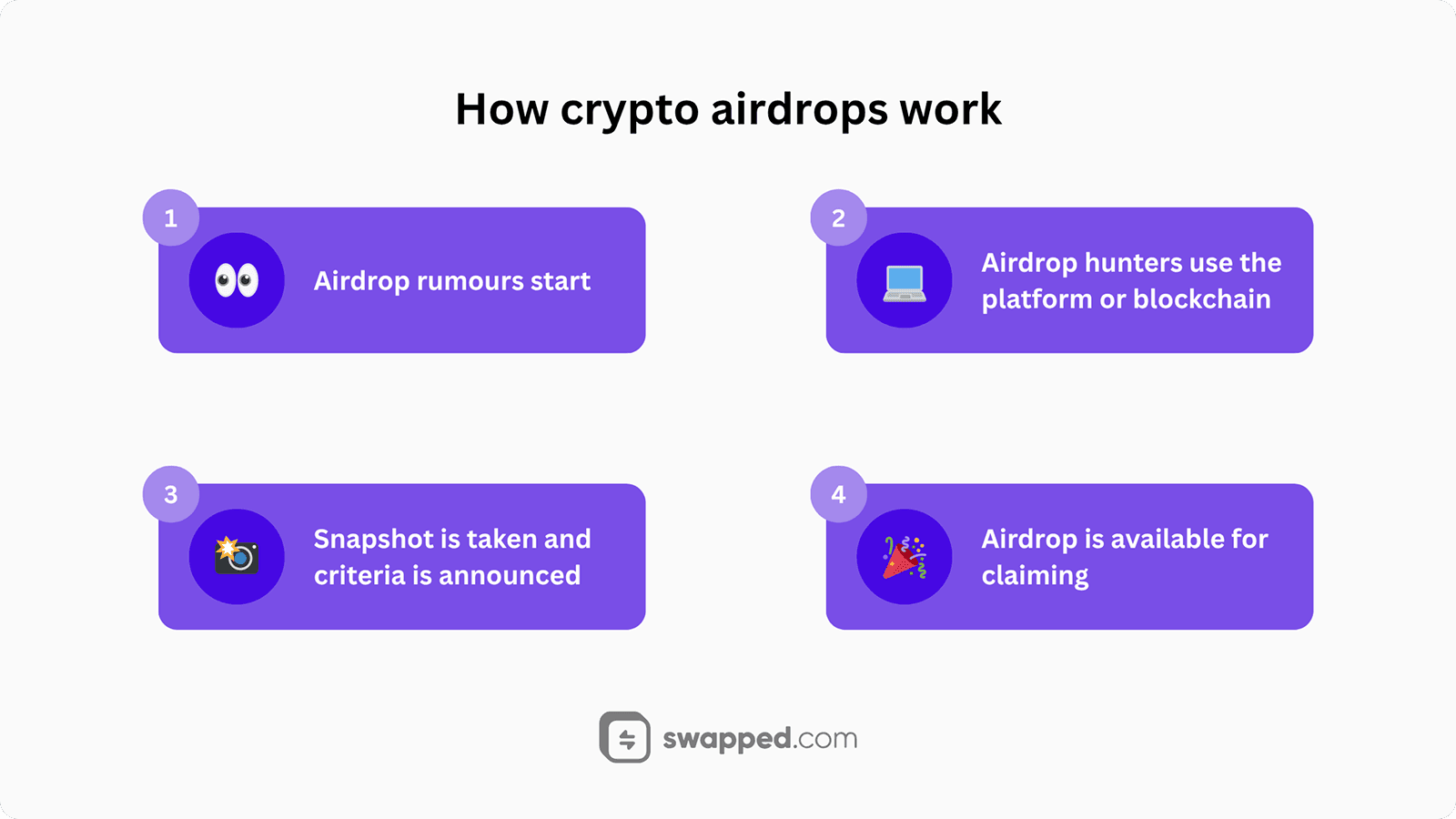
Announcements, eligibility checks and claim windows are separate stages of a distribution.
Allocation Design
In DeFi, a distribution may allocate governance or utility tokens to users, contributors and a treasury under different schedules. Compare the rules for each group. A large headline allocation can include tokens unavailable for immediate transfer.
Uniswap’s UNI Distribution
Uniswap’s September 2020 UNI announcement included a distribution to historical users and other eligible participants. Its published allocation illustrates how a project can recognize past usage. It does not establish that using another protocol creates a similar entitlement.
dYdX Retroactive Rewards
The dYdX Foundation’s 2021 retroactive program combined historical eligibility with additional conditions and jurisdiction limits. This is a useful example of why an initial allocation and an immediately claimable balance can differ.
ENS Governance Participation
ENS distinguishes its governance token from the names managed by the naming system. Its historical distribution and governance documentation show why the function of the received token must be understood separately from the application activity used for eligibility.
Arbitrum’s Eligibility Specification
Arbitrum published detailed activity criteria, a snapshot reference and a finite claim period for its 2023 distribution. The historical program is closed. Its documentation demonstrates why old announcements should not be treated as current opportunities to claim.
Decisions After Receiving Tokens
Claiming, holding, using and selling are different decisions. The appropriate assessment depends on the token’s rights, transferability, costs and the recipient’s circumstances. Receiving something without a purchase does not make every later action costless.
Assessing a Sale
Before considering a sale, identify a legitimate market, available liquidity and the complete costs. A quoted price for a small amount may not apply to the whole balance. The tax treatment of receipt and disposal requires current jurisdiction-specific guidance.
Assessing Continued Holding
Holding retains exposure to the token and its associated project or mechanism. Examine current rights, supply changes and access conditions rather than relying on the fact that the token was a reward. The acquisition story does not determine future value.
Evaluating the Overall Effort
Include time, transaction costs and operational exposure when assessing an airdrop program. A sequence of paid interactions undertaken for an uncertain reward is not equivalent to receiving a guaranteed benefit.
Airdrop research can teach useful lessons about token distribution and governance. DTCC Trading’s educational coverage does not announce an airdrop, guarantee an allocation or ask readers to connect a wallet to obtain a reward.
Related Reading
Use the linked material to compare definitions and claim risks. Verify current availability through the project’s own documentation before treating any historical example as actionable.