How to Read a Crypto Whitepaper
Use a whitepaper to examine a project’s problem, architecture, token rules and assumptions, then compare its claims with implemented code and current evidence.
DTCC Trading Editorial

A whitepaper explains a proposal. In crypto, it commonly describes a network, application or token system and the reasoning behind its design. Reading it well means identifying the claims that can be checked, not simply deciding whether the vision sounds compelling.
There is no universal format or quality threshold attached to the word whitepaper. A document can be a rigorous technical argument, a product overview or a marketing brochure. Its title does not establish that the system exists or that its claims are correct.
A Widely Read Example
The Bitcoin paper appeared in 2008 and described an electronic cash design based on cryptographic verification and proof of work. Its significance comes from the proposal and the system that followed, not from a formal certification attached to the document.
The paper introduced Bitcoin as a peer-to-peer electronic cash system. It is a useful example of a document organized around a concrete technical problem and a proposed mechanism for addressing it.
Reading the Bitcoin Paper
The paper discusses digital signatures, transaction ordering, proof of work and incentives. It is a starting point for understanding the original design. Modern implementation details and later protocol changes require additional documentation.
Proposals and Implementation
Later blockchain projects published their own descriptions of different approaches. Networks such as Ethereum and Solana have distinct architectures and ongoing documentation. Their whitepapers should be read as specific proposals rather than interchangeable declarations of progress.
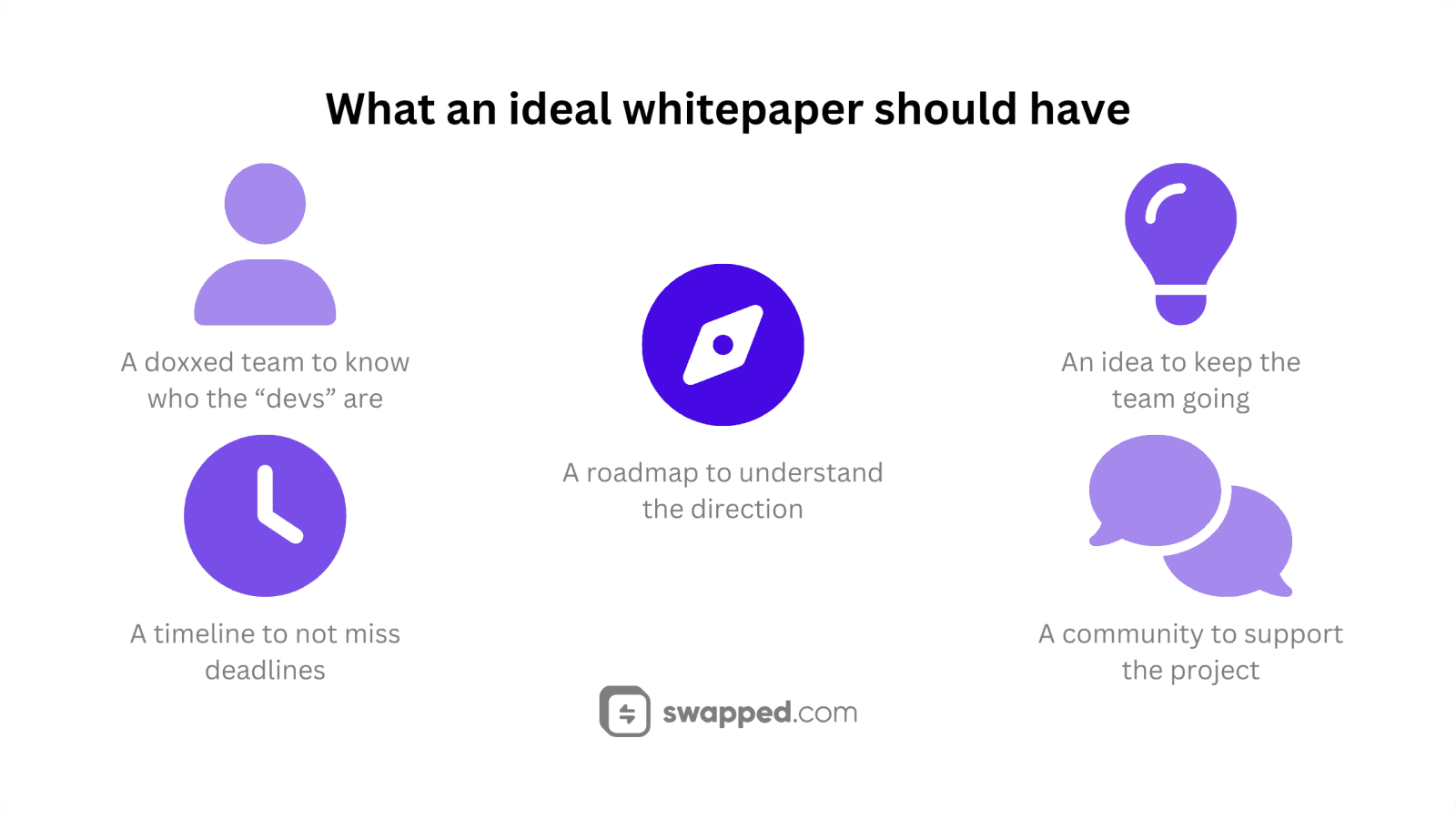
A useful document makes its assumptions and claims possible to examine.
What to Look For
Across cryptocurrencies, the most useful whitepapers explain the problem, proposed mechanism and limits. They distinguish implemented features from planned ones and provide enough detail for a reader to identify what evidence would support or contradict the proposal.
Different readers ask different questions. A developer needs interfaces and assumptions; a prospective user needs to understand rights and dependencies. A token buyer also needs to understand supply and incentives. One document may not answer all of those questions.
Evidence and Accountability
Look for named maintainers or a clear governance process, version history and references to implementation material. Identity alone does not establish competence or honesty, but a clear process makes it easier to understand who is responsible for decisions and corrections.
Technical Architecture
The architecture should explain how state changes, who validates them and what assumptions the system requires. Performance figures should identify the workload and test conditions. A diagram with many components is not a substitute for explaining how they interact.
Participation and Governance
A community section should describe actual powers and responsibilities. Who can propose changes, approve upgrades or control treasury assets? Large audience numbers do not answer whether decision-making is accountable or whether minority participants have a practical exit.
Roadmap and Status
A roadmap is a plan, not evidence of completion. Compare milestones with releases, deployed contracts and available product behavior. The document should make it possible to tell which features are live, being tested or still under discussion.
The Problem Statement
A clear problem statement identifies who experiences the problem and what existing approaches fail to provide. It also explains why the proposed use of a blockchain or token is relevant. A broad claim about transforming an industry can conceal an undefined user need.
The Proposed Mechanism
Follow one operation through the design: its inputs, authorization, state change and result. Then consider failure. What happens if a participant disappears, supplies bad data or refuses to cooperate? These questions reveal assumptions that promotional summaries often omit.
Token Supply and Incentives
Tokenomics includes issuance, distribution, vesting, use and incentives. Check who can mint or burn, how circulating supply is measured and what rights a token confers. A pie chart showing allocations does not explain future dilution or the economic reason someone would need the token.
Use Cases and Rights
A use case should identify an actual operation and its dependencies. If a token refers to an external asset, establish the issuer’s obligations and the connection between the on-chain record and that asset. Technology cannot create an enforceable external claim merely by naming it.

The original Bitcoin paper is available at: https://bitcoin.org/bitcoin.pdf
Claims That Need Closer Examination
A careful reading distinguishes missing detail from proven misconduct. Record what is unknown and seek the relevant evidence. It is reasonable to leave a claim unresolved when the document does not support a conclusion.
Watch for technical terms used without definitions, performance figures without methods and security claims without a threat model. A claim of an audit should identify the report, reviewed version and unresolved findings. Repetition of an assurance does not strengthen its evidence.
Guaranteed returns, risk-free participation and universal interoperability deserve particular scrutiny. Ask which mechanism could support the claim and under what conditions it fails. If the answer depends on future growth, the document should say so plainly.
An identified team can still make mistakes or misrepresent a project. An anonymous team can still publish inspectable code. Evaluate accountability, permissions and evidence together rather than treating either identity status as a complete verdict.
Documents Change Over Time
Projects can replace a single PDF with versioned specifications, repositories and live documentation. Record the version and review date. A historical whitepaper may accurately describe an earlier design while no longer matching the deployed system.
Turn Reading Into Verification
Extract the important claims into a short checklist: what exists, how it works, who controls it and which assumptions remain. Link each claim to implementation or operational evidence where available. This makes the document useful beyond its narrative.
A whitepaper can be an excellent starting point, but it is one part of a wider assessment. Compare it with code, contracts, governance records and observed behavior before relying on the proposal for a practical decision.
Related Reading
The linked guides offer additional reading approaches. Prioritize the project’s versioned source material when checking a specific design claim.