Stablecoins: Pegs, Reserves and Redemption
Understand how stablecoins target a reference value, how reserve and collateral models differ, and why market price, redemption and token identity need separate checks.
DTCC Trading Editorial

An asset such as Bitcoin can change substantially in market value between receiving it and spending it. Stablecoins address a different objective: tracking a reference value, commonly one unit of a fiat currency. A target value is an objective of the design, not an unconditional guarantee.
Stablecoins can make amounts in crypto applications easier to express in familiar units. Their usefulness depends on the issuer or protocol, the reserve or collateral arrangement and the ability to exchange or redeem the token. Those dependencies deserve the same attention as its quoted price.
A clear stablecoin assessment separates three things: the value it targets, the mechanisms intended to support that target and the rights a particular holder can exercise. The word stable does not answer all three.
Why a Reference Value Helps
Assets such as bitcoin and Ethereum’s ether can have volatile prices in local currencies. A business quoting an invoice in one currency may want a digital payment unit that tracks that same currency more closely. That is a different purpose from seeking price appreciation.
Imagine an invoice for one hundred currency units. If payment arrives in a floating-price asset, its converted value can change before the recipient uses it. A currency-linked token aims to reduce that particular mismatch, subject to the peg holding.
The recipient still needs a usable route to spend, exchange or redeem the token. A balance tracking dollars does not automatically become dollars in a bank account. Fees, eligibility and processing time affect the final result.
Stablecoins therefore shift some risks rather than remove all risk. They can reduce exposure to one market price while introducing issuer, reserve, redemption, contract or collateral dependencies.
What a Peg Means
A peg is a targeted relationship between a token and a reference asset or unit. The market price can trade above or below that target. Different designs rely on redemption, collateral, incentives or combinations of mechanisms to encourage alignment.
A token targeting one US dollar can still trade below or above one dollar on an exchange. Direct redemption terms can differ from secondary-market trading. A holder’s ability to access redemption is central to understanding the practical strength of the peg.
Programmable transfers on a blockchain can make a reference-linked asset useful in applications. The network processes the token’s rules; it does not independently guarantee that an external reserve exists or that every holder has an immediate redemption right.
Different Stabilization Models
Common categories include reserve-backed, crypto-collateralized and algorithmic designs. Real systems can combine mechanisms. Commodity-linked tokens deserve separate attention because a stable quantity of gold, for example, is not a stable dollar value.
Reserve-Backed Tokens
An issuer can hold reserve assets intended to support outstanding tokens. Those reserves may include cash and other eligible assets, depending on the arrangement. Fully backed does not necessarily mean every token corresponds to a banknote held in one account.
Redemption connects the token to its reference asset under defined terms. Check who is eligible, the minimum amount, fees, timing and circumstances in which processing can be restricted. A retail holder trading through an exchange may not have the same access as an issuer’s direct customer.
USDT and USDC are examples of issuer-backed tokens. Their reserve composition, reporting and terms differ. An independent reserve attestation has a defined scope and date; it should not be described as a guarantee of all future redemptions or a complete audit of every operational risk.
Collateral and Commodity References
Crypto-collateralized systems use pledged assets and programmed rules to support issuance. They can require excess collateral and liquidate positions when conditions deteriorate. The reliability of collateral prices and liquidation markets matters to the design.
A commodity-linked token can represent a claim connected to a quantity of gold or another asset. Verify custody, the holder’s rights and redemption conditions. The commodity’s price can change, so a fixed quantity reference does not create fixed purchasing power in a currency.
Both categories require more detail than a backing label. Ask what is held, where it is held, who can access it and which event would prevent a holder from realizing the stated claim.
Algorithmic Mechanisms
Algorithmic designs use programmed incentives or supply adjustments to influence price. Some have collateral and others rely heavily on another token or market demand. The category should not be reduced to one identical mechanism.
A system might encourage issuance above its target or redemption below it. That process depends on participants finding the trade worthwhile and being able to execute it. Rules on paper cannot manufacture outside demand or liquid collateral during stress.
Feedback between a stablecoin and its supporting token can become destabilizing if confidence falls. Evaluate stressed conditions and the source of redemption value. A clever adjustment formula is not evidence that the peg will survive every market environment.
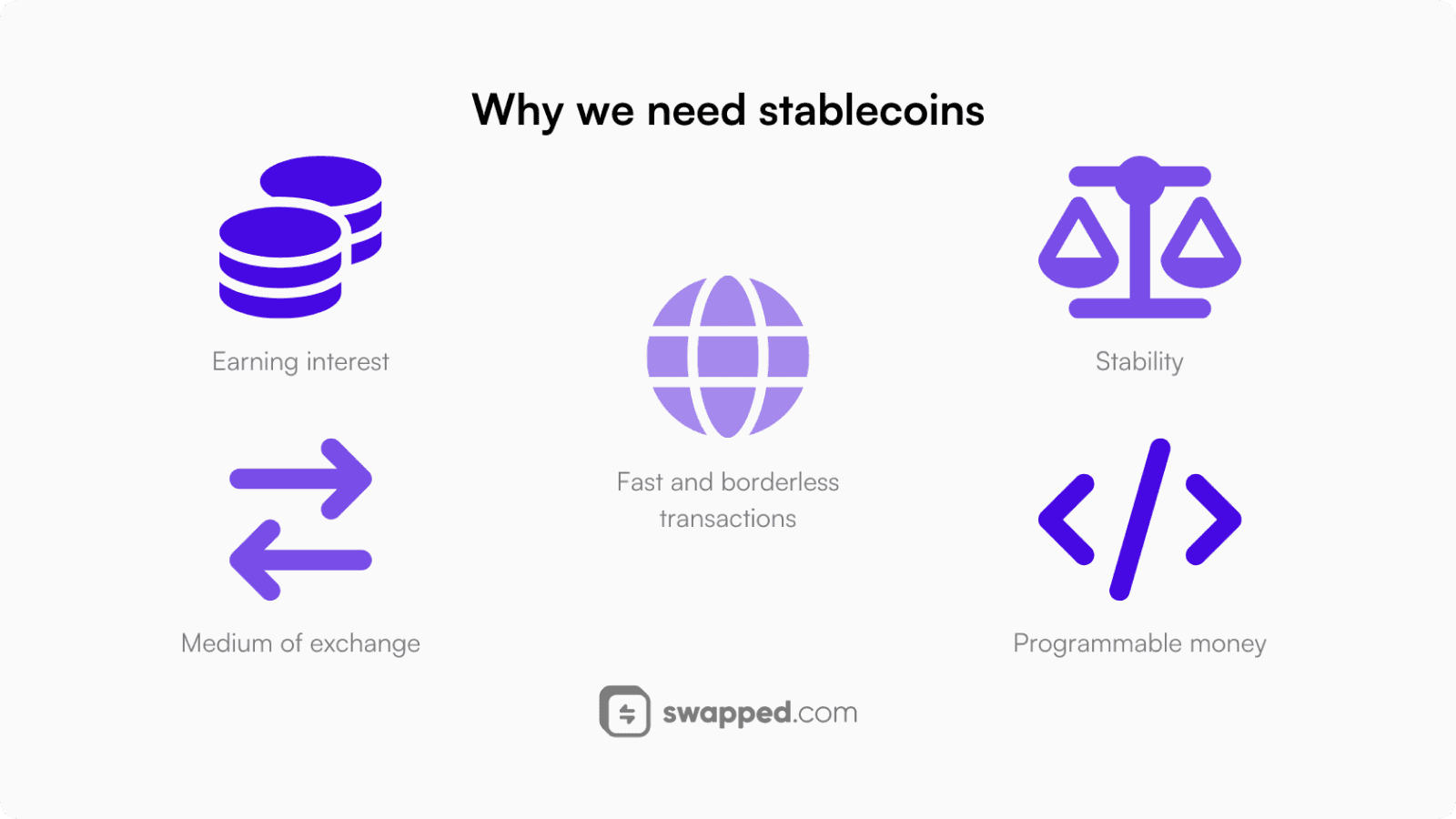
Stablecoin designs aim to support a reference value through specific mechanisms.
Common Uses
Stablecoins can act as quoted units, settlement assets or collateral in digital systems. Their suitability depends on the route and the holder’s ability to use the resulting balance.
Invoices and Application Balances
An application can express prices in a familiar reference unit while settling through a token network. The interface should still identify the token issuer, contract or asset code and network. A shared dollar symbol does not make different tokens interchangeable.
Cross-Border Transfers
A network transfer can be one stage in an international payment. The complete route may also involve purchasing the token, service checks, conversion and a local payout. Measure the total cost and time across those stages.
A token reaching a destination account does not automatically mean the recipient has spendable local currency. Confirm the receiving service’s support, any memo or tag and the payout requirements. That makes the payment result concrete.
Financial Protocols
An application in DeFi can use a stablecoin for trading, lending or collateral. Depositing it into a protocol creates a new position with its own contract, liquidity and counterparty dependencies. A quoted yield is not equivalent to a protected savings-account return.
Collateral can lose value relative to its target, and a lending position can still be liquidated. Stablecoin use does not remove every volatility or market risk. Review the protocol’s pricing and liquidation assumptions.
Changing Market Exposure
Exchanging a floating-price asset for a stablecoin changes the exposure being held. It can reduce one price risk while adding another set of dependencies. The destination token should be evaluated on its own terms rather than treated as a universal safe harbor.
Examples and Their Differences
These examples identify distinct arrangements. They are not a ranking of safety, availability or suitability, and their current terms should be checked directly.
USDT is issued by Tether under its token and redemption terms. Review the current reserve disclosures, the exact supported network and the distinction between an issuer-backed token and a bridged representation. A familiar ticker is not sufficient identification.
USDC is issued by Circle and related issuing entities under the relevant arrangements. Circle publishes reserve information and independent assurance reports. Read the scope and date of those reports alongside redemption eligibility and token-control terms.
DAI and USDS are associated with the Maker and Sky ecosystem. Understanding their relationship requires current protocol documentation, collateral information and governance rules. They should not be described simply as unbacked algorithms or assumed to have identical features.
What Can Undermine the Target
A deviation from the target can reflect market stress, impaired redemption, uncertainty about backing or technical failures. Different causes call for different evidence, so a price chart alone cannot diagnose the problem.
Access and Regulatory Arrangements
Stablecoin issuers and service providers operate under particular legal and commercial arrangements. Those arrangements can affect eligibility, distribution and redemption. A token’s category does not establish the rights of every holder in every location.
Use the current terms applicable to the actual service and issuing entity. Avoid treating a general statement that a token is regulated as proof that every activity involving it has the same protections or availability.
Reserve Evidence
Check the reserve asset types, liabilities covered, reporting date and independent assurance scope. A report about a past snapshot does not show every intraday movement or guarantee future liquidity. The quality of disclosure matters as much as its existence.
Distinguish attestations, audits and on-chain balances. Each can answer different questions. A visible token supply does not prove the value of off-chain reserves, and a reserve total does not alone establish every holder’s legal claim.
Technical and Operational Dependencies
Contracts, signing keys, bridges, price feeds and liquidation mechanisms can fail or be misused. Some issuers can freeze specified balances under their token rules. Read those controls before assuming that self-custody removes all issuer authority.
A bridged stablecoin can add dependence on a bridge or custodian beyond the original issuer. Verify whether the destination asset is native issuance or a representation. Similar symbols and logos can conceal materially different redemption paths.
Checking a Stablecoin Route
Before choosing to obtain a stablecoin, identify the issuer or protocol, exact asset identifier and receiving network. Then compare the route to the final balance or payout you actually need.
The Complete Quote
Review the amount paid, token amount expected, service fees, spread and network charges. Confirm the quote expiry and any account-specific limits. A one-to-one target price does not mean buying or redeeming the token has no cost.
After purchase or transfer, distinguish the payment result, network transaction and receiving account credit. Keep the public transaction reference. An uncertain outcome should be investigated before sending again.

A stable-value objective still relies on backing, access and implementation.
How Digital Money Models Differ
Stablecoins, tokenized deposits and other digital claims can share similar interfaces while representing different issuers and obligations. Compare the legal and operational relationship behind the balance instead of relying on its digital format.
A central bank digital currency would be a central-bank-issued form of money under its design. It is distinct from a privately issued stablecoin. Digital delivery alone does not make the two products equivalent.
Future payment systems may use several models together. Their practical value will depend on interoperability, access, reliability and clear rights. Adoption forecasts should be separated from capabilities demonstrated today.
A Clear Stablecoin Assessment
Identify the reference value, supporting mechanism, holder rights and exact network asset. Then follow the full route from acquisition to use or redemption. These checks explain what a stablecoin balance actually represents.
For tokenization and multichain applications, those distinctions are fundamental. A stablecoin can be useful infrastructure, but its name and target price are only the beginning of the explanation.
Related Reading
The linked introductions explain common models. Current issuer terms, reserve reports and protocol documentation provide the evidence for a particular token.