Altcoin season describes broad relative strength among non-Bitcoin assets. Its meaning depends on the selected assets, comparison period and measurement method.
Altcoin season, often shortened to alt season, describes a period when many non-Bitcoin assets outperform Bitcoin under a chosen measure. It is a market description, not a scheduled event. A clear analysis states which assets and dates are being compared.
What Alt Season Describes
The term usually emphasizes relative performance across a group of assets. One token rising sharply is not enough to establish broad outperformance. Different commentators can reach different conclusions because they use different groups, periods and thresholds.
Relative and absolute returns are separate. An asset can outperform Bitcoin while both decline, or rise in local-currency terms while underperforming Bitcoin. Specify the quote currency and comparison before interpreting a claim about strength.
A named index provides one operational definition rather than a universal rule. Read its methodology, exclusions and update schedule. The same market can look different when measured across ten large assets, a wider set of tokens or a different time window.
How the Comparison Is Built
A simple approach calculates each included asset’s return over the same period and compares it with Bitcoin’s return. The resulting breadth measure describes how many assets outperformed, rather than how much money was necessarily invested in them.
A capitalization-weighted measure answers a different question because larger assets contribute more to the result. Equal-weighted breadth and aggregate market share can therefore move differently without either calculation being wrong.
Reading an Index Methodology
CoinMarketCap’s published index is an example of a defined asset set and rolling comparison period. Its exclusions and thresholds are part of the measurement. Use the current methodology rather than assuming every alt season chart applies identical rules.
Changes to membership or supply estimates can also affect comparisons over time. Record the provider and observation date when sharing a value. A chart without a source makes it difficult to determine whether two reported readings are comparable.
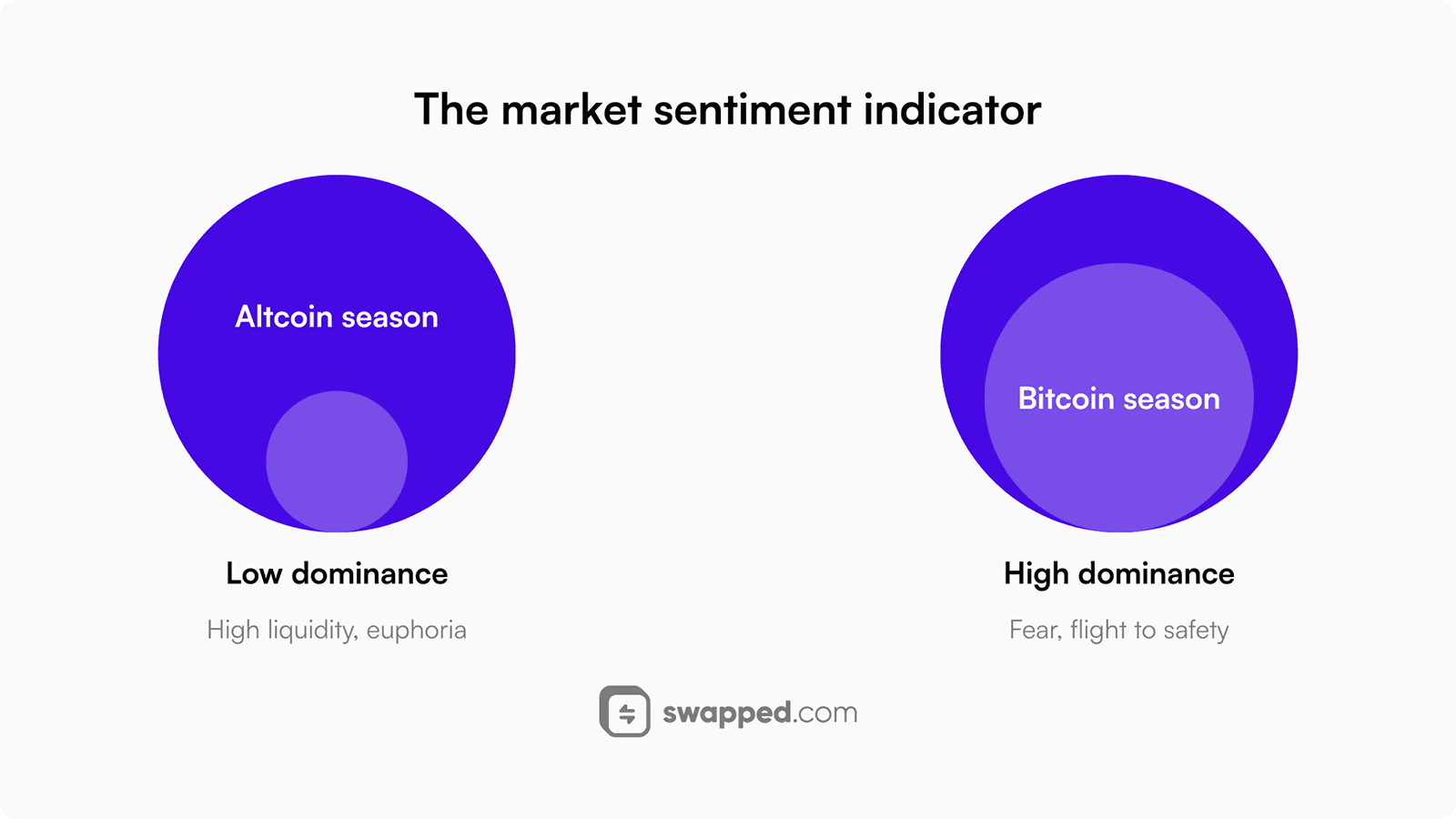
Relative performance depends on the asset set, benchmark and time window.
Signals Often Discussed Alongside It
Commentary often combines relative returns with market share, trading activity and sentiment. These observations can add context, but they measure different things and should not be treated as interchangeable proof.
Bitcoin Market Share
Bitcoin dominance compares its market capitalization with a defined crypto total. A decline can accompany stronger non-Bitcoin performance, but can also reflect supply changes or assets included in the denominator. It is not a direct ledger of capital moving between assets.
Breadth Across Assets
Breadth asks how widely a move is shared. A few large gains can dominate a headline while many tokens lag. Inspect the distribution of results and the chosen sample before describing a move as broad or market-wide.
Volume and Liquidity
Reported volume describes trading activity, while liquidity concerns the ability to execute at available prices. A surge in one does not guarantee depth in the other. Check the venue coverage and measurement rules behind the displayed statistics.
Market share, breadth and liquidity provide different views of market conditions.
Narratives and Attention
A theme can attract attention to a group of tokens without proving common fundamentals or lasting demand. Separate the evidence of increased discussion from claims about future adoption, value or a predictable sequence of market rotation.
What the Label Cannot Tell You
Alt season does not establish which token will outperform next, when a trend will end or whether a particular transaction is suitable. It summarizes observations under a method; it does not remove asset-specific risks.
Duration and Reversals
A rolling indicator can remain elevated while recent prices reverse because earlier observations are still inside its window. The indicator’s construction explains that lag. Read the underlying period before interpreting the latest number as a real-time forecast.
There is no required duration for the informal market phase. A change in relative performance can develop gradually or reverse quickly. Historical sequences provide examples, not an obligation for future markets to repeat them.
Also distinguish a group-level pattern from the experience of an individual holder. Entry price, costs and the particular asset can produce a very different result from an index that describes the wider market.
Use the Term Precisely
A useful statement identifies the provider, asset universe, period and measured result. That makes it possible to discuss the evidence without implying that a market slogan establishes the next trade.
Define the comparison: State which assets, benchmark and dates are included.
Separate observation from prediction: A measured past period does not establish future returns.
Check the individual asset: A broad label does not resolve token identity, liquidity, custody or transaction risk.
Related Concepts
FAQs about Alt Season
How does alt season differ from a bull market?
Alt season usually describes non-Bitcoin assets performing better than Bitcoin across a defined group. A bull market describes a broader rising-price phase. Relative outperformance can occur without positive absolute returns, so the two labels do not necessarily identify the same period.