Stablecoins and the Different Forms of Money
Compare stablecoins, bank money and central bank digital currencies through their issuer, redemption terms, payment use and operating dependencies.
DTCC Trading Editorial
Discussions about the future of money often group several different instruments together. Stablecoins are one category: tokens designed to track a reference value. Understanding their role starts with identifying the issuer or mechanism, the holder’s rights and the route back to the reference asset.
Whether one form of money replaces another is a question about adoption, institutions and payment infrastructure as well as technology. There is no established timetable for universal replacement. Comparing the instruments is more useful than treating a forecast as a fact.
What a Stablecoin Tries to Maintain
Unlike an asset such as Bitcoin, a currency-linked stablecoin targets a reference value. That target is a design objective, not a promise that every market trade occurs at exactly the reference price or that every holder has identical redemption rights.
Different stablecoins use different reserve and stabilization arrangements. For a reserve-backed token, examine the issuer’s disclosures and terms. The composition of reserves, custody, redemption eligibility and operational access all affect how the arrangement works.
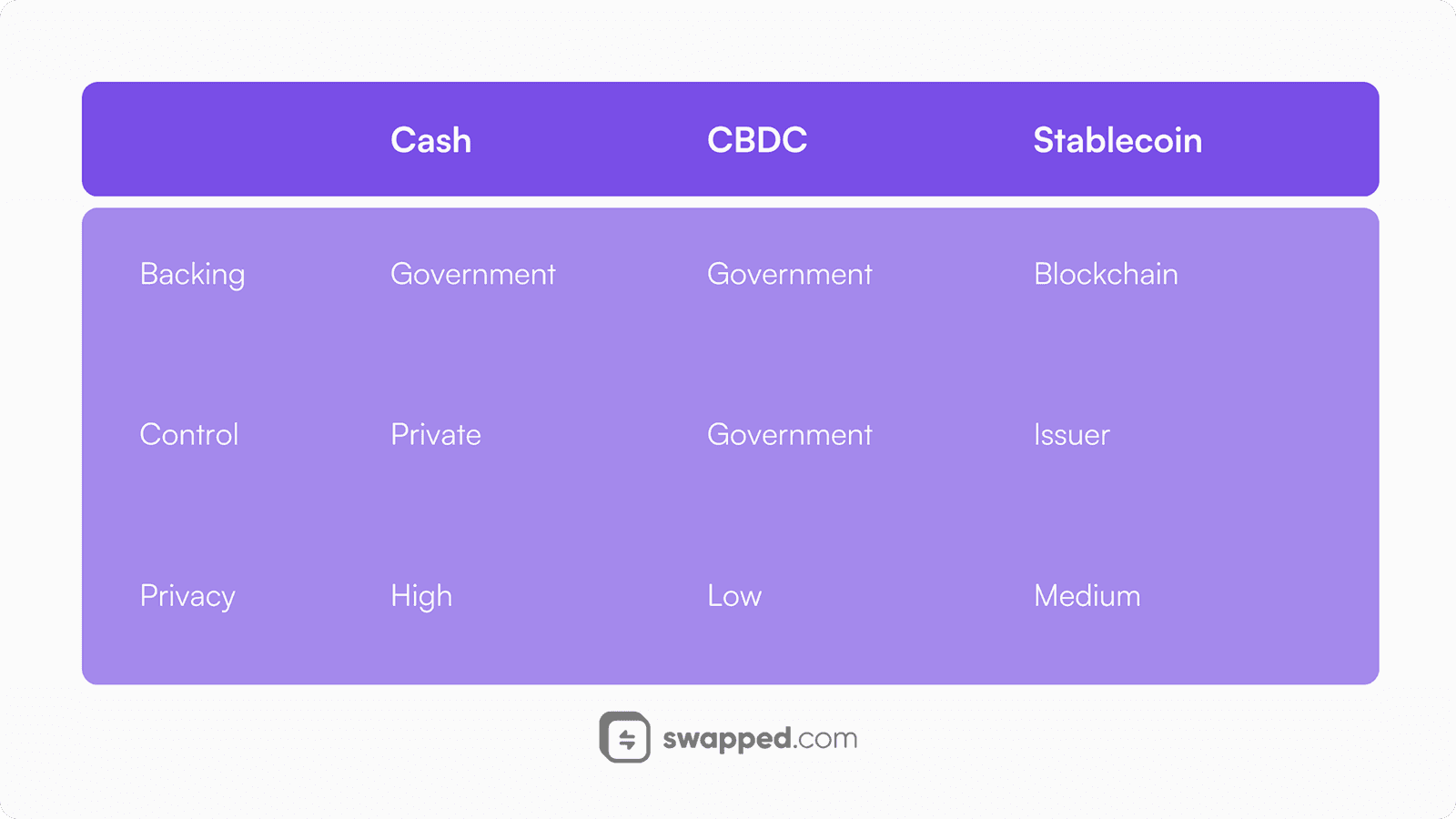
Compare the issuer, legal claim and redemption route behind each form of money.
How Stablecoins Are Used
Stablecoins can be transferred between compatible addresses and used in applications that accept them. A transfer route may offer useful operating hours or programmability, but its full cost and completion depend on the network and services at both ends.
Some holders place stablecoins in DeFi applications. That adds a separate lending, liquidity or contract arrangement. Any return comes with the conditions and risks of that arrangement; holding a stablecoin is not the same as holding an insured bank deposit or a guaranteed savings product.
Understanding Existing Money
Traditional monetary systems already contain several forms of money. Cash issued by a central bank differs from a deposit held with a commercial bank. Electronic payments often move claims recorded by financial institutions rather than physical notes.
This distinction prevents a misleading comparison between digital tokens and supposedly non-digital fiat money. Many ordinary payments are already electronic. The meaningful questions concern the issuer, settlement process, access and rights of the holder.
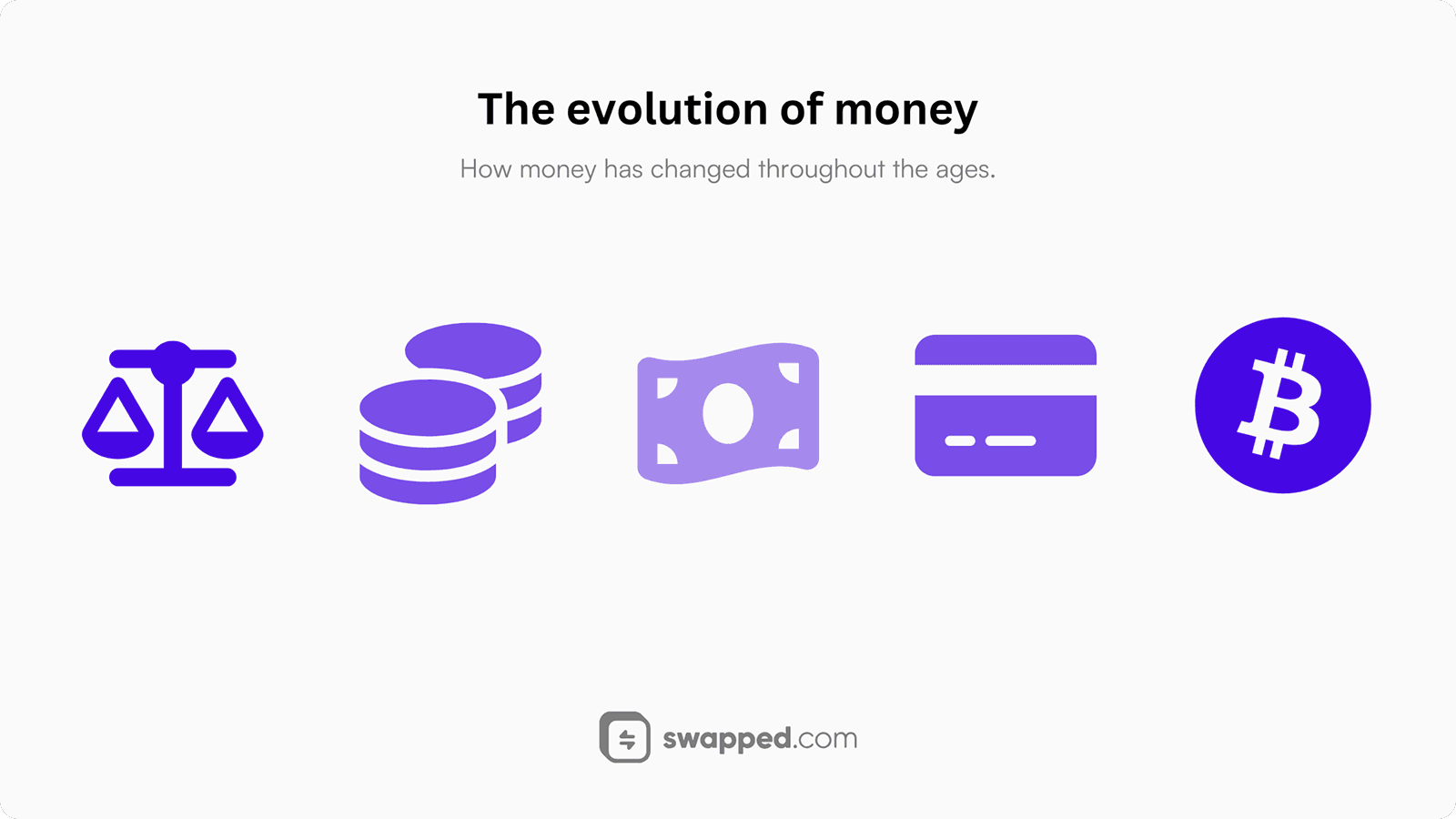
Money can be recorded and transferred in different ways without changing every underlying legal claim.
What Existing Payment Systems Provide
Established payment systems connect account access, acceptance, dispute processes and settlement arrangements. Their terms differ across countries and services. A comparison should identify the particular payment method instead of treating all bank or card payments as identical.
Merchant acceptance and the ability to meet everyday obligations matter alongside technical transferability. A token can move successfully on a network while still requiring conversion before the recipient can use it for the intended expense.
Where CBDCs Fit
A central bank digital currency, or CBDC, is a digital form of central bank money. Designs can target public retail use or access by eligible financial institutions. Research and pilots do not necessarily imply that a country will issue one.
A CBDC differs from a privately issued stablecoin in the identity of the issuer and the nature of the claim. It also need not use the same technology as a public blockchain. The official project design determines its access and operating rules.
Design Choices Matter
Questions about a CBDC include privacy, offline use, access intermediaries, resilience and interaction with existing accounts. Those choices involve policy and operational tradeoffs. No single feature follows automatically from the words digital currency.
A proposed design should therefore be distinguished from an implemented service. Read the central bank’s current materials for what has actually been tested or launched, and avoid assuming that one country’s approach applies elsewhere.
Why Replacement Has No Fixed Schedule
Payment adoption depends on acceptance, legal arrangements, costs, reliability and the ability to move between systems. A technically available token does not become a general means of payment merely because it can be sent quickly.
Different forms can also coexist. A person may use one instrument for a network application and another for everyday bills. Coexistence is a possible outcome, but the balance among instruments remains uncertain and varies by market.
Evaluating Adoption Claims
Distinguish a pilot announcement, a supported checkout option and measured recurring usage. Each describes a different stage. A headline about one merchant or jurisdiction does not establish broad replacement of existing payment methods.
Useful evidence includes the actual payment route, eligible users and completed activity under a clear definition. Transaction counts can include trading or internal movements, so they should not automatically be presented as retail payment adoption.
Constraints Beyond the Token
A stablecoin depends on more than its transfer protocol. Issuance, reserve management, redemption, custody and access services can each introduce constraints. Legal treatment and user protections also vary with the jurisdiction and product.
A blockchain can face congestion or service interruptions, while wallets and payment providers add their own dependencies. Reliable use requires understanding the complete route, including recovery and support when a transfer or payout does not complete as expected.
Trust Needs Specific Evidence
Trust in a monetary instrument involves confidence in the issuer or mechanism, the ability to use it and the rights that apply when something goes wrong. A stable price chart alone does not answer those questions.
For a stablecoin, examine current disclosures, redemption conditions and operational controls. For a bank or payment account, examine the relevant account terms and protections. The comparison should use the actual instruments available to the user.
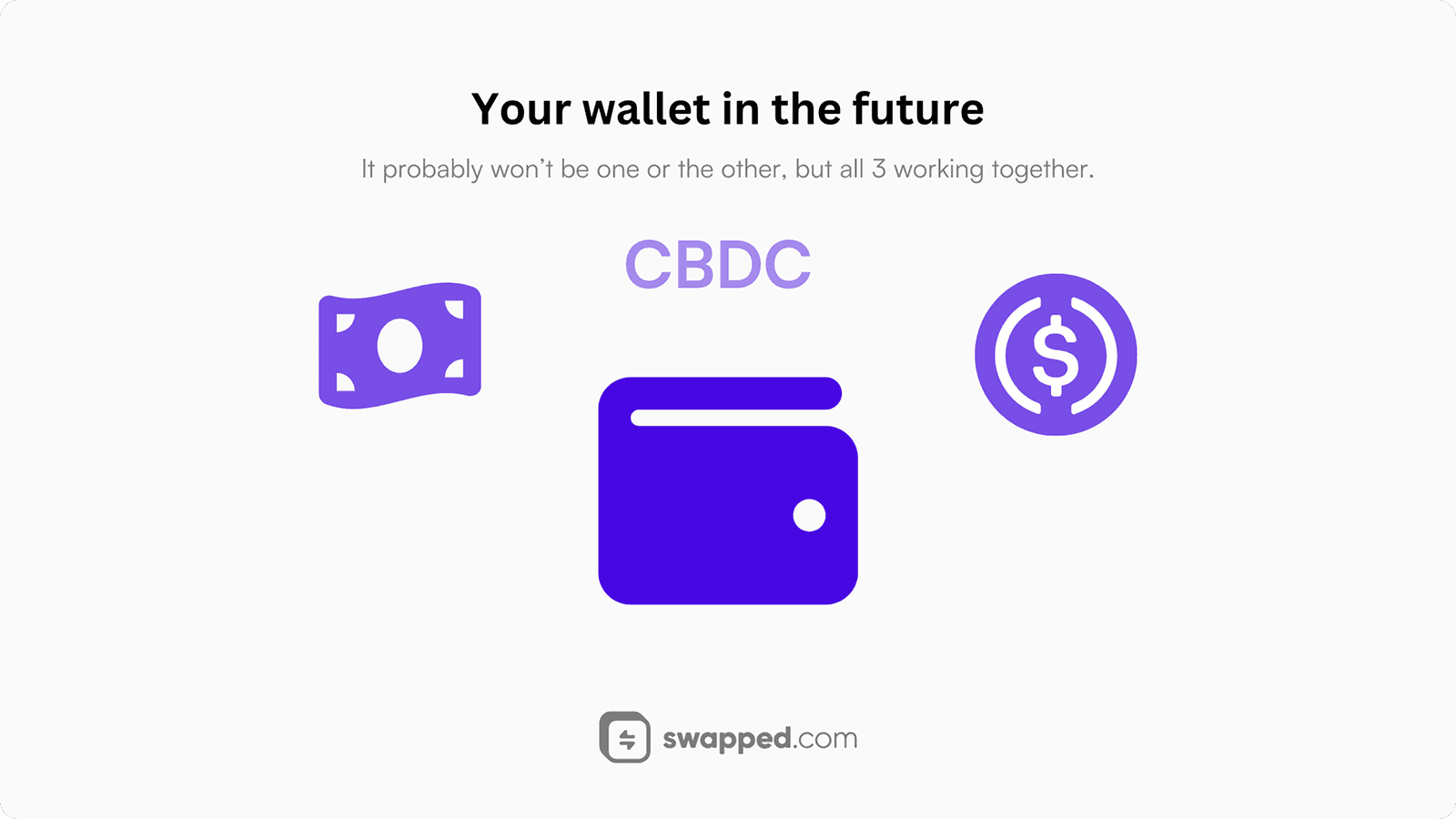
Several forms of money can coexist, with different access rules and payment roles.
A Better Way to Compare the Future
Instead of predicting a universal winner, compare how each instrument solves a specific payment problem. Consider who can hold it, who accepts it, how final settlement is reached and what it costs to convert into another usable form.
People working in digital-asset roles also need to distinguish technical integration from monetary equivalence. Connecting two systems does not make their issuers, protections or redemption rights the same. Those differences should remain visible in the product.
Stablecoins, tokenized deposits and CBDCs create useful questions about financial infrastructure. Understanding their distinct claims and dependencies provides a firmer basis for evaluating developments than assuming that digitization means all existing money will disappear.
Related Reading
The linked articles discuss different views of stablecoins and tokenized money. Read their publication dates and separate the authors’ analysis from established product or policy facts.