How Over-the-Counter Crypto Trading Works
Understand negotiated crypto trades, dealer and agency models, firm quotes, counterparty exposure and the evidence needed for settlement.
DTCC Trading Editorial

Trading cryptocurrency can involve an exchange order book or a negotiated transaction with a desk or counterparty. Familiar crypto exchanges may offer both. Over-the-counter, or OTC, describes the trading arrangement; it does not automatically establish privacy, a better price or lower risk.
What OTC Means
An OTC trade is negotiated outside a centralized exchange order book. The parties agree on an instrument, quantity, price and settlement conditions. The desk may trade as principal using its own balance sheet or act as an intermediary.
That distinction matters because it identifies who owes delivery to whom. A broker arranging a match and a dealer committing its own funds have different roles. Read the agreement instead of assuming every OTC service works the same way.
The quote and settlement process may be less publicly visible than an order-book trade, but counterparties and service providers still receive information. Network transfers can also remain public. OTC should not be equated with anonymity.
An OTC agreement specifies the trade and how both sides will settle it.
Why Negotiated Trading Exists
A large Bitcoin order can consume liquidity across several price levels on an exchange. A negotiated quote can make the offered price and quantity explicit before acceptance. Whether it improves the result depends on the quote and available alternatives.
A desk may source or hedge inventory elsewhere, so OTC activity can still affect public markets indirectly. Avoiding a visible customer order on one book does not mean the transaction has no economic market impact.
From Inquiry to Settlement
A useful way to understand OTC is to separate onboarding, quotation, execution and settlement. Different services combine or automate these stages, but the obligations at each stage should remain clear.
The Quotation Process
Eligible customers typically establish an account and agree to service terms before requesting a trade. The requirements, supported assets and available settlement methods are provider-specific. A general article cannot establish access for a particular customer.
A request identifies the side, asset, quantity and desired settlement arrangement. The response can be indicative or firm for a limited period. Confirm which kind of quote is being shown and what action creates a binding trade.
After acceptance, retain the trade confirmation. It should identify the agreed amount, price, fees, counterparty and settlement obligations. A conversation about a possible price is not equivalent to a completed execution record.
Delivery and Settlement
Settlement arrangements vary. They can require prefunding, simultaneous delivery mechanisms or agreed credit terms. Escrow is one possible arrangement, not an automatic feature of OTC trading. Identify the actual control and release conditions.
A custody service, if offered, is a separate dependency. Determine where assets are held, what withdrawal conditions apply and which entity is responsible. A relationship with a trading desk does not itself establish custody protection.
Order Books and Negotiated Trades
Both methods can be legitimate ways to transact, and providers can combine them. Compare the actual execution and settlement terms rather than treating one category as universally better.
Order-Book Execution
An order book displays bids and offers for a trading pair. A marketable order can execute against several orders, while a limit order can remain unfilled. The displayed best price may cover only a small quantity.
The relevant comparison is the expected result for the complete trade size, including fees and any required transfers. A narrow spread at the top of the book does not establish deep liquidity throughout the order.
Negotiated Execution
An OTC quote can offer a specified quantity at an agreed price, subject to its validity and terms. It may reflect the desk’s inventory, hedging costs, credit exposure and service margin. Those components are not always separately displayed.
Minimum sizes and processing times vary by provider and product. Do not assume a universal threshold or that every OTC trade is slow. Read the current service requirements and distinguish execution time from final delivery.
Comparing Prices
Compare quotes for the same side, asset, size and settlement time. A quote with different delivery obligations is not directly equivalent. Record the time of the comparison because market prices and quote validity can change quickly.
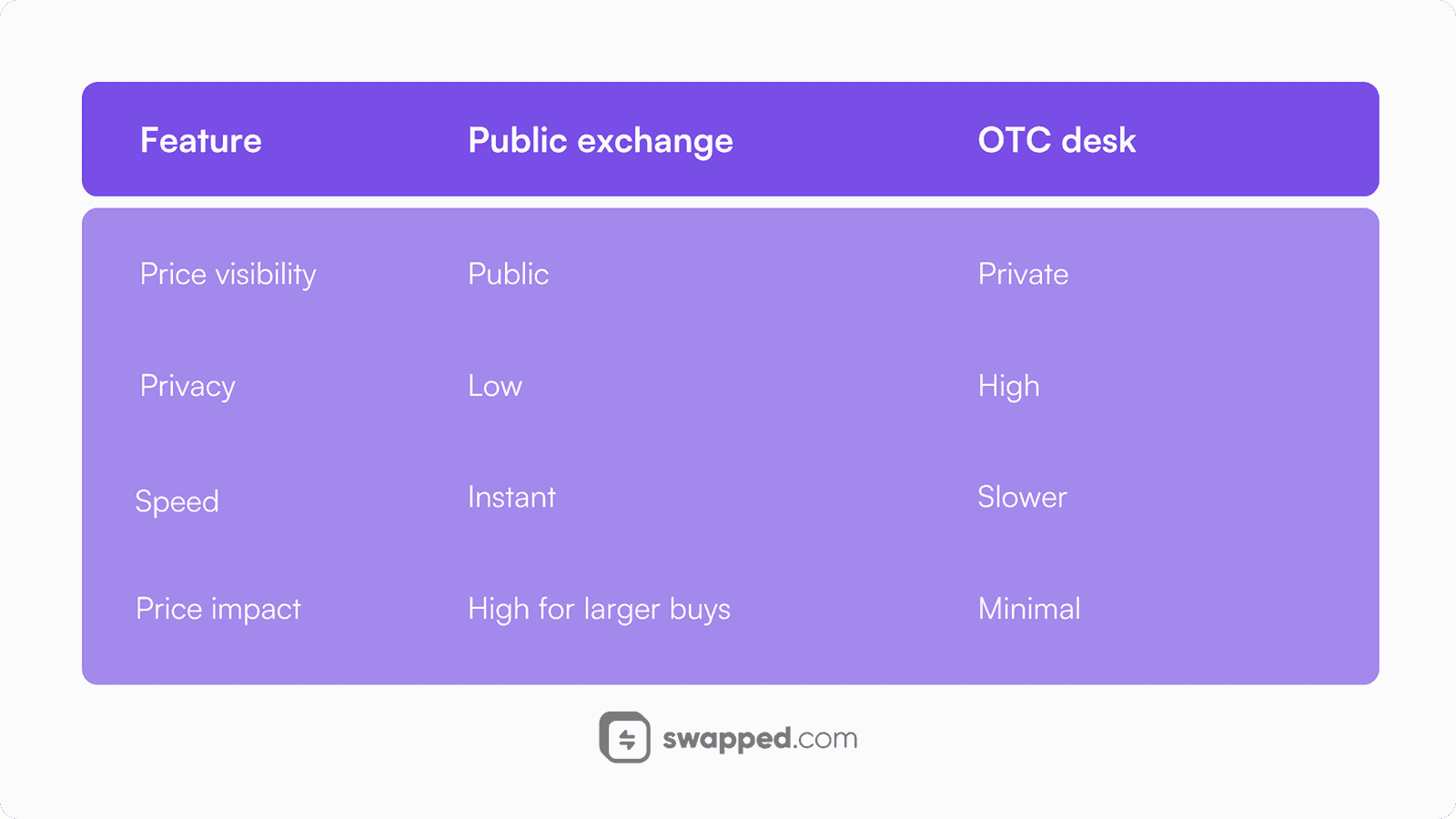
Compare the complete trade terms, including price, size, timing and counterparty obligations.
Who Uses OTC Arrangements
OTC services can address particular execution and operational needs. The relevant factor is the transaction requirement, not simply whether a customer is described as professional or wealthy.
Institutional Participants
An institution may need a documented execution process, a large quoted size or a settlement schedule that fits its controls. An OTC service can be evaluated against those needs alongside other execution methods.
For example, a hypothetical treasury conversion might require a specific asset amount delivered to an approved custodian. The suitable route depends on price, counterparty limits and settlement procedures, not solely on the size of the treasury.
Individuals With Larger Orders
An individual seeking a substantial trade may also request a negotiated quote. Access requirements and protections still depend on the provider and jurisdiction. A personalized contact does not replace review of the legal entity and written terms.
Operating Businesses
Businesses receiving or producing digital assets can need recurring conversions. Their requirements may include reconciliation, approved destinations and predictable settlement procedures. Those operational needs are separate from an expectation about future asset prices.
Common Reasons to Consider OTC
Potential reasons include a firm quote for a specified size, coordinated settlement or a service relationship. Each benefit needs to be verified in the actual agreement. None implies that the route is automatically cheaper or safer.
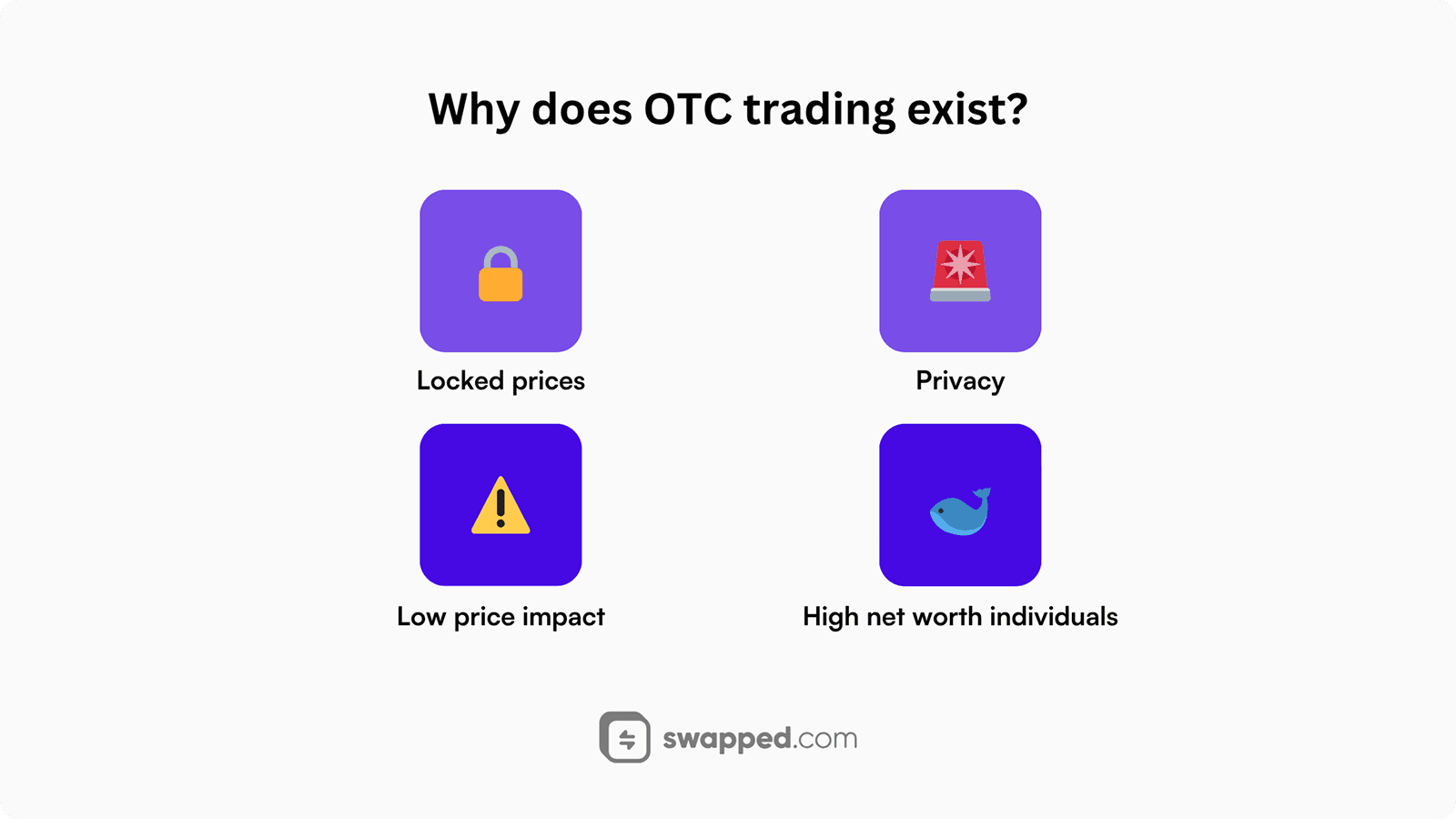
A negotiated price can clarify execution, while settlement and counterparty exposure still require review.
Benefits and Tradeoffs
Evaluate an OTC arrangement as a bundle of price, service and obligations. A favorable feature in one area can be offset by a cost or dependency elsewhere.
Potential Benefits
A firm quote can make the execution price known before acceptance for the stated size and validity period. It does not stabilize the asset’s price afterward or guarantee that a different quote would have been worse.
A negotiated process can limit public visibility of the customer’s order before execution. That is narrower than complete privacy. The provider’s records, required disclosures and eventual network settlement can still reveal relevant information.
A dedicated service team can help coordinate unusual settlement requirements. Assess its actual responsibilities and escalation process. Market commentary from a counterparty should be evaluated separately from its obligation to execute and settle a trade.
Risks and Limitations
Eligibility and minimum trade requirements can limit access. Prefunding can also create exposure before execution. Determine when assets leave your control and what claim you hold during each stage.
A private quote can be harder to compare with public execution data. Obtain a clear net price and identify any separate charges. A claim of no commission does not establish that the quoted spread contains no service margin.
Settlement can fail or be delayed because of incorrect instructions, network conditions, banking cutoffs or counterparty problems. The agreement should explain deadlines and remedies. Do not assume that an executed trade has already delivered both sides.
Assessing Whether OTC Fits
The appropriate arrangement depends on size, access, execution needs and operational controls. A generic recommendation cannot substitute for comparing the available routes for the actual transaction.
Situations Worth Comparing
A large or operationally complex trade can justify requesting several comparable quotes. Include the cost of funding and withdrawing, the settlement deadline and the exposure created while waiting for delivery.
For recurring business use, also compare reporting and reconciliation. A route that produces a clear trade confirmation and delivery reference can be easier to control, but those features need to be demonstrated.
When Another Route May Be Simpler
A smaller transaction may have straightforward execution through another supported service. Compare its complete terms with the OTC offer rather than assuming that the most specialized service provides the best result.
Public order data can improve visibility, but it does not guarantee a fair outcome at every trade size. Inspect the available depth, order type and fees, and account for the difference between an estimate and an actual fill.
What New Readers Should Learn First
Before choosing an execution arrangement, understand the asset and what it means to receive delivery. A trading balance, a custodial claim and assets controlled by your own keys are different outcomes.
Learn how wallets, public addresses and transaction records work, then identify the counterparty’s role. You can study those concepts without making a large trade or responding to an unsolicited offer.
Be especially careful about instructions sent outside the provider’s established channel. Changes to settlement destinations should be verified independently through that channel. A professional-looking document does not authenticate the sender.
A decision to buy crypto or acquire Bitcoin remains separate from choosing an execution mechanism. DTCC Trading’s educational coverage of OTC does not establish an OTC desk, quoted liquidity or a purchase service on the platform.
Related Reading
Use the linked explainers to compare terminology, then read the actual provider agreement for a proposed trade. Provider requirements and settlement methods can change.