Prediction Markets: Prices, Rules and Resolution
Learn how outcome contracts work, why market prices are imperfect probability signals and how resolution rules determine the final result.
DTCC Trading Editorial

A prediction market lets participants trade contracts linked to a defined outcome. The resulting prices can be interesting information, but they are not facts about the future. Understanding the contract and its resolution process comes before interpreting the price.
Some markets use cryptocurrency and blockchain infrastructure for collateral or settlement. Others use different account and exchange systems. The technology changes how positions are recorded, while the question, evidence source and rules still determine what the contract means.
A Forecast Is a Statement About Uncertainty
A prediction expresses an expectation about an event that has not yet been resolved. It can be a simple yes-or-no guess or a probability estimate. Those forms convey different amounts of information.
For example, saying rain is possible tomorrow differs from assigning a particular probability to rainfall measured at a named station. A useful forecast defines the event, location and time rather than leaving the outcome open to interpretation.
Financially linked forecasts add consequences to being wrong, but incentives do not guarantee accurate information. Participants can misunderstand evidence, face constraints or trade for reasons other than expressing their best estimate.
A market combines those actions into prices under a particular trading mechanism.
What an Outcome Contract Represents
An outcome contract defines a payoff based on how an event is resolved. It is not a share of ownership in the event itself. Its rules specify the condition, reference source and any exceptions.
In a hypothetical binary market, one contract pays one unit if a defined event occurs and zero otherwise. Its opposite pays under the complementary outcome. Real markets can have additional resolution provisions, so the example is not a substitute for their terms.
Trading can aggregate information from participants, but the quality of the result depends on participation, liquidity and incentives. A price reflects the market that produced it, not an infallible collective judgment.
From Question to Resolution
The workflow has several distinct stages: define the question, create the contracts, allow trading and resolve the outcome. Ambiguity at the first stage can create disputes at the last.
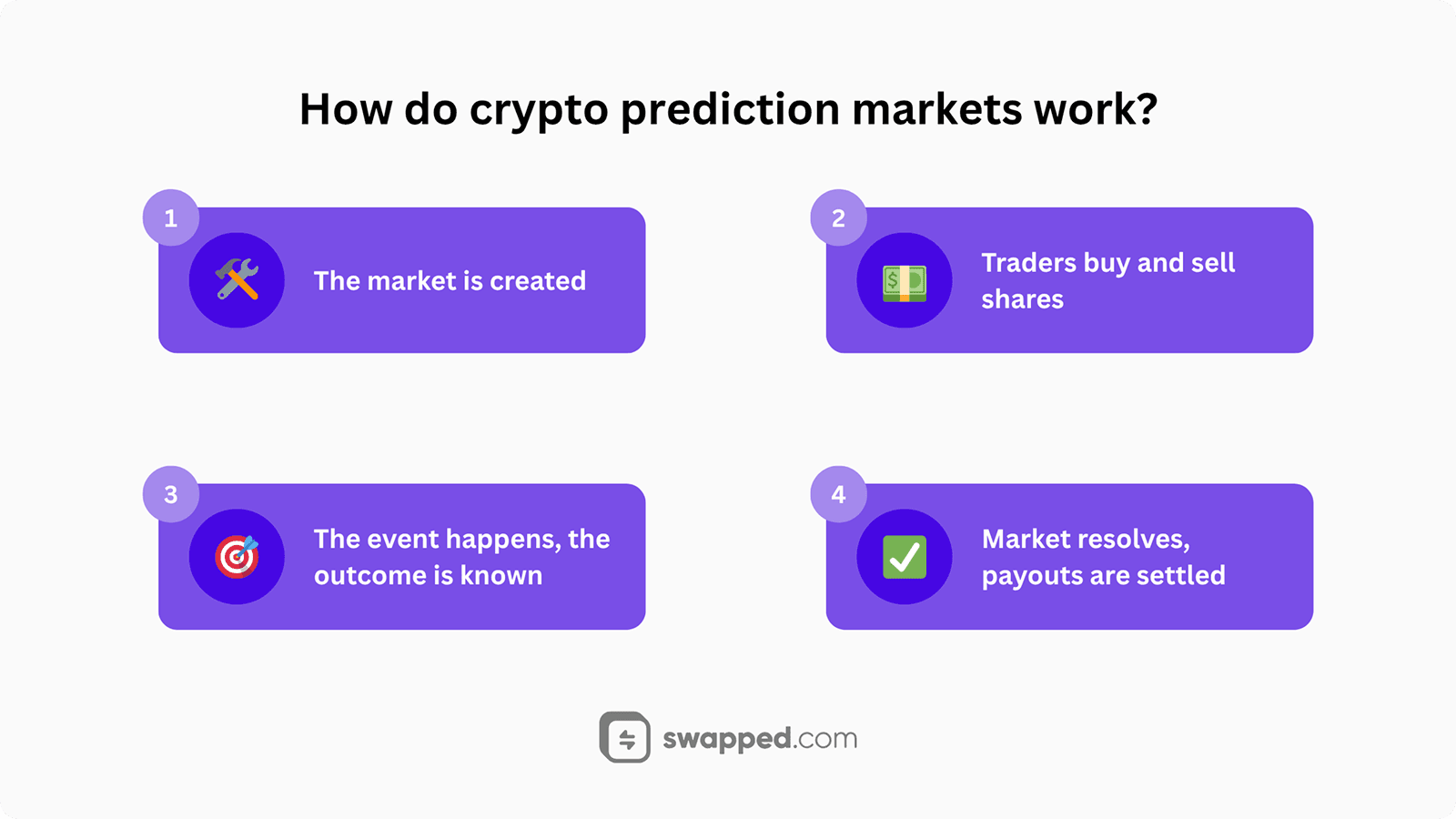
Prediction markets connect a defined question to a trading and resolution mechanism.
Defining the Market
A market about Bitcoin needs more than a general price question. It must specify the price source, threshold, time and treatment of unavailable or revised data. Without those details, people can agree about the headline while disagreeing about the contract.
Representing Outcomes
Binary markets commonly represent complementary yes and no outcomes. Other formats can include multiple choices or ranges. Read the payoff definition and the treatment of invalid or unresolved events for the exact contract.
Interpreting the Price
For a contract paying one unit on success, a price of 0.60 is often discussed as a 60% implied probability. That interpretation is approximate: fees, spreads, risk preferences, funding costs and market constraints can affect the price.
Trading and New Information
Participants submit orders based on their views and circumstances. The available bid, ask and recent trade can differ, especially in a thin market. Specify which price you are using before comparing forecasts across time or platforms.
Determining the Result
Resolution applies the published rules to the designated evidence. The process can include delays, disputes or special outcomes. An event appearing finished in the news does not necessarily mean that the contract has reached final settlement.
Prices Can Change Before the Event
A position’s market value can change before resolution. This creates a distinction between the eventual payoff and the price available to exit earlier. Both depend on conditions that a headline probability may not reveal.
A Hypothetical Price Change
Suppose a contract is purchased for 0.30 units and later can actually be sold for 0.50. The gross difference is 0.20 before costs. That example explains price exposure; it does not imply that predicting or obtaining such a move is straightforward.
The displayed last trade may not be available for the full position. An exit requires sufficient counterparties at acceptable prices. A chart showing a gain is therefore different from an executed sale after fees.
Information and Speculation
A participant can form a view from public data, specialized knowledge or a model, but each source can be incomplete or wrong. Confidence should be evaluated against evidence and the precise resolution condition.
Outcome contracts can lose the amount paid when the selected result does not occur. Short-term trading can also produce losses before resolution. The existence of a probability display does not turn the activity into a predictable return.
How Efficient Is the Market?
Some prices respond quickly to news, while others remain stale or reflect limited participation. Evaluate liquidity, timing and comparable evidence. A market’s apparent responsiveness in one event does not establish universal forecasting accuracy.
Comparing Platform Designs
Named platforms can illustrate different operating models, but access, products and rules change. A useful comparison identifies the legal entity, contract, collateral and resolution process for the exact service being discussed.
Polymarket as an Example
Polymarket’s documentation describes outcome tokens and a resolution process using an oracle and dispute mechanism. The market’s detailed rules define its result. The title alone is not sufficient to determine how an unusual event will be treated.
A platform can use a stablecoin or another settlement asset, but the current collateral and redemption arrangement must be checked directly. A stable reference value does not remove contract, access or settlement dependencies.
A large public audience or reported volume is not proof that every market has deep liquidity. Inspect the specific market and the date of any metric. Historical attention should not be presented as a current ranking or an endorsement.
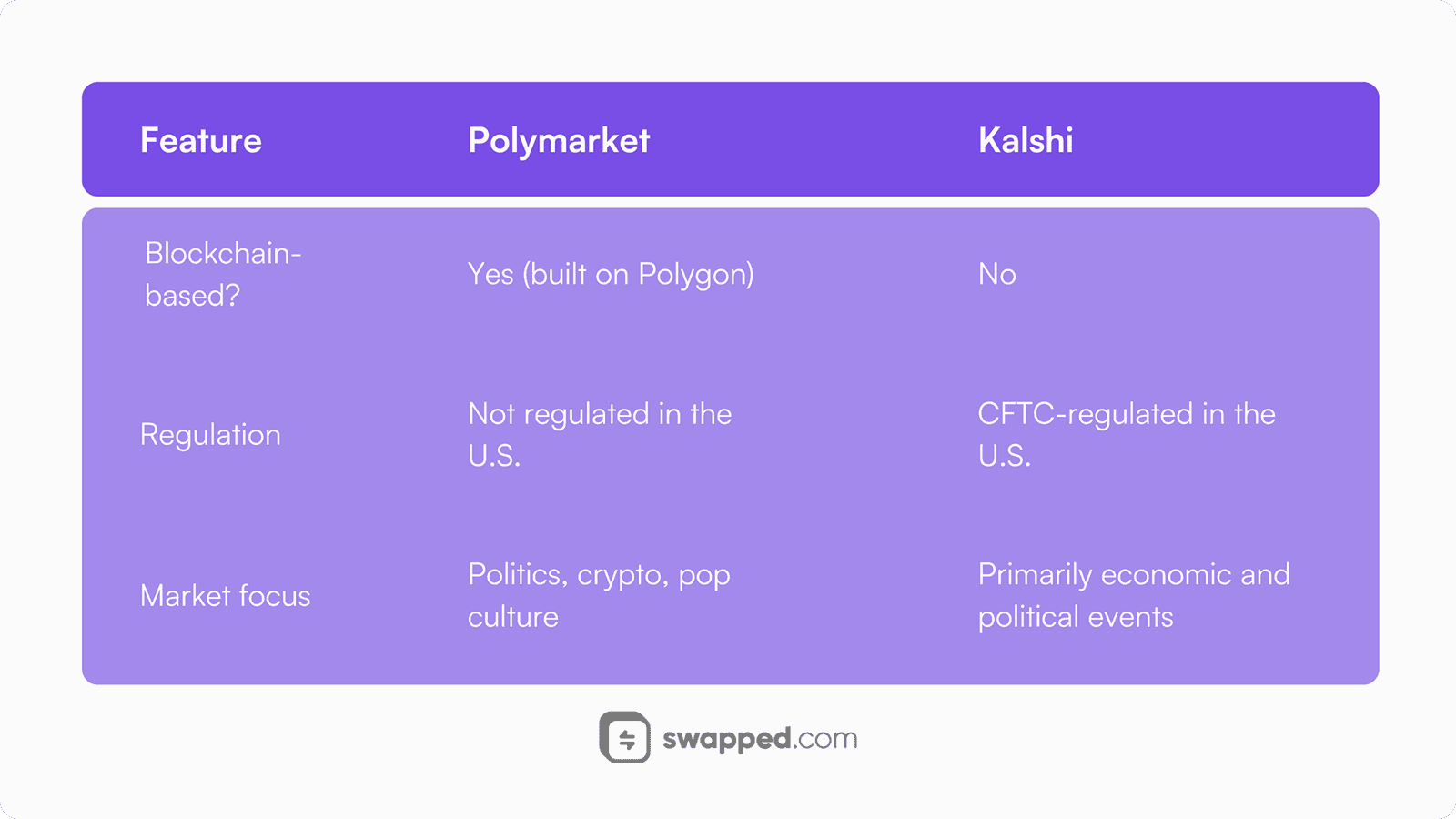
Compare the actual contracts, access rules and resolution processes behind each platform.
Kalshi as an Example
Kalshi’s market documentation explains rules, outcome determination and settlement. Its operating model should be evaluated from its own current terms. Do not assume that a description of another prediction platform applies to it.
For any listed event, the designated source and determination time matter. A data release can be delayed or revised, and the contract can specify how those situations are handled. Read those conditions before interpreting the displayed market price.
What Prediction Markets Can Contribute
A well-defined market can provide a continuously updated signal about participants’ expectations. That can complement surveys, models and expert analysis. It does not replace the need to understand the event or evaluate the signal’s limitations.
Blockchain infrastructure can make some records publicly inspectable, but availability is still subject to platform rules and local law. Technical reachability should not be confused with universal permission to participate.
Research and Planning Uses
Organizations can study forecasting mechanisms for questions such as demand or project timing. The design needs enough informed participation and a clear way to determine outcomes. Poorly defined incentives can produce misleading information.
Accuracy claims require a dataset, scoring method and comparison baseline. One memorable correct prediction is insufficient. Calibration across many forecasts is a more informative question than whether the favorite won a single event.
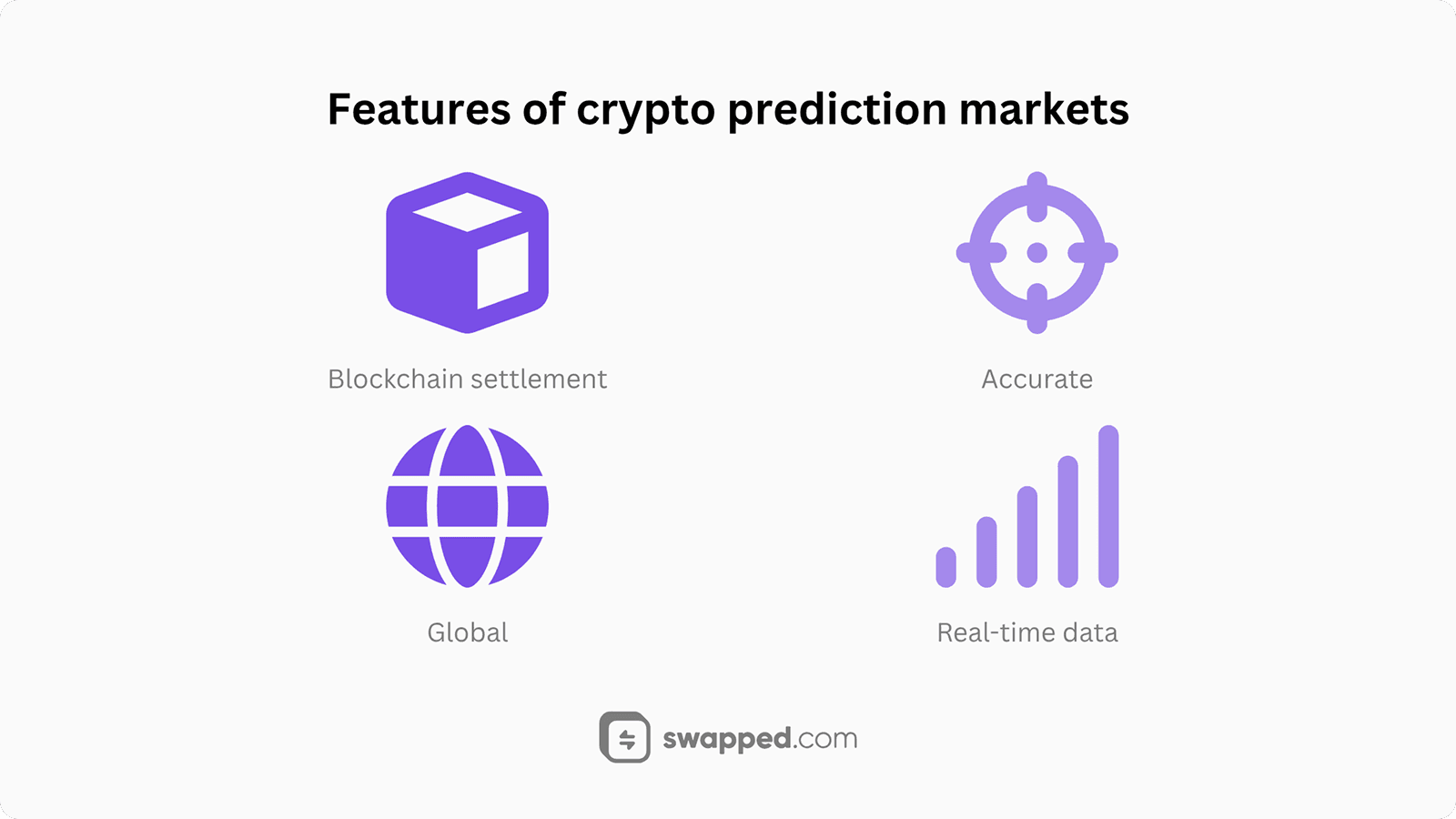
Forecasting value depends on clear questions, useful participation and reliable outcome data.
A Research-First Approach
You can study market rules and price histories without funding an account. Start by identifying the exact event, payoff and resolution source. Then compare the market’s changing estimate with the information available at the time.
If assessing participation, verify eligibility, costs and the possible loss under the actual contract. Do not bypass location or account restrictions. This article explains the mechanism rather than recommending a wager or a trading strategy.
A requirement to obtain USDC or USDT belongs to a particular platform’s current funding route and must be verified there. DTCC Trading’s educational coverage does not offer access to prediction markets or establish a supported funding integration.
The most useful habit is to separate a market’s question, its price and its final resolution. Those are connected observations, but they answer different questions about the event and the contract.
Related Reading
The linked discussions offer additional perspectives. Check the publication date and compare platform claims with current official contract and resolution documentation.