A 51 percent attack usually refers to majority hash-power control in a proof-of-work network. It threatens transaction history and inclusion, while valid-signature and consensus rules still matter.
A 51 percent attack is commonly used to describe an attacker controlling a majority of the mining hash power in a proof-of-work network. That position can give an advantage in producing a competing valid history. It does not mean controlling a majority of all computers or owning every user’s keys.
What the Percentage Refers To
For proof of work, the relevant resource is computational work, not a simple count of nodes. One operator can control more mining power than many others combined. The term is shorthand for a resource advantage within a particular consensus mechanism.
Work and Validation Are Different
Miners propose blocks, while validating nodes check them against the rules they enforce. More hash power does not make an otherwise invalid transaction valid. A proposal still needs to satisfy the network’s signature, spending and other consensus requirements.
The attack concerns which valid history gains the required work advantage. It can affect recent transaction inclusion and ordering without granting the ability to sign arbitrary transfers from other people’s accounts.
Why Chain Selection Matters
In Bitcoin, competing valid histories are compared by accumulated proof of work. This is more precise than saying the network simply follows whichever chain contains the most blocks or whichever story most computers support.
An attacker with sufficient resources can attempt to extend a competing branch and make it the accepted history under those rules. The outcome involves resources, timing and probability; the name is not a guarantee of instant control over every event.
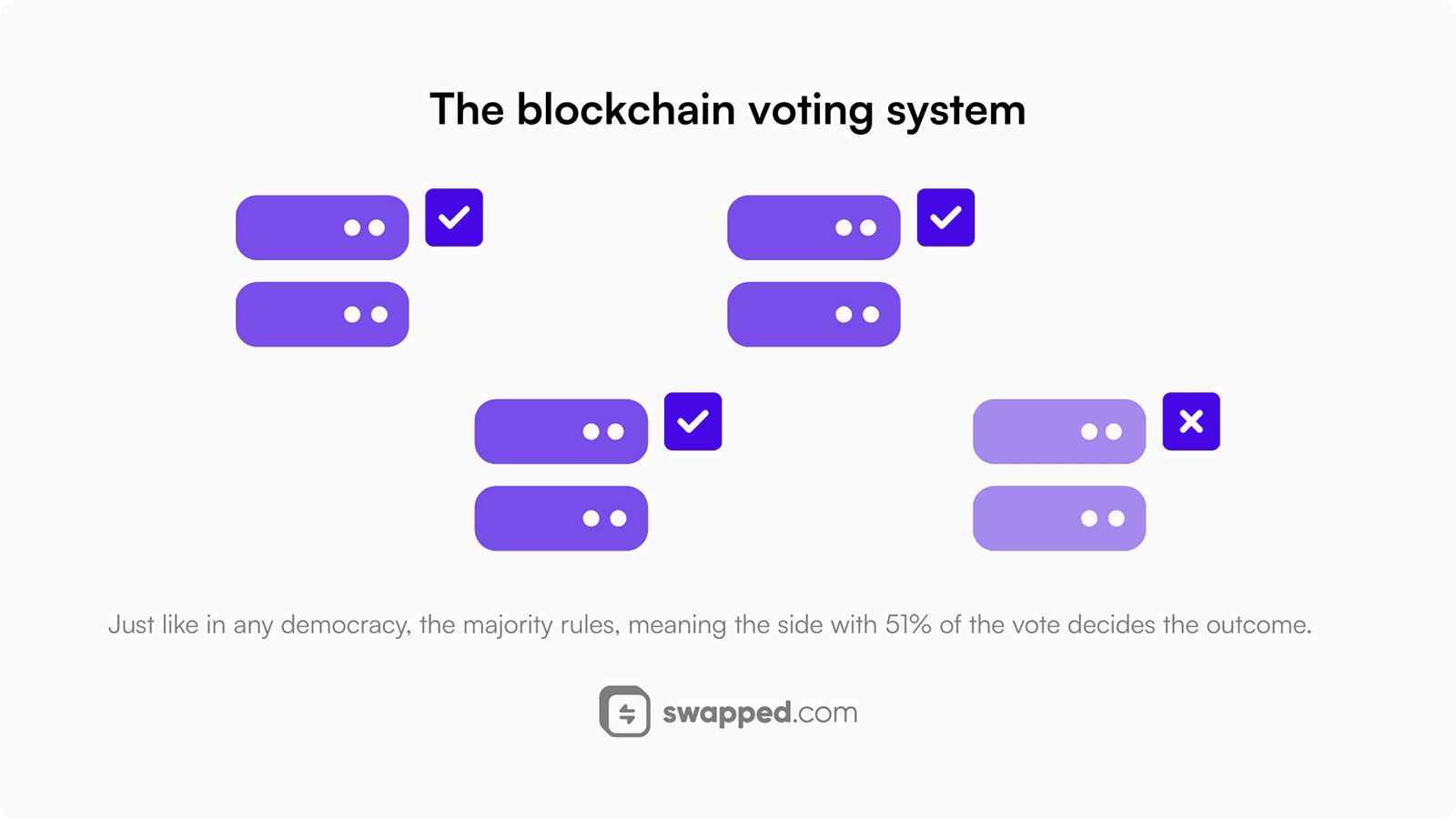
Consensus resources and node counts are different measures of network influence.
The Consequences of a Reorganization
A reorganization changes which recent valid blocks form the accepted history. Transactions from a displaced branch may be absent from the replacement branch or included in a different order.
Conflicting Payments
The double-spend concern involves conflicting uses of the same spendable asset across competing histories, with only one ultimately accepted.
For example, a recipient may observe a payment on one branch and treat it as complete. If a competing branch later replaces that history and contains a conflicting spend, the original payment is no longer part of the accepted record.
This is why confirmation policy matters to services accepting proof-of-work payments. Waiting for more accumulated work can change the risk, but the relevant policy depends on the network, transaction and threat assumptions.
The example concerns settlement evidence and competing history. It does not imply that an attacker can forge another person’s signature or spend an unrelated balance without authorization.
Transaction Inclusion and Censorship
Concentrated mining power can also be used to interfere with which valid transactions become established in the chain. The exact effect depends on the strategy and network conditions. Distinguish censorship attempts from theft through compromised keys.
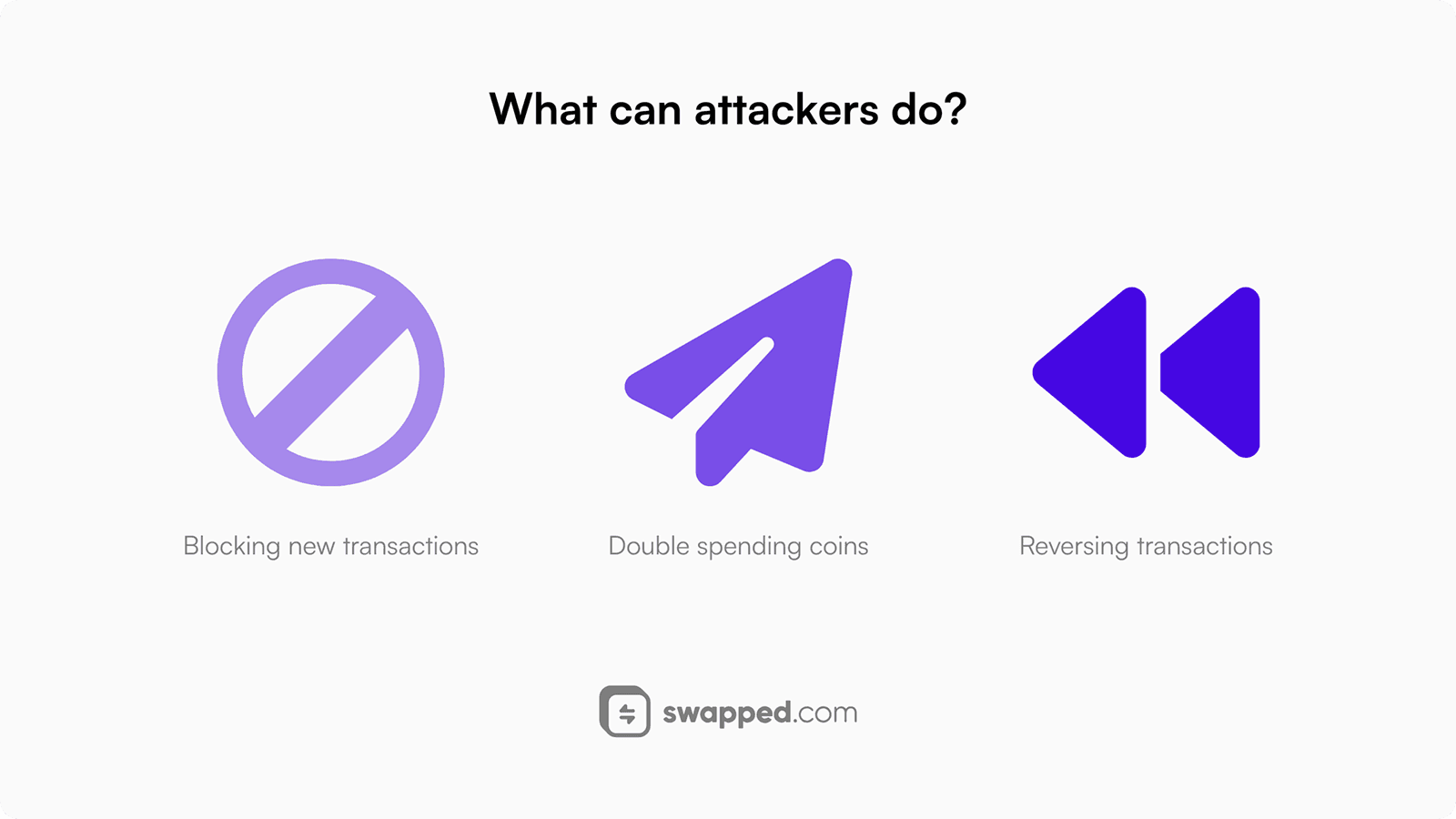
A valid transaction can face inclusion risk without its signature being broken.
Why the Threshold Is a Shorthand
A majority resource share changes the attacker’s ability to outpace honest work over time. Smaller resource shares can still create some attack probability. There is no sharp promise that every network is safe just below one percentage and instantly lost just above it.
Accumulated Work and Finality
Proof-of-work confirmation provides increasing confidence under assumptions about competing resources. It differs from the finality mechanisms used by other consensus designs. A generic explanation should not substitute one network’s rule for another’s.
Proof-of-stake systems use different resources and can have several relevant thresholds for different attacks. Describing them all as a majority of validation nodes is inaccurate. Read the specific protocol’s participation and finality rules.
The useful question is which resource grants influence, what the protocol checks and which actions become possible at different levels of control. The familiar label alone does not answer those questions.
Reading Network Security Claims
Evaluate resource concentration, the cost and availability of attack resources, observed behavior and the application’s confirmation requirements. No single headline hash-rate number proves the absence of every possible attack.
Also distinguish consensus attacks from wallet compromise, contract defects and exchange failures. These mechanisms require different evidence and protections. A network can resist one kind of attack while users remain exposed to another.
DTCC Trading’s glossary uses the term to explain consensus risk. It does not certify the security of a network or imply a particular supported chain. A meaningful assessment needs the actual protocol, current evidence and the intended application.
Related Concepts
FAQs about 51% Attack
Does majority hash power reveal private keys?
No. Majority mining power does not by itself reveal keys or create valid signatures for unrelated users. The concern is an advantage over transaction inclusion and competing valid histories. Key theft and malicious wallet authorizations are separate attack mechanisms.