Bitcoin History: Key Events and Their Meaning
Trace Bitcoin from its original proposal and early payments to exchange failures, futures markets and spot investment products, with the limits of each milestone.
DTCC Trading Editorial

Bitcoin began as a proposal for electronic payments and developed into a network with a much wider financial ecosystem. Its history concerns software, users, markets and institutions. Those histories overlap, but a price milestone is not the same event as a protocol change in a cryptocurrency.
This overview places Bitcoin market history beside technical and institutional developments. It is a selection of important events rather than a complete archive. Historical facts help explain how the ecosystem formed; they do not establish a pattern that future prices must follow.
The Proposal and Network Launch
The original proposal appeared during 2008, a period of major financial disruption. That context is often discussed alongside Bitcoin’s design, but context alone cannot establish every motivation of its pseudonymous author.
The Satoshi Nakamoto Name
The Bitcoin whitepaper, published under the name Satoshi Nakamoto, described a peer-to-peer electronic payment system using proof of work and a shared transaction history. The document is a primary source for the proposal, distinct from later interpretations of its purpose.
The design addressed how participants could agree on a transaction history without one central operator maintaining the payment ledger. It combined earlier cryptographic ideas with a particular consensus and incentive arrangement.
The name Satoshi Nakamoto identifies the author of the proposal and early software contributions. Claims about the real-world identity behind the name remain separate claims requiring evidence; a history introduction should not present speculation as established identity.
The First Ledger Records
Bitcoin’s genesis block dates to January 2009. It contains a newspaper headline about bank rescues, a detail visible in the original chain data. The block marks the beginning of the recorded chain, not a normal payment between two users.
Early transactions and software releases show the network becoming operational among a small group of participants. When describing a first transaction, specify whether the claim concerns a block reward, a transfer between people or a purchase of goods.
Early Use and Price Formation
In its early period, Bitcoin had limited exchange infrastructure and few established commercial uses. Participants experimented with software, transfers and informal valuation. That environment differs substantially from a later market with many venues and quoted instruments.
The Pizza Transaction
In May 2010, Laszlo Hanyecz posted an offer to exchange 10,000 bitcoin for pizza and later reported completing the trade. The original forum thread provides direct evidence of the offer and outcome, now widely commemorated as Bitcoin Pizza Day.
Converting that historical amount at a later market price can illustrate price change, but it does not measure what the participants knew or could obtain in 2010. A retrospective valuation is different from the economic circumstances of the original trade.
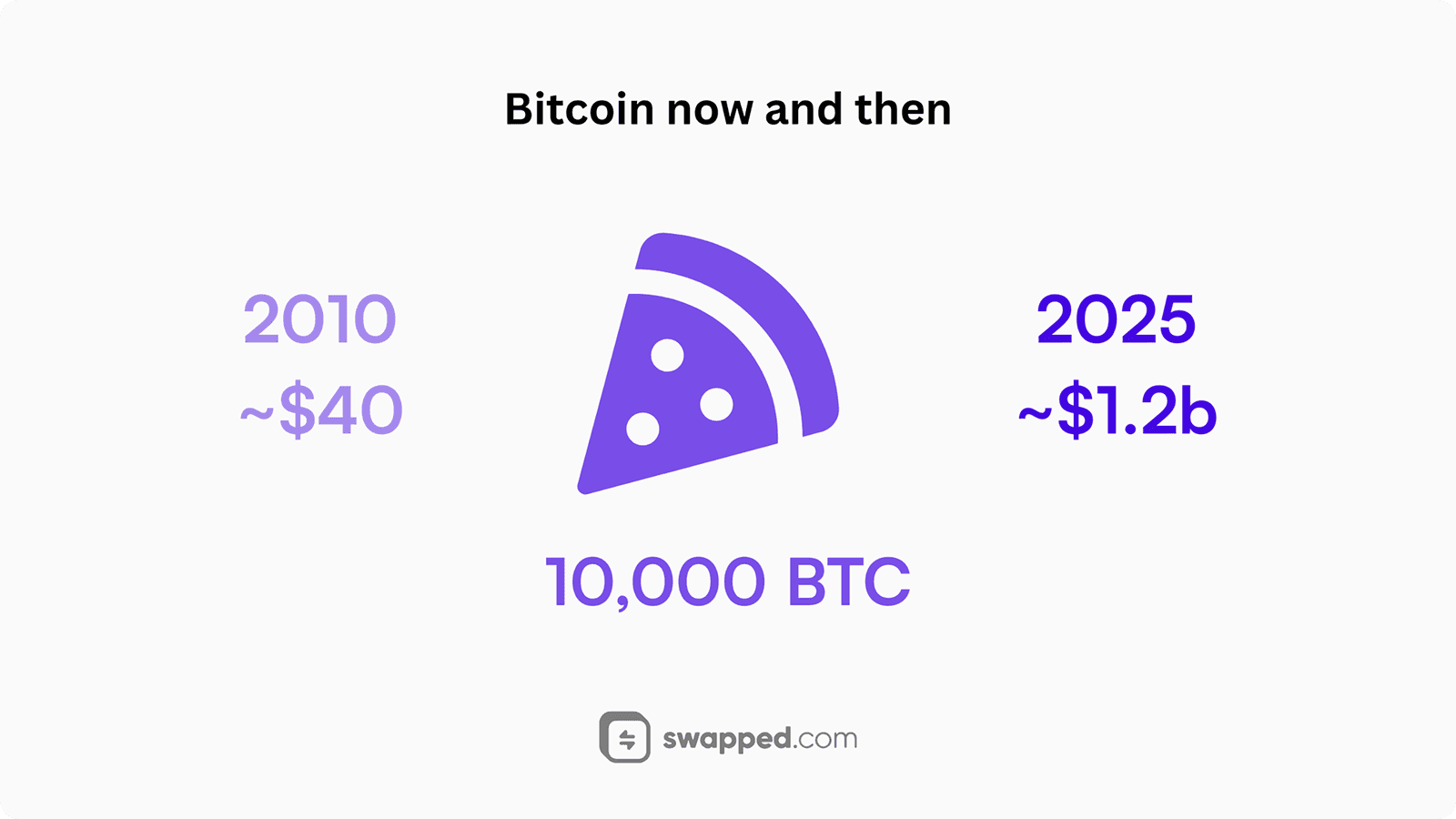
The 2010 pizza trade records an early exchange of bitcoin for goods.
Reading Early Price Records
Early price figures depend on the venue, time and type of transaction being measured. An informal quote, a small exchange trade and a broadly available market price are not equivalent observations. A careful timeline identifies its source.
Rapid rises and declines became part of Bitcoin’s market history. The useful lesson is to retain the full path, including periods of loss and low liquidity, rather than selecting only the starting point and a later high.
Exchanges, Growth and Operational Risk
As exchanges and supporting services developed, more people could access Bitcoin without running every part of the infrastructure themselves. That convenience introduced intermediaries whose operations and solvency were separate from the network’s consensus rules.
A Broader Trading Market
The expanding exchange ecosystem made price discovery more visible, but prices could differ across venues. Funding access, withdrawal restrictions and local demand affected whether a quoted price was actually obtainable by a particular user.
This distinction remains important in historical comparisons. A market chart records a methodology and data source. It should not automatically be treated as the realized return of a person who faced fees, access limits or custody losses.
The Mt. Gox Failure
Mt. Gox entered insolvency proceedings in 2014, creating a major loss and recovery event for its customers. The trustee’s published notices document the legal process. That service failure was distinct from a failure of Bitcoin’s base consensus protocol.
The event exposed the gap between an account balance shown by a custodian and direct control of spendable assets. Customers depended on the exchange’s records and ability to honor withdrawals, even while Bitcoin’s public ledger continued operating.
The lasting lesson concerns custody, reconciliation and operational controls. Self-custody creates its own key-management responsibilities, while custody adds dependence on another organization. Neither arrangement can be evaluated from a market price chart alone.
Scaling Debates and New Instruments
Later growth brought debate about capacity, transaction costs and the responsibilities of different participants. Bitcoin’s history includes technical disagreements as well as financial adoption, and those should be described on their own terms.
The 2017 Market Cycle
The 2017 market cycle drew substantial attention to Bitcoin and other digital assets. Describing it accurately requires both the advance and the subsequent decline, along with a specified market-data source and time period.
Public attention does not have a single cause or measure. Media coverage, account registrations and actual network activity can move differently. A historical narrative should avoid turning a broad social impression into a precise adoption statistic.
Demand for block space also made transaction fees and confirmation timing more visible to users. Fees depend on transaction construction and competition for inclusion, so a busy period does not establish one permanent cost for all Bitcoin payments.
Bitcoin Futures
CME introduced its Bitcoin futures contract in December 2017. A futures contract is a derivative with its own settlement and margin rules. Trading that instrument is different from receiving bitcoin in a personal wallet.
The new instrument expanded the ways eligible market participants could take or manage exposure. It did not remove price risk, and exchange oversight of a derivative should not be interpreted as a guarantee about the underlying asset’s future value.
The development of derivatives also complicates simple narratives based only on spot prices. A participant’s total exposure can include offsetting positions that are not visible from a single on-chain address or one market transaction.
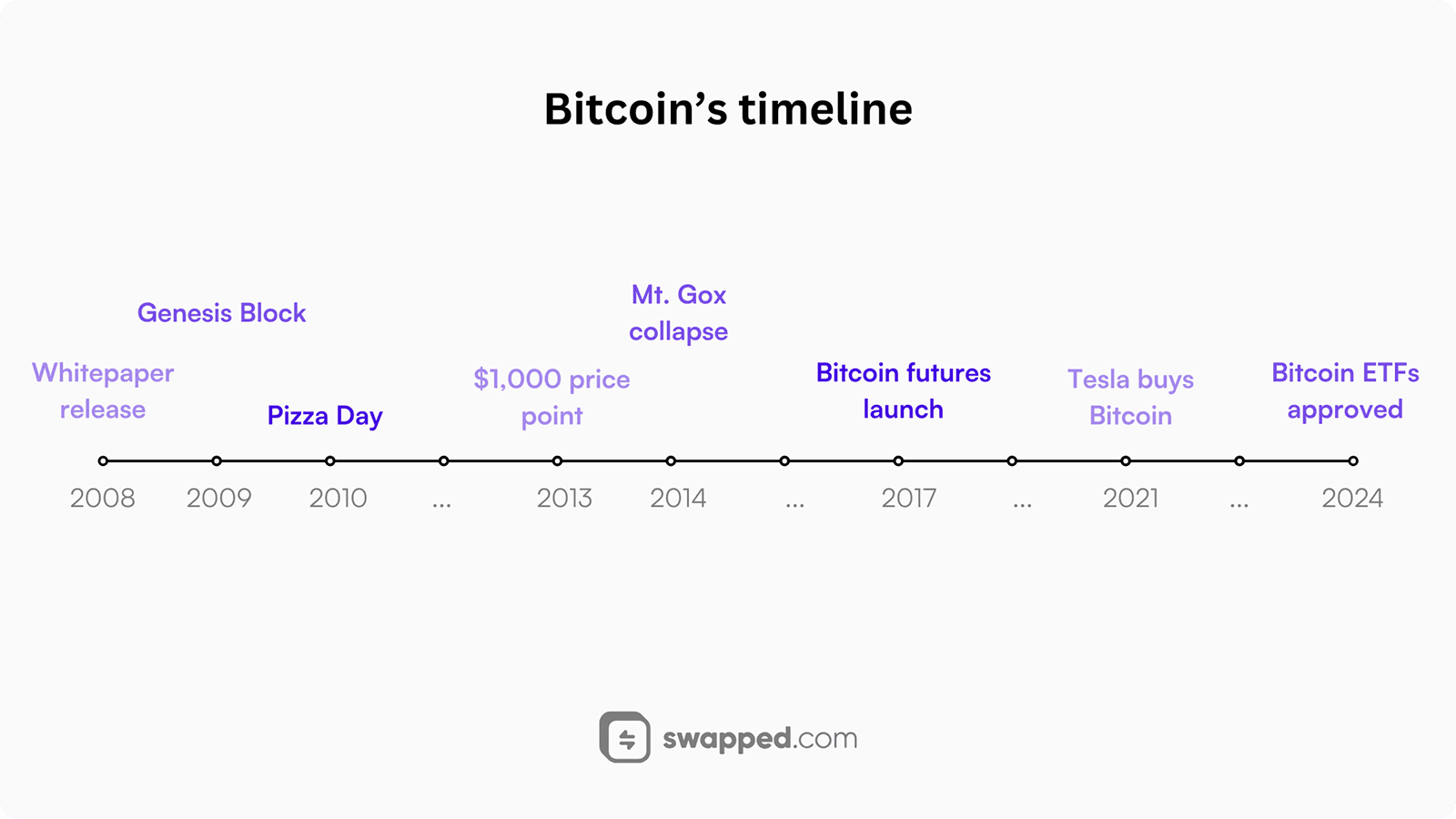
Bitcoin’s history includes separate milestones in software, custody, markets and investment access.
Corporate Holdings and Investment Products
Corporate treasury holdings and exchange-traded products brought Bitcoin into additional financial arrangements. These developments changed access and reporting, but they did not make every form of exposure equivalent to direct ownership.
Corporate Treasury Decisions
Companies that hold bitcoin disclose their policies and positions through their own reports. Those reports are the appropriate source for historical holdings; a headline purchase announcement does not establish that the same amount remains held later.
Tesla’s 2021 annual report disclosed bitcoin purchases and a brief period of accepting it for certain product sales. This illustrates why holding an asset and accepting it as payment are separate corporate decisions that can change over time.
A company’s shares also reflect its other assets, liabilities and financing choices. They should not be treated as a mechanically identical substitute for bitcoin. The relationship between the company and the asset needs to be assessed from the actual structure.
Spot Bitcoin Exchange-Traded Products
In January 2024, the US Securities and Exchange Commission approved exchange rule changes for listing and trading certain spot Bitcoin exchange-traded product shares. The approval concerned those products and applicable listing rules.
Such products provide exposure through a securities account, subject to their prospectus, fees and custody arrangements. Holding product shares is different from controlling the private keys for bitcoin and transferring it directly on the network.
The SEC explicitly distinguished its approval from endorsement of Bitcoin. That distinction is essential: a permitted listing is not a promise of safety, profitability or suitability for every investor.
Understanding the Ongoing History
Bitcoin’s story continues through software releases, network activity and institutional decisions. A dated overview should state its scope and avoid presenting a past snapshot as the current market position.
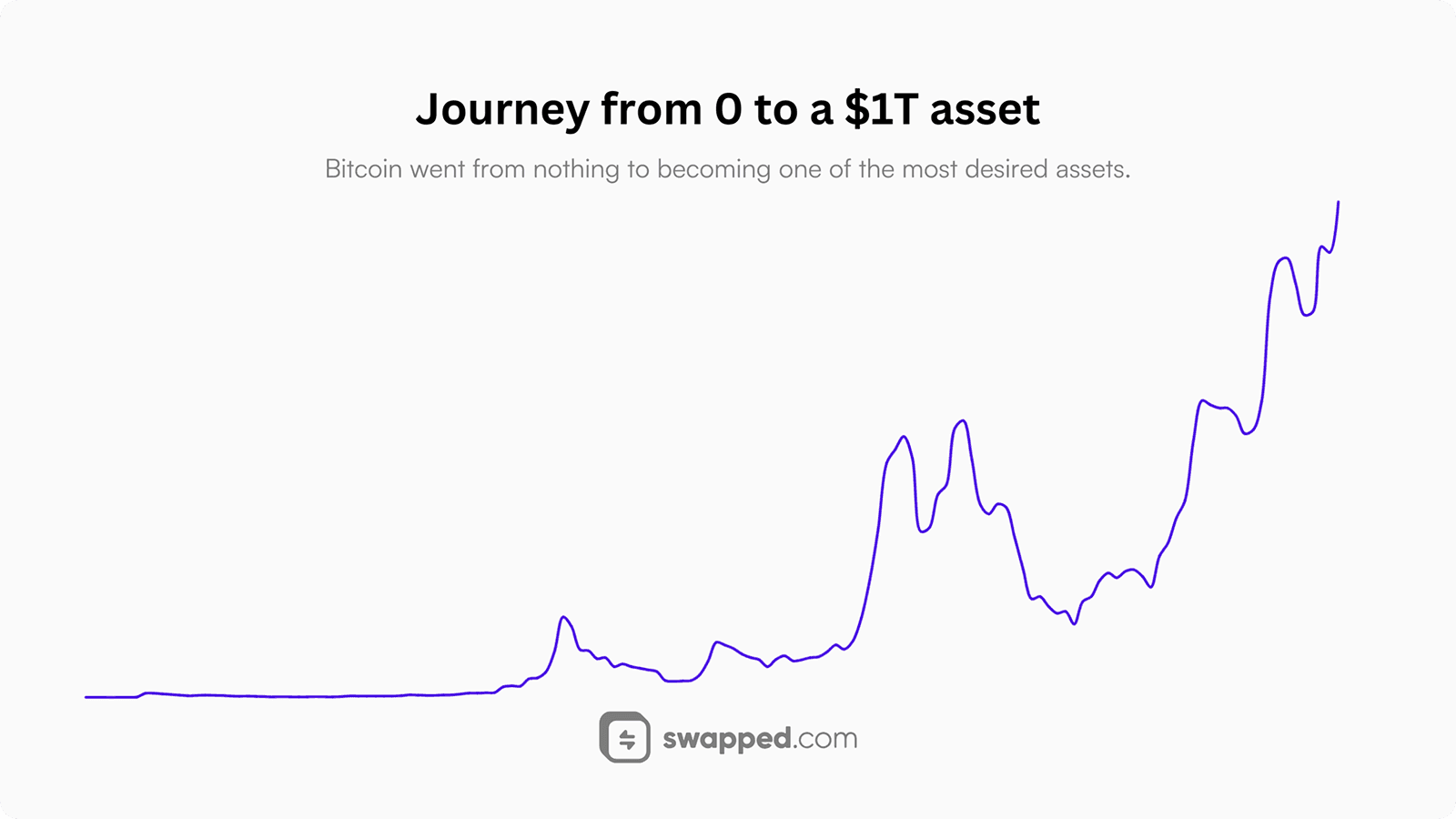
Historical milestones explain development; they do not determine future price or adoption.
Separate Current Data From History
Current prices, supply measures and market capitalization require current data and a stated methodology. They are unnecessary for understanding the meaning of the original proposal, a past service failure or the launch of a financial instrument.
Labels such as digital gold express an analogy or investment thesis. They do not remove differences in volatility, access, custody and legal treatment. A historical account can explain the label without adopting it as a guarantee.
Access interfaces have changed over time, but convenience does not prove safety. Any present-day service still needs its own review of custody, fees, eligibility and operational controls. This article does not endorse a purchase route through DTCC Trading.
Questions for the Next Chapter
Future development depends on many participants and uncertain conditions. Separate a proposed software change, an activated network rule and a new service launch. Each has a different process and different evidence of completion.
Additional payment layers and wallet tools also have their own operating assumptions. Improvements in one part of the ecosystem should be evaluated for the actual problem they address rather than described as resolving every network limitation.
Historical analysis is strongest when it keeps dates, primary records and interpretation distinct. It can explain what happened and why people considered it significant without claiming that the same sequence will repeat.
Bitcoin’s development shows how a technical proposal can support a complex ecosystem of users and institutions. Understanding the boundaries between those parts makes both past events and new announcements easier to assess.
Related Reading
Use the original proposal and dated records alongside broader timelines. Check whether a source describes protocol events, market prices or the history of a particular service.